
A green taxonomy is the dictionary of the new economy. Without it, we are speaking different languages while the planet burns. India is writing that dictionary now.
Every economy that has taken sustainable finance seriously has eventually confronted the same foundational problem: without a common, legally defined standard for what counts as "green," capital markets cannot price climate risk accurately, cannot distinguish credible investments from greenwashed ones, and cannot direct the scale of funding required.
India is now building its own classification system. The process is at an advanced drafting stage, and when it is finalized, it will not be a minor regulatory update. It will be a structural reorganization of how sustainable capital is defined, measured, and allocated across one of the world's largest economies.
What a Taxonomy Actually Does
A green taxonomy defines which economic activities can be legitimately described as environmentally sustainable. It does not itself fund anything or prohibit anything. What it does is create the definitional infrastructure that makes sustainable finance legible to investors, regulators, and capital markets.
Why Financial Markets Need Classification Systems
Financial markets operate on definitions. Banks classify loans. Rating agencies classify risk. Regulators classify assets. Investors classify portfolios. Without classification systems, markets become inefficient because participants cannot compare opportunities using a common framework.
Climate finance faces exactly this challenge. For years, organizations have described projects as sustainable, green, climate-positive, net-zero aligned, nature-positive, regenerative, or ESG-compliant without a universally accepted definition of what those labels actually mean.
As a result, investors often struggle to distinguish between projects that generate measurable environmental outcomes and projects that simply market themselves as sustainable.
This problem becomes increasingly severe as capital flows scale. When billions of dollars are involved, vague sustainability claims create uncertainty. When trillions of dollars are involved, they create systemic risk.
A green taxonomy solves this problem by creating a standardized classification system for environmental sustainability. Instead of asking whether a company claims to be green, investors can ask whether its activities satisfy taxonomy requirements. This transforms sustainability from a marketing exercise into a measurable and auditable financial category.
In practical terms, a taxonomy functions much like accounting standards. Financial statements are useful because companies follow common accounting rules. Green taxonomies aim to create a similar level of consistency for environmental performance.
For India, this transition is particularly important because the country is expected to require trillions of dollars in climate-related investment over the coming decades. International investors, sovereign wealth funds, development finance institutions and climate funds increasingly require objective frameworks before allocating capital. India's taxonomy is therefore not merely a sustainability initiative; it is an economic infrastructure project designed to make climate investment more scalable and investable.
Why Investors Need Taxonomies
For institutional investors, the absence of a common sustainability definition creates a significant pricing problem. Two projects may both claim to be "green" while having radically different environmental outcomes. Without a standardized classification system, investors struggle to assess risk, compare opportunities and allocate capital efficiently.
Green taxonomies solve this information asymmetry problem. They create a shared language between governments, banks, investors, project developers and regulators. Once an activity is classified as taxonomy-aligned, investors gain greater confidence that environmental claims are supported by measurable evidence rather than marketing narratives.
This is one reason why green taxonomies are increasingly becoming the backbone of modern sustainable finance systems across Europe, China, Singapore and now India.
"India is not just adopting a classification system. It is signalling to global capital markets that it is ready to receive and is capable of verifying the trillions of dollars in sustainable investment that the transition requires."
EU Taxonomy vs. India Taxonomy: Learning from the Pioneer
India's taxonomy is being developed with reference to the EU framework the most mature system in existence but it is not a copy. It reflects India's unique economic structure and development priorities.
Six environmental objectives structure. Do No Significant Harm (DNSH) principle. Technical Screening Criteria methodology. Minimum social safeguards and third-party verification requirements.
Transition activities pathway for coal-dependent sectors. Agriculture criteria tailored to local NbS. MSME capacity thresholds. SEBI BRSR and RBI regulatory integration.
Why Greenwashing Becomes More Difficult Under a Taxonomy
One of the primary motivations behind green taxonomies is the growing concern around greenwashing.
Greenwashing occurs when organizations present themselves, products or projects as environmentally sustainable without delivering meaningful environmental outcomes. In the absence of standardized criteria, it can be difficult for investors to distinguish genuine sustainability performance from marketing narratives.
A green taxonomy significantly raises the evidentiary threshold. Rather than accepting broad sustainability claims, the framework requires projects to demonstrate measurable environmental performance against predefined technical criteria.
This changes the nature of sustainability disclosures. Companies must increasingly provide verifiable evidence rather than aspirational statements. Project developers must demonstrate measurable outcomes rather than estimated benefits. Investors gain access to a more reliable basis for comparing opportunities across sectors and geographies.
The implications extend far beyond compliance. As sustainable finance markets mature, organizations that cannot substantiate environmental claims may face reputational risks, higher financing costs and reduced access to ESG-oriented capital pools.
For India, this shift is particularly relevant because the country is simultaneously expanding renewable energy deployment, nature-based solutions, green hydrogen infrastructure and climate adaptation investments. Without clear standards, the risk of inconsistent sustainability claims grows rapidly as project volumes increase. A robust taxonomy helps preserve market credibility by ensuring that environmental labels are earned through evidence rather than marketing.
The Six Environmental Objectives
Following the EU model, India's taxonomy is structured around six core objectives. An activity must make a substantial contribution to at least one and cause no significant harm to the others.
01 Climate Change Mitigation: Direct reduction of GHG emissions across energy, transport, industry, and land use. The central objective for most discussions.
02 Climate Change Adaptation: Strengthening the resilience of infrastructure and ecosystems against physical risks like flooding, drought, and extreme heat.
03 Sustainable Use of Water: Protecting freshwater systems and ensuring sustainable extraction groundwater management is critical in India's context.
04 Transition to Circular Economy: Moving toward resource efficiency, reuse, and regeneration designing for durability and recyclability.
05 Pollution Prevention: Reducing emissions to air, water, and land directly relevant to India's urban air quality crisis.
06 Protection of Biodiversity: Protecting and restoring forests, wetlands, and mangroves directly linked to India's extensive NbS landscape.
Why The Six Objectives Matter For Nature-Based Solutions
Many climate projects focus exclusively on carbon removal. However, environmental sustainability extends far beyond carbon accounting. A project that captures carbon while degrading biodiversity, polluting water systems or damaging local ecosystems cannot be considered genuinely sustainable.
The six-objective framework creates a more holistic approach. It forces project developers to consider climate, biodiversity, water, pollution and resource efficiency simultaneously.
This is particularly relevant for India's rapidly growing nature-based solutions market, where projects involving forests, mangroves, agroforestry and regenerative agriculture will increasingly be evaluated against multiple environmental dimensions rather than carbon metrics alone.
Why Biodiversity Is Becoming a Financial Issue
Historically, financial markets treated biodiversity loss primarily as an environmental concern rather than a financial risk. That assumption is changing rapidly.
Modern economies depend on ecosystem services. Agriculture depends on soil health and pollination. Water utilities depend on healthy watersheds. Fisheries depend on functioning marine ecosystems. Infrastructure depends on climate resilience. Insurance markets depend on predictable environmental conditions.
When biodiversity declines, these systems become less stable. As a result, biodiversity loss increasingly translates into operational risk, supply chain risk, regulatory risk and ultimately financial risk.
This is one reason why biodiversity protection now appears alongside climate mitigation in major sustainable finance frameworks. Investors are beginning to recognize that environmental resilience influences long-term economic resilience.
India's taxonomy reflects this broader perspective. Activities cannot simply reduce carbon emissions. They must also avoid causing significant harm to biodiversity, water systems and other environmental objectives.
For nature-based solutions, this represents a major shift. Forest projects, mangrove restoration programs and regenerative agriculture initiatives may become increasingly valuable because they can simultaneously support multiple environmental objectives. Projects capable of delivering carbon benefits, biodiversity improvements and ecosystem resilience are likely to become particularly attractive within taxonomy-aligned capital markets. In this sense, biodiversity is no longer only a conservation issue. It is becoming a capital allocation issue.
DNSH: The Guardrail Against Carbon Tunnel Vision
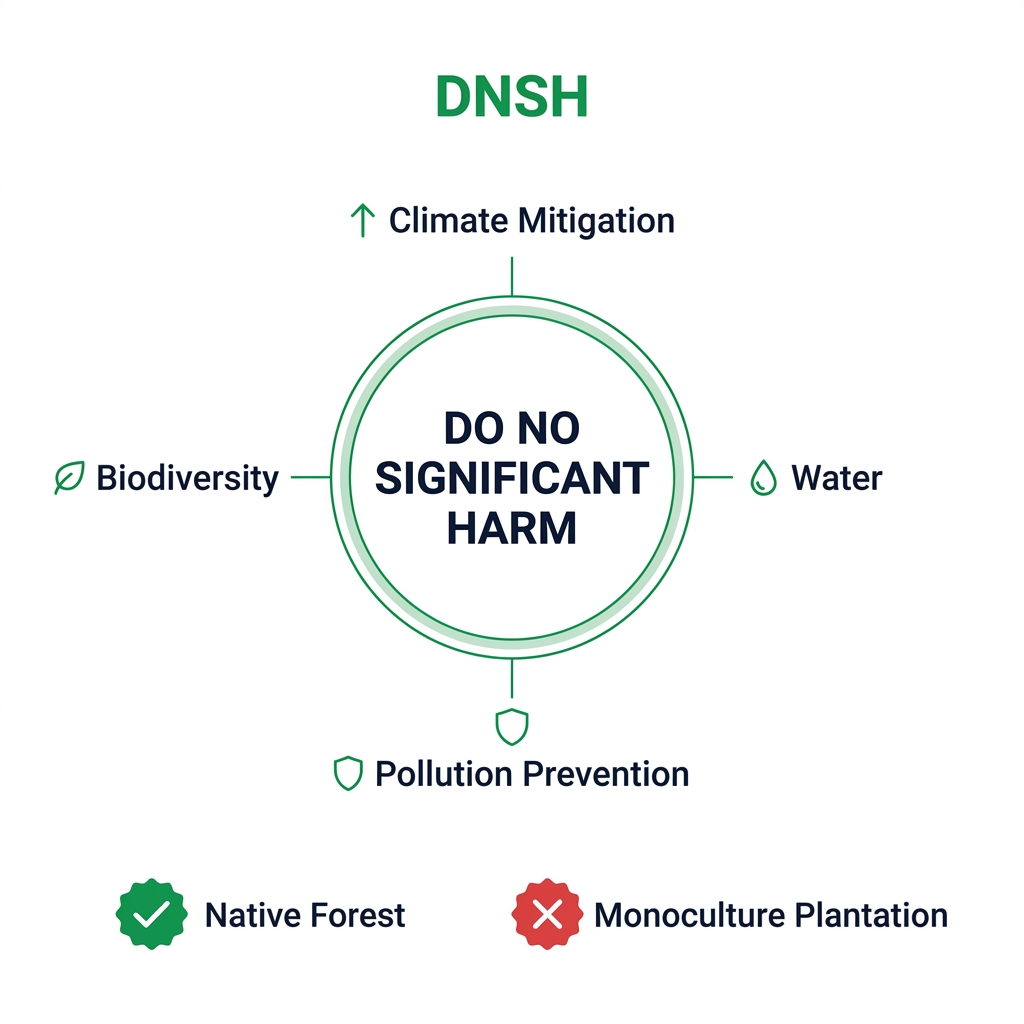
The Do No Significant Harm (DNSH) principle is the mechanism that prevents a single-objective optimization pursuing carbon reduction at the cost of everything else from qualifying as sustainable.
Sequesters CO2 while enhancing biodiversity and protecting local water tables. Meets both Substantial Contribution (Mitigation) and all DNSH tests. Qualifies for green capital.
Sequesters CO2 but uses non-native species that deplete groundwater and crowd out native biodiversity. Fails Objective 3 and 6 DNSH tests. Disqualified from green labels.
Technical Screening Criteria: The Bar for Entry
Technical Screening Criteria (TSC) translate the six high-level objectives into measurable, sector-specific standards. This is where narrative ESG ends and empirical proof begins.
Explore this data interactively below. Sort and filter as needed.
| Activity | Key TSC Indicators | Verification Method | Alignment status |
|---|---|---|---|
| Native reforestation | Canopy density ≥X%, native species ratio | Satellite dMRV + Ground truth | Eligible |
| Mangrove restoration | Tidal hydrology, species survival rate | SAR + Ecological survey | Eligible |
| Monoculture plantation | Fails species diversity thresholds | Field audit + Monitoring | Disqualified |
| Regenerative agriculture | Soil organic carbon %, input reduction | Soil sampling + Activity data | Pending |
| Green steel (Hydrogen) | Emissions intensity ≤0.4 tCO2/t steel | Process audit | Eligible |
Why Data Becomes the New Currency
Taxonomies fundamentally change how sustainability claims are evaluated. Historically, organizations could rely heavily on narrative disclosures and qualitative reporting. Under taxonomy frameworks, measurable evidence becomes the primary determinant of eligibility.
This transition shifts sustainability from a communications exercise to a data infrastructure challenge. Environmental outcomes must be monitored continuously, documented systematically and verified independently.
As a result, remote sensing technologies, satellite intelligence, ecological monitoring systems and digital MRV platforms are expected to play an increasingly important role in sustainable finance ecosystems.
Reshaping Capital: Green Bonds, FDI, and the RBI
The primary goal is to restructure the risk-reward relationship. Taxonomy-aligned projects will receive government-backed price signals via Sovereign Green Bonds and preferential risk weights in banking regulation.
"A taxonomy-aligned green bond is not just cheaper to issue. It is more stable to hold, more defensible to disclose, and more durable in a tightening regulatory environment."
The Greenium Effect
One of the most important consequences of taxonomy alignment is access to what financial markets often describe as a "greenium"—a premium attached to credible sustainable assets.
Investors managing ESG mandates face growing pressure to deploy capital into taxonomy-aligned projects. As demand for verified green assets increases, projects that can demonstrate compliance may benefit from lower financing costs, improved market access and stronger investor interest.
This dynamic is already visible in several international green bond markets where sustainability-aligned assets frequently achieve more favourable financing conditions than comparable conventional projects.
The Implementation Timeline: What Comes Next
Drafting committee releases consultative documents. Sector-specific criteria under development for energy, buildings, and agriculture.
Formal notification of the framework. BRSR Core disclosures begin incorporating taxonomy-aligned metrics for the top 1,000 listed companies.
RBI expected to consult on Taxonomy Alignment Ratio disclosure requirements for commercial banks. Priority sector lending updated.
Taxonomy alignment becomes a standard underwriting criterion. India's framework informs regional standards across South and Southeast Asia.
What Businesses Must Do Now
Wait-and-see on requirements. Defer investment in dMRV. Maintain narrative disclosures. Risk: stranded assets and rising cost of capital.
Conduct readiness audits now. Build dMRV infrastructure to generate TSC-compliant data. Capture greenium pricing and FDI access ahead of competitors.
Why Digital MRV Will Become Essential
A taxonomy is only as credible as the evidence supporting it.
As India moves toward implementation, organizations will increasingly require systems capable of generating continuous, auditable and scientifically robust environmental data. This requirement extends across climate mitigation projects, biodiversity initiatives, forestry programs, regenerative agriculture projects and blue carbon ecosystems.
Digital Monitoring, Reporting and Verification (dMRV) platforms address this challenge by combining satellite imagery, remote sensing, AI-powered analytics and automated reporting workflows.
For taxonomy-aligned investments, dMRV systems help establish both Substantial Contribution and DNSH compliance through objective evidence rather than subjective claims. This shift from disclosure-driven sustainability to evidence-driven sustainability represents one of the most significant structural changes emerging from modern green finance frameworks.
Why This Matters for Sylithe and the Future of dMRV
The most important implication of India's Green Taxonomy may not be the taxonomy itself. It may be the enormous demand for environmental data that the taxonomy creates.
- Every taxonomy-aligned investment requires evidence.
- Every DNSH assessment requires evidence.
- Every technical screening criterion requires evidence.
- Every sustainable finance disclosure requires evidence.
As a result, environmental monitoring infrastructure becomes a strategic asset.
Historically, many sustainability disclosures relied on periodic reporting, consultant assessments and limited field surveys. While these approaches remain valuable, they become increasingly difficult to scale as project volumes increase.
Digital Monitoring, Reporting and Verification (dMRV) systems provide a scalable alternative. By combining satellite imagery, remote sensing, geospatial analytics, machine learning and automated reporting workflows, dMRV platforms create continuous streams of environmental intelligence.
This capability becomes especially important for nature-based assets. Forests, mangroves, wetlands and regenerative agriculture projects evolve continuously over time. Their environmental performance cannot be adequately assessed through a single annual report. Continuous monitoring becomes essential.
dMRV improves confidence. Real-time environmental data reduces information asymmetry and supports more accurate risk pricing across taxonomy-aligned portfolios.
dMRV improves transparency. Continuous monitoring creates auditable evidence trails that regulators can use to verify taxonomy compliance at scale.
India's Green Taxonomy therefore represents more than a policy framework. It represents the emergence of a data-driven sustainable finance ecosystem in which environmental outcomes must be continuously measured, verified and demonstrated.
Organizations that invest early in environmental intelligence infrastructure will likely gain a significant advantage as taxonomy-aligned capital becomes increasingly important across global markets.
"The future of sustainable finance is not built on claims. It is built on evidence."
India's Green Taxonomy is a fundamental restructuring of how sustainable capital is defined and verified. The organizations that invest now in the data infrastructure and verification capability will find themselves at the front of the queue for the trillions in global green capital.
At Sylithe, we provide the truth layer that makes the taxonomy operational. Our multi-sensor dMRV platform is built specifically to verify both Substantial Contribution and DNSH compliance for nature-based assets.
Assess Your Taxonomy Readiness
Is your organization ready for taxonomy-aligned finance? Contact the Sylithe policy desk for a readiness assessment and dMRV scoping session.