 New
New
VM0048
VM0048 is Verra’s consolidated REDD+ methodology. It represents the most significant reform in forest carbon history, replacing developer-chosen reference regions with independent, jurisdictional risk maps to determine baseline deforestation.
Under VM0048, projects can no longer "game the system" by picking their own baselines. Instead, independent Data Service Providers (DSPs) allocate deforestation risk across an entire jurisdiction. This drastically increases the integrity of carbon credits.
Why VM0048 Matters
- Eliminates conflict of interest in baseline generation
- Introduces mandatory uncertainty quantification (RSS)
- Shifts the market toward activity-based crediting and verified conservation actions
- Demands higher precision via digital MRV
The Baseline Problem: What VM0048 is Solving
Under legacy methodologies, project developers were responsible for selecting the "reference region" used to estimate counterfactual deforestation. This allowed for the selection of regions with high historical rates that were not representative of actual threat.
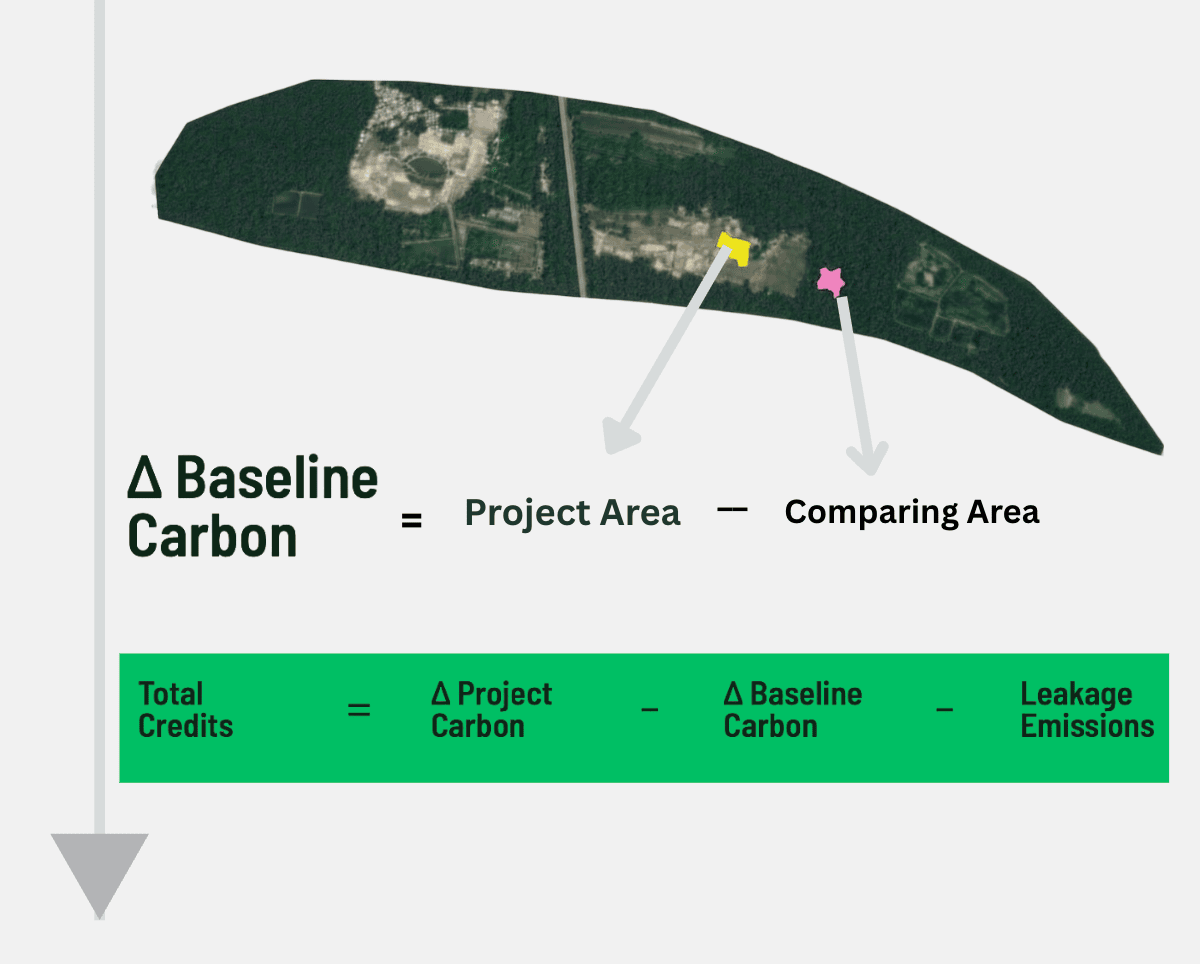
In REDD+ markets, the baseline is not a technical detail. It is the economic engine. Carbon credits are issued based on the difference between what actually happened and what would supposedly have happened without the project.
If the projected deforestation risk is high, the project generates more credits. VM0048 removes the incentive for aggressive risk assumptions by separating project developers from baseline generation itself.
The credibility crisis emerged because institutional buyers questioned whether the quantity of credits issued accurately reflected measurable climate impact. VM0048 is Verra’s response to concerns around inflated baselines, leakage, and permanence uncertainty.
Developer-constructed baselines. Systematic upward pressure on baseline estimates. Integrity assessments frequently questioned the environmental integrity of some legacy REDD+ credits, leading to substantial market discounts in certain cases.
Independent jurisdictional risk allocation. Data Service Providers (DSPs) produce risk maps for entire jurisdictions. Conflict of interest is structurally eliminated.
The Shift to Jurisdictional Baselines
The core innovation of VM0048 is the mandatory use of Allocated Deforestation Risk Maps. A DSP constructs a spatially explicit model across an entire jurisdiction, and individual projects receive an allocated score.
How Risk Allocation Works
Rather than allowing each project to define its own reference region, VM0048 assigns risk using a standardized regional framework that models the probability of future forest loss.
These models typically incorporate variables such as proximity to roads, population centers, historical forest loss, agricultural expansion pressure, topography, and protected area status. Projects receive an allocated share of jurisdictional risk, creating consistency across projects operating within the same landscape.
Under VM0048, projects become components of a larger jurisdictional carbon accounting system. This attempts to solve leakage by modeling deforestation risk across an entire state or province, making it easier to detect and allocate risk systematically.
Elimination of Developer Conflict: The entity producing the baseline data is now independent of the entity benefiting from it.
Jurisdictional Accounting Consistency: Aggregate credit volume from all projects is bounded by the jurisdictional deforestation estimate.
6-Year Revision Cycles: Maps are updated frequently to ensure the baseline stays relevant to current land-use pressures.
VMD0055: The Module for Avoiding Unplanned Deforestation
VMD0055 handles Avoiding Unplanned Deforestation (AUD) by using spatial predictor variables — distance to roads, settlements, and existing frontiers — to produce statistical probability models.
One of the most immediate consequences of VM0048 is lower overall issuance volumes. This reduction is an integrity objective, achieved through conservative risk allocation and independent DSP modelling.
Developers may generate fewer credits overall, but those credits command higher institutional demand and stronger long-term pricing resilience due to their defensibility.
Mandatory Uncertainty Quantification
Under VM0048, if monitoring data carries a high error margin, you must subtract that uncertainty from your credit claim. This is known as the Root-Sum-Squared (RSS) approach.
RSS combines multiple independent uncertainty sources into a single overall uncertainty estimate. Rather than adding errors directly, each uncertainty component is squared, summed, and then square-rooted. This prevents excessive double-counting while maintaining statistical conservatism.
Common uncertainty sources include biomass estimation error, land-cover classification error, activity data uncertainty, and sampling error. Projects with lower uncertainty retain a larger proportion of their potential credit volume.
Connecting Quality to Finance
VM0048’s uncertainty requirements connect monitoring quality directly to financial outcomes. Higher measurement uncertainty leads directly to lower credit issuance, turning high-quality digital MRV infrastructure into a financial necessity.
Estimated 25%+ credit deduction from RSS uncertainty penalty. Projects with legacy monitoring infrastructure face significant volume losses.
Uncertainty deduction approaches the minimum threshold. High-accuracy platforms allow projects to capture near-full credit value.
Activity-Based Integrity: Proving Real Impact
VM0048 introduces activity-based crediting, allowing developers to demonstrate additionality through verifiable conservation actions like ranger patrols and fire management.
Projects are no longer evaluated only by hypothetical forest loss scenarios. They are evaluated by observable operational management quality, pushing REDD+ closer to a measurable land stewardship model.
Patrol Operations: Documented ranger patrol hours and GPS tracks serve as verifiable evidence of active protection.
Fire Management: Recorded firebreak maintenance corroborated by satellite fire data.
Community Engagement: Benefit-sharing disbursements and FPIC documentation required for high-integrity ratings.
Near-Real-Time Monitoring: disturbance alerts and incident response logs demonstrating active surveillance.
The Long-Term Direction of REDD+
Large buyers face growing scrutiny around offset quality. VM0048-aligned projects are viewed as structurally safer because baseline manipulation risk is reduced and uncertainty is quantified explicitly.
VM0048 represents part of a broader market transition toward jurisdictional accounting, continuous dMRV, and sovereign accounting alignment. The projects best positioned are those already building scalable monitoring infrastructure.
The VM0048 Transition Pathway
Identify the applicable DSP and obtain the allocated risk map.
Assess map accuracy; reprocess imagery if below 90%.
Implement RSS propagation across all monitoring estimates.
Establish digital audit trails for patrols and community records.
What VM0048 Means for Carbon Project Developers
VM0048 fundamentally changes how REDD+ projects are designed, monitored, and financed. Developers must now focus on monitoring quality, uncertainty reduction, and activity documentation rather than optimizing baseline assumptions.
How Sylithe Adapts Automatically
Sylithe’s verification infrastructure integrates VM0048 data demands directly. We automate jurisdictional mapping overlays and calculate pixel-level RSS uncertainty to maximize your issuance. Is your project ready for VM0048? Contact the Sylithe policy desk for a readiness assessment and jurisdictional risk map analysis.
VM0048 is more than a methodology revision. It is a structural redesign of how avoided deforestation claims are quantified, monitored, and trusted.
The framework intentionally sacrifices issuance simplicity for stronger institutional credibility. For developers, the shift represents the movement from assumption-based carbon accounting toward continuously verifiable environmental evidence.
The future of REDD+ will belong to projects capable of proving their climate impact with the highest degree of defensible precision.
Key Takeaways & Metrics
A summary of the core concepts discussed in this article.
| Concept | Relevance | Impact Level | Status |
|---|---|---|---|
| Methodology | Core to accurate MRV | High | Active |
| Integrity | Essential for credit value | Critical | Mandatory |
| Technology | Enables scale | High | Growing |
Data synthesized from Sylithe Research.