 New
New
A methodology sounds like the least interesting part of a carbon market. It is, in practice, the part that decides whether anything else in the market can be trusted.
In January 2025, the Bureau of Energy Efficiency (BEE) released 12 offset methodologies under the Carbon Credit Trading Scheme (CCTS), covering six sectors. For project developers, investors and sustainability teams, this is the detail that turns a policy framework into something you can actually build a project around. Everything upstream of this release, the CCTS notification, the sector approvals, the institutional architecture, was necessary. None of it was sufficient. A carbon project cannot be designed, baselined or credited without a methodology to design it against.
“Without a credible methodology, a carbon credit is just a claim. With one, it becomes a verifiable, tradable asset.”
How we got here
CCTS is the backbone of the Indian Carbon Market (ICM), India's structured attempt to price carbon and channel investment toward emission reductions, while supporting the country's Nationally Determined Contributions (NDCs) under the Paris Agreement. It was notified through S.O. 2825(E) in June 2023 and amended by S.O. 5369(E) in December 2023.
The scheme runs on two tracks, and the distinction matters for everything that follows. A compliance mechanism sets mandatory emission-intensity targets for obligated, hard-to-abate industries, discussed in detail in our analysis of the 490 obligated entities now covered under CCTS. An offset mechanism offers a voluntary, project-based route for non-obligated entities to earn credits for reducing, removing or avoiding greenhouse gas emissions.
Two tracks, one certificate
| Compliance Mechanism | Offset Mechanism | |
|---|---|---|
| Participation | Mandatory, for notified obligated entities | Voluntary, open to eligible project developers |
| Measured against | A sectoral GEI (emission intensity) target | A project-specific baseline |
| Who it serves | Energy-intensive, hard-to-abate industries | Renewable, waste, agriculture, forestry and transport project developers not covered by compliance targets |
The offset mechanism is where most of the opportunity lies for the wider ecosystem: renewable developers, waste managers, farmers, foresters and clean-tech innovators who aren't covered by compliance targets but can still generate real climate impact. In September 2024, BEE approved a list of 10 sectors for the offset mechanism. Of these, six were placed in Phase 1, and it is for these six that the 12 methodologies have now been drafted.
What a methodology actually is, and why it matters
A methodology is the rulebook for a carbon project. It defines how you calculate the emissions a project avoids or removes, how you set the baseline (what would have happened without the project), and how you monitor performance over time.
A methodology, in two parts
Baseline: the reference emissions scenario against which a project's savings are measured. Monitoring: how the project's actual performance is tracked and reported across its crediting period. Every one of BEE's 12 methodologies is structured around these two components.
BEE's methodologies are adapted from the UNFCCC Clean Development Mechanism (CDM), the globally tested framework India already has deep experience with. This is a deliberate design choice rather than a shortcut: rather than building baseline logic and monitoring conventions from a standing start, BEE is inheriting a framework that Indian project developers, validators and consultants have spent nearly two decades working with under the CDM and, subsequently, the voluntary carbon market.
The published methodology document lists, for each methodology, the typical projects it covers, the type of GHG mitigation action, and its scope and applicability. One detail is worth flagging precisely because it signals how early-stage this rollout still is: at the time of release, the formal approval dates for each methodology were left blank, marked in yellow, to be filled in once the document is finalised. A methodology you can read is not yet the same as a methodology that is formally in force; developers should treat the published document as the design specification and confirm current approval status against BEE's own notifications before relying on it for a live project.
The six Phase 1 sectors
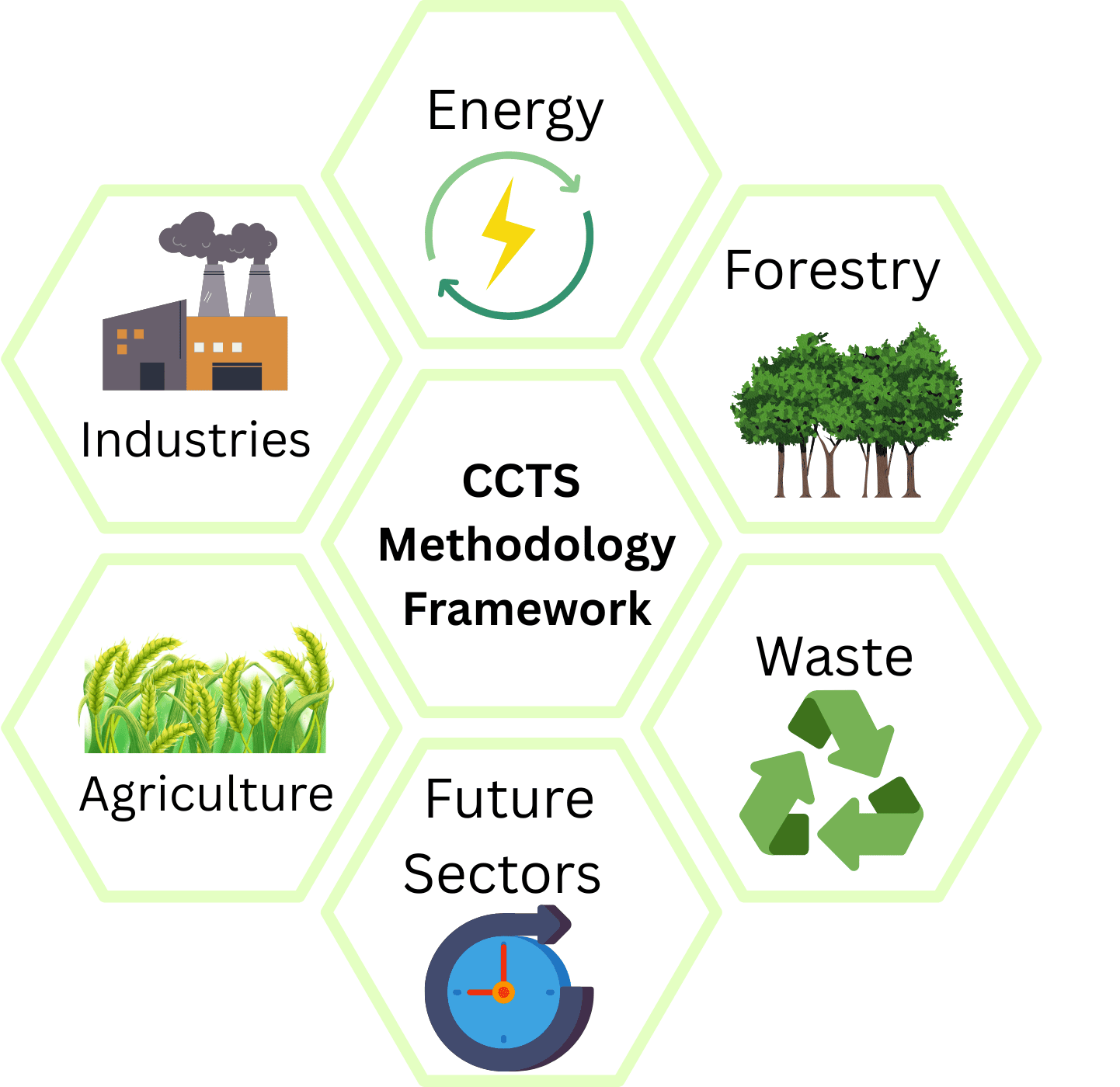
The 12 methodologies span the six sectors that account for the overwhelming majority of India's carbon project pipeline. This focus is deliberate: stakeholder consultations with BEE indicate these sectors host the highest-demand, highest-impact projects in India. To put it in perspective, energy projects make up roughly 83% of all projects under the CDM and voluntary carbon market in India, with industrial projects at about 7%. Together, the Phase 1 sectors cover more than 85% of India's existing offset project activity.
What each Phase 1 sector typically covers
| Sector | Typical project types |
|---|---|
| Energy | Solar, wind, small hydro, biomass power, green hydrogen — displacing grid and fossil-based electricity |
| Industry | Energy efficiency, waste-heat recovery, process optimisation in manufacturing |
| Waste handling & disposal | Landfill methane capture, waste-to-energy, biogas and compressed biogas |
| Agriculture | Emission reductions and avoidance in farming practices |
| Forestry | Afforestation, reforestation, mangrove restoration |
| Transport | Cleaner mobility and fuel-switching projects |
These are the two sectors with the longest track record under the CDM in India, and where baseline and monitoring conventions are most mature. That maturity is precisely why BEE could adapt existing methodological logic quickly for them, while sectors like transport are earlier in that process.
What comes next: Phase 2
Four sectors queued for Phase 2
- Construction — embodied carbon and materials-intensive decarbonisation, methodologically harder to baseline than a single point-source emitter.
- Fugitive emissions — leaks and unintended releases across oil, gas and industrial processes, historically difficult to measure directly rather than estimate.
- Solvent use — a diffuse, process-chemistry-dependent emissions category with limited precedent under the CDM.
- Carbon Capture, Utilisation and Storage (CCUS) — a technically demanding frontier requiring long-horizon monitoring of storage permanence, not just point-in-time capture.
These represent some of the harder, more technical frontiers of decarbonisation, and their inclusion signals BEE's intent to eventually cover the full breadth of India's emissions profile, not just the sectors with the most immediately available precedent. No methodologies have been published for these four sectors yet; developers in these spaces should treat Phase 1 as the template for how BEE structures a methodology, without assuming Phase 2 will simply be a copy-paste extension of it.
How a project earns credits
For a non-obligated entity, the path to earning Carbon Credit Certificates (CCCs) follows a defined project cycle. Each stage gates the next, and a weakness at any single stage limits what the certificate at the end of the chain is actually worth.
The project developer registers an account and the project itself with the registry.
The project design is validated against an approved methodology, confirming it fits an eligible project type and sector.
The project is implemented and monitored according to the plan set out in its design document.
Actual emission reductions are independently verified against the monitoring record.
Carbon Credit Certificates are issued following approval by the National Steering Committee.
Key eligibility conditions
A project start date on or after 1 January 2025. Clearly defined project boundaries. A credible baseline and monitoring plan. Exclusivity, meaning the project generally cannot be double-registered under another crediting scheme.
That start-date rule is easy to read past and expensive to get wrong. A project that commenced physical implementation before 1 January 2025 does not become eligible under these methodologies retroactively, regardless of how well it otherwise fits an approved sector and project type. Developers evaluating existing assets against the offset mechanism should treat this as a hard filter, applied before any baseline or monitoring work begins, not a detail to resolve later in the registration process.
The challenges worth watching
A robust methodology framework is necessary but not sufficient for a credible market. A recent analysis by the Centre for Science and Environment (CSE), The Indian Carbon Market: Pathway Towards an Effective Mechanism, flags lessons from other emissions trading systems: oversupply of credits and weak integrity have historically undermined market value elsewhere, and there is no structural reason India's market is automatically immune to the same dynamic simply because its methodologies are adapted from a well-tested source.
The report also raises the risk of double counting, given that India has multiple crediting schemes managed by different agencies, such as the Green Credit Programme running alongside CCTS. A single afforestation project, for instance, sits within a sector where more than one government-backed crediting mechanism could plausibly apply. Without an unambiguous, shared rule for which scheme takes precedence, or a registry that flags cross-scheme claims automatically, the same tonne of avoided or removed emissions can end up counted, and monetised, more than once.
“The takeaway for regulators is clear: coordination, transparency and strong verification will make or break the market's credibility.”
None of this is a reason to wait on the sidelines. It is a reason to treat evidence quality, not just methodological fit, as a first-order design decision for any project built against these 12 methodologies. A project with an impeccable baseline calculation but a thin, undocumented monitoring trail is exactly the kind of claim CSE's warning is describing.
Why this matters for project developers
The release of these methodologies moves the Indian Carbon Market from ambition to actionable. With the Detailed Procedure for the offset mechanism firming up through 2025 and the ICM expected to become fully operational around mid-2026, the window to prepare is now.
Confirm your project sits within a Phase 1 sector and project type, and check the 1 January 2025 start-date rule before anything else.
These systems are the backbone of certification. Retrofitting a monitoring plan onto a project that is already underway is materially harder than designing it in from the start.
Approval dates and procedural specifics are still being finalised. Treat the January 2025 document as the design template, not the final word, and confirm current status against BEE's own notifications.
India's carbon market is being built to last, and the projects that engage early, with methodological rigour, will be best placed to lead it.
"A methodology tells you how a claim will be judged. Getting that right before a project breaks ground is far cheaper than discovering it afterward."
Building a project against BEE's methodologies?
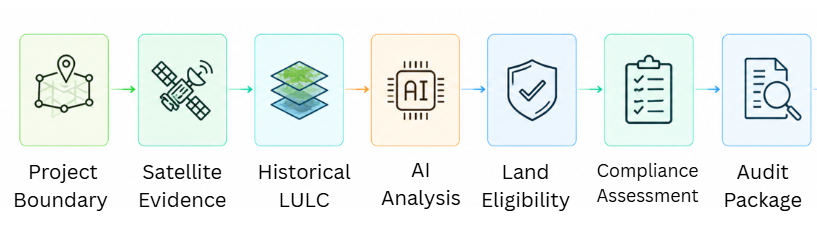
This is where digital MRV infrastructure becomes directly relevant: not simply to calculate a baseline, but to hold the evidence trail, satellite-backed monitoring, land eligibility checks, verification-ready records, that a methodology's monitoring component actually demands.
Sylithe helps organisations navigate carbon markets, from methodology selection and project design to measurement, verification and credit issuance.
Sources
- Bureau of Energy Efficiency, Government of India — Offset Methodologies under the Carbon Credit Trading Scheme (January 2025).
- Government of India — Carbon Credit Trading Scheme, 2023 (Gazette notification S.O. 2825(E)), as amended by S.O. 5369(E), December 2023.
- Bureau of Energy Efficiency — Approved sectors for the CCTS offset mechanism (September 2024).
- Centre for Science and Environment — The Indian Carbon Market: Pathway Towards an Effective Mechanism.
- UNFCCC — Clean Development Mechanism methodology framework, as adapted by BEE for CCTS offset methodologies.
This article synthesises BEE's published methodology framework and secondary reporting on its release. A couple of forward-looking dates referenced here, the 2025 Detailed Procedure and the approximately mid-2026 ICM launch, come from secondary sources rather than a single definitive BEE notification, and should be verified against current BEE publications before being relied upon.
Methodology approval dates, sector coverage and procedural details continue to be finalised as the offset mechanism matures. Project developers should confirm the current status of any methodology against BEE's own notifications before relying on it for compliance, registration or investment decisions.