 New
New
India's carbon market has moved from policy design to active compliance. With 490 industrial entities now covered under the Carbon Credit Trading Scheme (CCTS), emissions intensity is no longer solely a sustainability metric — it has become a regulated measure of industrial performance.
In January 2026, the government notified a further 208 obligated entities across petroleum refineries, petrochemicals, textiles, and secondary aluminium. This followed 282 companies notified three months earlier across aluminium, cement, chlor-alkali, and pulp & paper. Together, these notifications bring the total to 490 obligated entities, each now subject to legally binding emission-intensity targets.
The scale of the number is less significant than its practical implication: 490 companies must now measure their emissions to a standard rigorous enough that a certificate built on that data can withstand simultaneous scrutiny from a regulator, a verifier, and a buyer. This is a substantially harder problem than meeting a target, and it is the aspect of the rollout that has received the least attention.
“Carbon performance is now formally quantified, targeted, and linked to a certificate that trades for real money. That fact is why measurement, rather than policy design, is the principal challenge from this point forward.”
Regulatory Status
Published September 7, 2026 · Last updated September 9, 2026. This analysis reflects notifications, gazette publications, and BEE procedures available as of that date. CCTS rules and target schedules continue to be amended; figures should be checked against current BEE and Ministry of Power notifications before being relied upon for compliance decisions.
What CCTS is
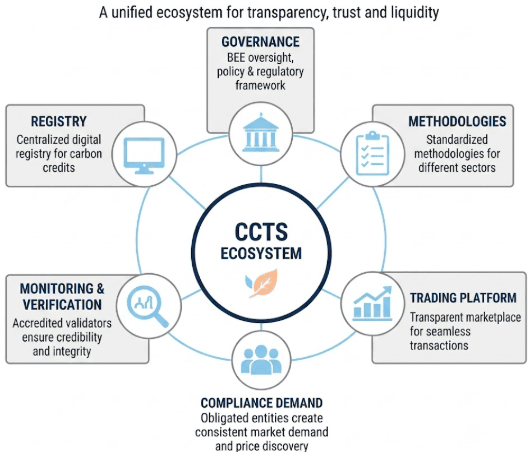
CCTS was notified in June 2023 under the Energy Conservation Act and serves as the legal foundation of the Indian Carbon Market. Its objective is to reduce, remove, or avoid emissions by establishing a functioning market around them, using Carbon Credit Certificates as the unit of trade. Its distinguishing feature relative to a straightforward carbon tax is that certificates can be earned as well as owed: an entity that outperforms its target holds a tradeable asset rather than merely avoiding a liability.
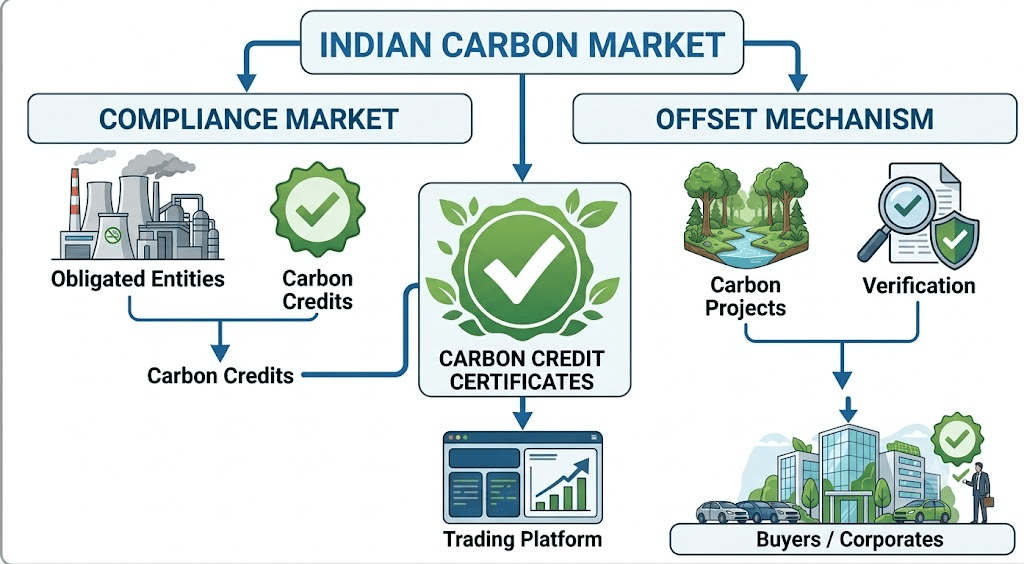
The scheme operates through two distinct tracks, and conflating them is among the most common errors in discussion of India's carbon market. The Compliance Mechanism is mandatory and applies to the 490 entities covered in this analysis, operating on GEI targets. The Offset Mechanism is voluntary and project-based, open to any party running an eligible mitigation project — mangrove restoration, biogas generation, agroforestry — and generates certificates through project baselines rather than sectoral targets. Participation in one mechanism does not confer participation in the other, even though both ultimately produce the same class of certificate.
Origins of the scheme
India did not build this framework from a standing start. The country operated PAT (Perform, Achieve and Trade) for over a decade, a market in which energy-intensive plants traded Energy Saving Certificates denominated in tonnes of oil equivalent.
PAT created an institutional foundation for measuring industrial energy performance: designated facilities, standardized reporting, an established compliance culture. What it measured, however, was a proxy rather than the outcome that ultimately matters. Energy savings do not equate to emissions reductions, particularly as the electricity grid itself decarbonizes; a facility could improve its energy efficiency while its associated emissions barely moved. CCTS extends PAT's institutional architecture into an actual carbon market, by linking greenhouse gas emission intensity directly to tradable Carbon Credit Certificates.
What changed in practice is the unit of account. Companies now trade tonnes of CO₂e rather than energy savings. The Ministry of Power's 2025-26 annual report confirms that all 490 current entities migrated from PAT, which has materially accelerated this transition relative to a market built from first principles. Most of these companies are therefore not new to regulatory measurement; they are new to being measured specifically on carbon, a considerably more exacting standard.
Sector and entity coverage
Sectors covered — October 2025 (Batch 1)
- Aluminium — primary smelters with among the highest process energy intensities in Indian industry.
- Cement — kilns operating at scale, where clinker production drives the bulk of CO₂e.
- Chlor-alkali — electrolytic chlorine and caustic soda production, electricity-dominated emissions profiles.
- Pulp & Paper — combined process heat and chemical recovery emissions across integrated mills.
Sectors added — January 2026 (Batch 2)
- Petroleum Refineries — catalytic crackers and distillation columns, with direct combustion and process emissions.
- Petrochemicals — crackers and derivatives plants operating at continuous, high-temperature throughput.
- Textiles — dyeing, weaving, and finishing operations with both thermal and water-intensive emissions.
- Secondary Aluminium — scrap-based remelting, distinct from primary smelting in its emissions profile and target methodology.
BEE is bringing sectors into the scheme as sector-specific measurement methodologies are finalised — not on a single fixed date. This sequencing means each batch arrives with a measurement framework tailored to its process type, rather than a single generic methodology applied across fundamentally different industries. Further notifications, extending coverage across more of India's PAT-era industrial base, appear to be a matter of timing rather than likelihood.

How the target is structured
CCTS does not specify an absolute emissions ceiling. Instead, it requires an entity to keep its emissions per unit of output — its Greenhouse Gas Emission Intensity, or GEI — below a defined threshold. The logic is comparable to a fuel-economy standard: output volume is not capped, but the emissions associated with each unit of output are. A facility producing 100,000 tonnes of product with 80,000 tonnes of associated CO₂e has an intensity of 0.8 tCO₂e per tonne. It is this ratio, rather than raw tonnage, that is managed, targeted, and ultimately traded.
Every target requires a reference point, and for the current cycle that reference point is FY 2023-24. The notified schedules record each entity's baseline output and baseline emission intensity from that year, and every subsequent figure — the assigned target, the reported achieved GEI, and the resulting surplus or shortfall — is derived from it.
This makes FY 2023-24 an unusually consequential figure in the framework, and one of the figures most susceptible to error. A baseline set even marginally too high — through inflated production figures, understated emissions, or an unrepresentative reference year — grants an entity an artificially attainable target for every subsequent compliance cycle. This outcome does not require deliberate misstatement; an inadequately audited baseline submission produces the same result. The effect is comparable to grade inflation in an academic system: once the reference point is compromised, every subsequent measurement appears more favorable than it should.
Earning or incurring a credit obligation
The formula is symmetric and warrants examination in both directions. An entity that outperforms its target earns certificates equal to (target minus achieved) multiplied by output. A facility with a 0.80 tCO₂e/unit target that achieves 0.70, across 100,000 units of production, generates approximately 10,000 tCO₂e in certificates, tradeable on the Indian Carbon Market. An entity that misses the target by the equivalent margin faces the same formula in reverse, which determines the number of certificates it is required to procure.
The formula, both directions
Surplus = (GEI target − GEI achieved) × output → certificates available for sale. Shortfall = (GEI achieved − GEI target) × output → certificates required for procurement. Same formula, opposite sign. This example is illustrative; the notified rules and applicable methodologies govern the actual issuance process.
This is the core economic mechanism of the scheme: over-performance creates supply, under-performance creates demand, and price is established between the two through an actual market rather than a fixed government fee. The more difficult challenge is demonstrating, to a regulator's satisfaction, precisely what an entity's "achieved" figure was. That determination is what decides whether a reported surplus represents genuine value or a filing subject to rejection.
Consequences of non-compliance
The framework applies substantive consequences to an unaddressed shortfall. If an entity neither closes the gap nor submits the required certificates, BEE may impose environmental compensation priced at twice the average certificate price for that trading cycle, payable within 90 days of the order. The 2x multiplier is a deliberate design choice, set above the prevailing market rate to ensure that procuring certificates is always the less costly option relative to accepting the penalty. Failure to meet the 90-day window results in further escalation under the Environment (Protection) Act, 1986. This constitutes an enforceable regulatory obligation rather than a market participants can decline to engage with when conditions are unfavorable.
What an intensity target does — and does not — measure
This is the aspect of the scheme most frequently misunderstood: an entity can meet its GEI target, earn certificates for doing so, and still emit more CO₂ in absolute terms than the previous year. If a facility reduces intensity from 1.0 to 0.8 tCO₂e per unit while doubling production over the same period, total emissions increase even as measured performance improves. The framework, the outcome, and its practical implication are worth separating explicitly.
CCTS assigns Greenhouse Gas Emission Intensity (GEI) targets measured against each entity's FY 2023-24 baseline. The target is expressed as emissions per unit of output, not as an absolute ceiling on total emissions.
An entity can reduce its emissions intensity year over year while its absolute emissions continue to rise, provided output grows faster than intensity falls. Meeting a target and reducing total emissions are not the same claim.
Investors, regulators, and buyers evaluating a company's compliance record need to distinguish intensity performance from absolute emissions reduction. A "490 companies are cutting emissions" framing and a "490 companies are cutting emissions intensity" framing describe different things.
This structure reflects the design logic of every intensity-based system, from fuel-economy regulation to industrial benchmarking schemes applied elsewhere, rather than an oversight specific to CCTS. An absolute cap constrains growth directly; an intensity target permits output to rise provided efficiency improves in parallel. Whether that is the appropriate trade-off for an industrializing economy is a legitimate policy question, and one the framework answers deliberately rather than by omission.
The target is visible. The data is where the risk sits.
Every element discussed so far — the target, the formula, the penalty — is a matter of public record. It is published in a gazette notification and can be read by anyone. What determines whether any of it functions as intended is not visible in the same way: it is the chain of Measurement, Reporting and Verification (MRV) that connects a facility's raw activity data to the certificate that eventually trades on the Indian Carbon Market. That chain, not the target-setting process, is where the scheme's credibility is actually decided.
It is useful to trace that chain as five sequential questions, each one gating the next.
Can the physical activity data be captured accurately? This is the raw layer: fuel consumed, energy used, process throughput at the facility level.
Can emissions be converted consistently using the prescribed methodology? Activity data is translated into GHG emissions and GEI using standard emission factors and Global Warming Potential values.
Can an independent ACVA reproduce and defend the result? An Accredited Carbon Verification Agency, with no financial relationship to the facility, reviews the submission before it can be recognized.
Can BEE rely on that number when determining performance against the assigned GEI target? This is the point at which a verified figure becomes a regulatory fact.
Can the resulting Carbon Credit Certificate be trusted by the next participant in the chain — the registry, the exchange, the buyer — without independently re-checking the physical measurement behind it?
Each stage depends entirely on the one preceding it, which is what makes this a chain rather than a checklist. A measurement error becomes a calculation error. A calculation error produces an inaccurate GEI. An inaccurate GEI distorts the comparison against the target. A distorted comparison results in a certificate issued incorrectly, or a genuine shortfall that goes unrecognized. No party at the compliance or market-value stage has an independent means of re-verifying the physical measurement the chain began with. Each participant relies on the integrity of everything upstream, not on direct evidence of the tonnes being claimed.
BEE's Detailed Procedure for CCTS governs this chain, and currently covers only two of the recognized greenhouse gases — CO₂ and PFCs — with provision to expand coverage over time. This is a narrower scope than the headline figures suggest: a facility with material methane or nitrous oxide emissions is, at present, being assessed at the calculation stage on only a portion of its actual emissions profile.
This is where digital infrastructure becomes material to the measurement stage specifically. Traditional MRV relies on field visits and periodic audits — a site inspection that checks meters and records, producing a report accurate only for the date of that visit. Digital MRV (dMRV) incorporates satellite Earth observation, weather data, remote sensing, and machine learning, replacing a single annual snapshot with continuous monitoring that leaves an auditable digital record for the verification stage to draw on.
This does not substitute for the verification stage itself — the accredited verifier's sign-off remains the point at which a number becomes recognized. A satellite image alone does not establish a carbon claim, in the same way that a photograph alone does not establish a bank balance. Its function is to give the verifier continuous evidence to assess, in place of a spreadsheet supported by a single site visit.
The measurement stage carries different stakes beyond the 490 compliance entities. The Offset Mechanism's voluntary track covers project types such as forestry, agroforestry, and mangrove restoration, where the underlying asset is biological and continuously changing: canopy expands through a monsoon season, a fire clears a hillside overnight, a boundary is encroached upon gradually enough to go unnoticed for a year. An annual site visit can miss all of this. Continuous, satellite-backed evidence is substantially harder to circumvent, whether through error or intent.
Distinguishing the Compliance and Offset mechanisms
This distinction is worth restating, as the confusion between the two mechanisms remains widespread: an industrial entity subject to the Compliance Mechanism is not automatically part of the Offset Mechanism, and a project developer earning offset credits is not automatically an obligated entity. The two operate under different eligibility criteria, different calculation methods, and different governing rules, converging only at the point where both produce a Carbon Credit Certificate.
Compliance vs. Offset, side by side
| Compliance Mechanism | Offset Mechanism | |
|---|---|---|
| Participants | The 490 notified obligated entities | Any eligible project developer |
| Participation | Mandatory | Voluntary |
| Measured against | A sectoral GEI target | A project-specific baseline |
| Certificates generated by | Outperforming the assigned GEI target | A registered project's verified issuance |
Institutional administration
CCTS requires active administration beyond its regulatory text. Responsibility is distributed across five institutions, each carrying a distinct function:
Who does what
| Institution | Function |
|---|---|
| BEE | Administrator — sets methodologies, assigns GEI targets, accredits verifiers |
| CERC | Regulator — oversees trading conduct and exchange operations |
| Grid-India | Registry — records certificates from issuance through retirement |
| National Steering Committee | Policy direction — sets overarching strategy across compliance and offset tracks |
| ACVAs | Independent verification — validate projects and verify monitoring data |
These five institutions, none of which has carbon markets as its sole original mandate, now jointly operate a single integrated market. BEE sets the target an entity must meet; an ACVA verifies whether the entity met it; Grid-India records the resulting certificate; CERC oversees the trade of that certificate; and the National Steering Committee ensures the whole structure stays aligned with India's broader climate commitments. According to the Ministry of Power's latest reporting, all five components are functioning in practice, not solely on paper.
Implications by stakeholder group
For the 490 companies directly affected, emissions intensity has shifted from a sustainability-reporting metric to a compliance filing item, with an attached formula, deadline, and financial value. That shift touches more functions inside a company than the sustainability team alone.
What this means for companies
| Function | What changes under CCTS |
|---|---|
| Sustainability | Emissions intensity becomes a compliance metric, not only a disclosure metric |
| Operations | Production and energy data require stronger controls and documentation |
| Finance | Carbon performance can create a cost (shortfall) or an asset (surplus) |
| Compliance | Targets, submissions, and verification become recurring regulatory workflows |
| Audit | Emissions data needs an evidence trail that can survive independent review |
| Technology | Monitoring and data systems become part of compliance infrastructure, not just reporting |
The effects extend beyond the obligated entities themselves. For verification agencies, this represents a growing and sustained volume of facilities requiring independent assessment, which constitutes either a capacity constraint or a business opportunity depending on perspective. For project developers operating under the Offset Mechanism, it signals the emergence of a genuine domestic buyer base for their credits, in addition to existing export-market demand. For technology and MRV providers, the implication is direct: measurement tools capable of withstanding independent verification command materially more value than reporting tools designed primarily for internal presentation. For regulators, the mandate shifts from drafting rules to defending them — demonstrating, through each successive notification, that an expanding market does not correspond to a less rigorous one.
Outlook
490 is a current figure, not a ceiling. Additional sectors and entities are likely to be incorporated as BEE develops further sector-specific methodologies and expands verification capacity. The questions that determine whether the market functions effectively remain constant regardless of scale: can emissions be measured consistently across every facility, irrespective of who conducts the assessment? Can a baseline withstand substantive scrutiny rather than nominal review? Can a certificate be traced from issuance through to trade without a gap that could be exploited? Answering these questions consistently, across 490 companies and an expanding total, represents a considerably larger undertaking than the initial target-setting process.
“The market is not judged by the volume of credits issued. It is judged by whether the data underlying them can be trusted.”
Preparing for CCTS compliance?
For obligated entities, the immediate priority is not simply setting a target. It is establishing an evidence trail from operational data to verified emissions performance — one that can hold up at every stage of the MRV chain described above.
Sylithe helps build that digital MRV layer, giving teams continuous, auditable evidence rather than relying solely on periodic snapshots.
Sources
- Ministry of Power — Annual Report 2025-26: status of the Indian Carbon Market and the 490-entity compliance mechanism.
- Government of India — Carbon Credit Trading Scheme, 2023 (Gazette notification S.O. 2825(E)).
- Government of India — Greenhouse Gas Emission Intensity Target Rules, 2025: target-setting, CCC calculation, environmental-compensation provisions.
- Bureau of Energy Efficiency — Detailed Procedure for the Compliance Mechanism under CCTS: GHG coverage, GEI methodology, MRV requirements.
- Bureau of Energy Efficiency — Accredited Carbon Verification Agencies: current accreditation register.
- Government of India, Press Information Bureau — notification of GEI targets for 208 additional entities, confirming 490 obligated entities total.
Interpretive claims in this article — including the framing of MRV as the scheme's determining constraint, the stakeholder-impact analysis, and comparisons to PAT-era measurement practice — reflect Sylithe Policy Team analysis of the primary sources above, not a government position.
CCTS rules and target schedules continue to be amended as the market matures. Figures presented here should be verified against current BEE and Ministry of Power notifications before being relied upon.