 New
New
In the current Indian market, the price of carbon is a measure of a buyer’s fear of a scandal, not the scientific reality of the forest.
India stands as a global powerhouse of carbon sequestration potential, yet its assets are systematically undervalued. We are seeing a 'Price Paradox' where high quality reforestation projects in states like Odisha or Madhya Pradesh trade at $6-$9, while inferior European industrial projects command $80+. This is not an environmental failure — it is a structural economic failure of Price Discovery.
This guide provides a deep-dive into the mechanics of mispricing: how Information Asymmetry creates the 'Market for Lemons,' why the CCTS is the most important regulatory shift in a decade, and how dMRV is finally turning carbon into a high liquidity financial asset.
For years, Indian carbon projects have faced a strange contradiction. Some of the world’s most ecologically valuable forests, community-led restoration programs, and high-impact conservation initiatives exist in India, yet the credits generated from them often trade at a steep discount compared to projects in Europe or North America.
The issue is not necessarily environmental quality. In many cases, the problem is visibility. Buyers sitting in London, Singapore, or New York often cannot independently verify what is actually happening on the ground in a forest project located thousands of kilometers away. When trust becomes difficult, price suffers. The market begins pricing uncertainty instead of actual climate impact.
The Information Asymmetry Problem: Why Quality is Hidden
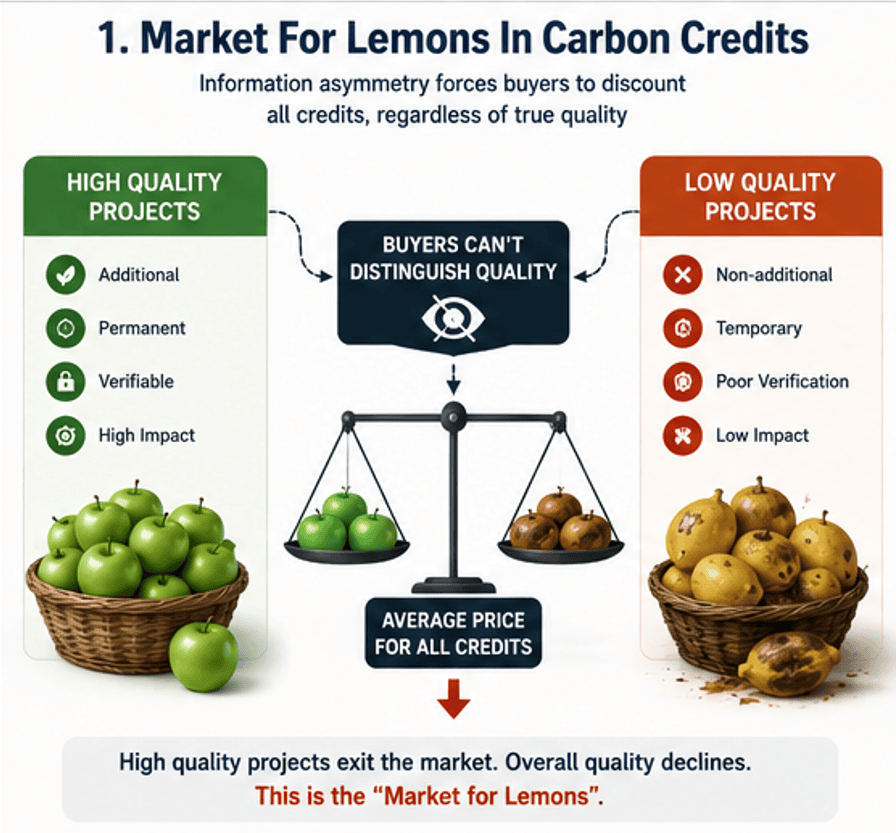
Information asymmetry occurs when the developer (the seller) knows significantly more about the project's true integrity than the buyer. In the Indian context, this gap is massive.
This has created a market where perception sometimes matters more than science. A project with strong branding and polished reports may command more attention than a technically stronger project that lacks visibility or verification infrastructure.
For many smaller Indian developers, this becomes frustrating. They may genuinely protect forests, yet still struggle to achieve fair pricing because institutional buyers cannot easily evaluate the project’s integrity remotely. The result is a market that often rewards confidence more than evidence.
Based on George Akerlof’s 'The Market for Lemons' theory, when quality is invisible, buyers assume every credit is a 'lemon' (low quality). This creates three devastating effects on the Indian market:
Why It Matters
- The Integrity Discount: Buyers apply a flat 40-60% discount to all Indian credits to protect themselves against the risk of non-additionality or reversals.
- The Credibility Tax: Small, honest NGOs must pay exorbitant fees to international auditors just to "prove" their existence.
- Narrative Over Data: Marketing agencies with better "storytelling" often sell low-quality credits for higher prices than scientific projects.
This discount affects behavior across the ecosystem. When developers realize the market does not reward higher integrity proportionally, investment into monitoring systems and better scientific infrastructure becomes harder to justify financially.
Over time, this creates a dangerous cycle: low trust reduces prices, lower prices reduce investment into quality, and weak quality reinforces low trust. Breaking that cycle requires making integrity visible rather than assumed.
The CCTS Revolution: Transitioning to Compliance
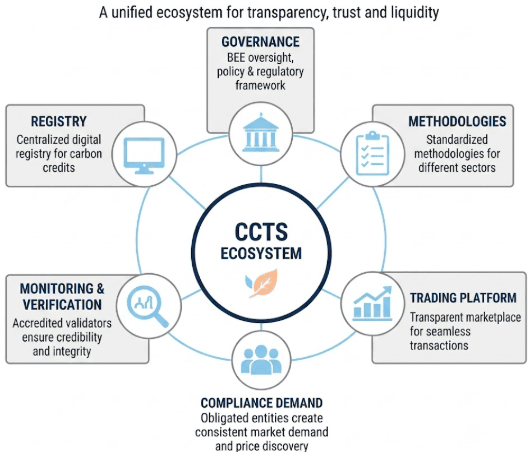
The Bureau of Energy Efficiency (BEE) and the Ministry of Power are fundamentally rewriting the rules through the Carbon Credit Trading Scheme (CCTS). This is moving India from a fragmented voluntary market to a unified compliance market.
By establishing a National Steering Committee and a centralized registry, the CCTS creates a 'Price Floor.' When domestic companies are mandated to buy credits to meet their ESG targets, they require standardized units. This standardization is the first step toward a liquid, exchange-traded market.
One reason the CCTS matters so much is because it changes who participates in the market. In the old voluntary system, many purchases were driven by corporate branding or net-zero announcements. Compliance markets operate differently.
When companies are legally exposed to carbon pricing, buyers become significantly more careful about permanence, additionality, and regulatory defensibility. That shift pushes the market away from “good-looking offsets” and toward measurable environmental assets.
Regulatory Insight
The CCTS is designed to align with Article 6.2 of the Paris Agreement. This means Indian projects will soon have a pathway to international 'Corresponding Adjustments,' which will overnight bridge the price gap.
Closing the Gap: dMRV as the Infrastructure of Trust
Price discovery requires a common denominator. If one project uses satellite verified 10m Canopy Height Models (CHM) and another uses five-year-old manual samples, they are not the same product.
This is where dMRV changes the economics of trust. Traditionally, verifying a carbon project involved periodic field visits and delayed audits. But forests change continuously. Illegal logging or fire damage can happen long before the next verification cycle begins.
Continuous satellite monitoring reduces that delay dramatically. Instead of waiting years, buyers can observe environmental performance almost in real time. That level of visibility changes buyer psychology completely.
Sylithe’s dMRV pipeline acts as a 'Truth Layer.' By providing every credit with a Digital Passport linked to raw LiDAR waveforms and daily change detection, we remove the 'Risk Discount.' When a buyer can verify the forest structure from their desk, the Information Asymmetry vanishes.
The concept of a digital carbon passport may become increasingly important. Institutional buyers are beginning to expect every credit to carry traceable origin data, monitoring history, and geospatial evidence. In many ways, carbon markets are evolving like financial markets: assets with stronger transparency infrastructure achieve stronger liquidity.
The Premium Metric
Our internal data shows that Indian projects utilizing dMRV transparency saw a 34% increase in their "Buy-Side" interest and a 22% reduction in the due-diligence time required by institutional investors.
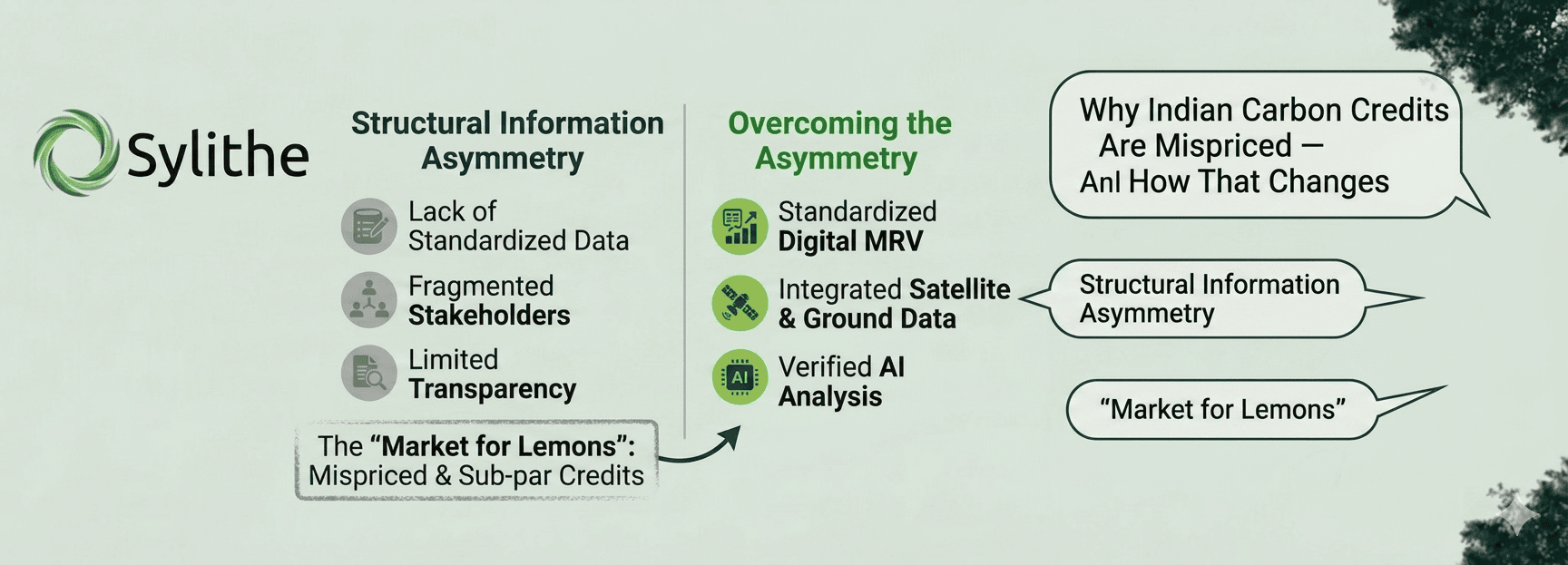
Case Study: The Cookstove Market Collapse and the Flight to Quality
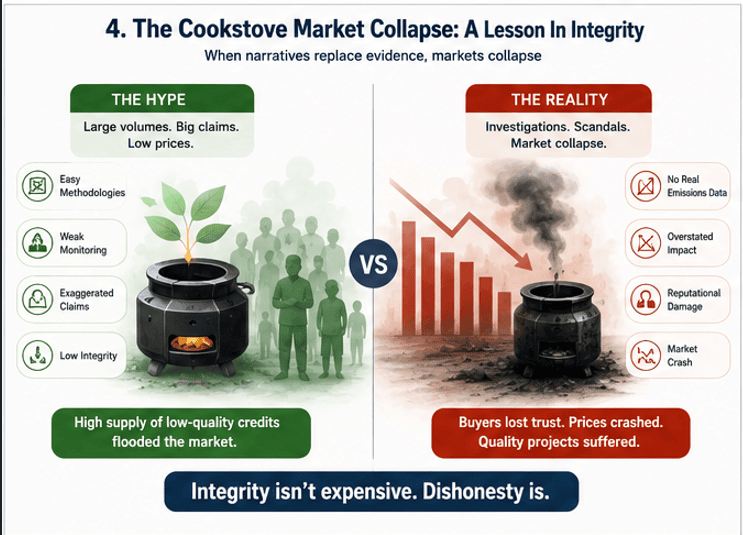
In 2024, the Indian clean cookstove market faced a crisis when investigative reports questioned the usage-rate assumptions of major projects. Prices for 'narrative-based' cookstove credits plummeted by nearly 80%.
The cookstove controversy became an important turning point because it showed how quickly confidence can collapse when underlying assumptions are questioned. At the same time, it also demonstrated that the market is still willing to reward projects that can produce hard evidence.
Projects using IoT sensors and measurable usage verification were treated differently because buyers could directly evaluate performance. This distinction between assumption-based credits and evidence-based credits is becoming a defining theme of the modern carbon market.
Key Takeaway
However, a small subset of projects that had implemented IoT sensors to track real-time stove usage saw their prices *increase*. This 'Flight to Quality' proves that the market is looking for the most defensible data.
The Rise Of The Digital Carbon Passport
A digital carbon passport is emerging as the next evolution of market transparency. Instead of relying on PDFs and annual reports, every credit can be linked to its monitoring history, geospatial evidence, project documentation, and verification records.
This approach allows institutional buyers to independently assess project quality, reducing due diligence costs and increasing market confidence. In the same way financial securities require disclosures, future carbon assets may require continuously updated digital records.
Projects unable to provide transparent monitoring data may face increasing discounts, while projects supported by digital MRV systems could command measurable pricing premiums.
The Future: Carbon as a Sovereign Asset
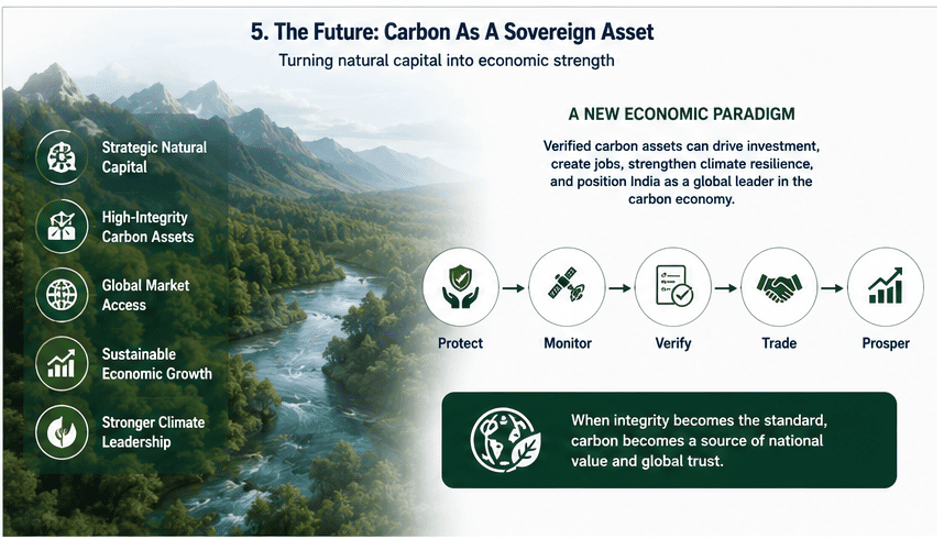
As India matures its domestic market, carbon will transition from an 'offset' to a 'financial asset.' We expect the birth of Carbon-Backed Bonds and SEC-style disclosure requirements for carbon holdings.
India’s carbon economy may still be early in its development, but the direction is becoming clearer. The market is slowly shifting from narratives to measurable outcomes, and from trust-based claims to observable evidence.
As verification infrastructure improves, pricing may begin reflecting actual project quality more accurately rather than broad geographic assumptions. That transition will likely determine which developers emerge as long-term leaders.
The winners in this new era will not be the projects with the biggest marketing budgets, but those with the most rigorous monitoring pipelines. Transparency is the only cure for mispricing.
The biggest change happening in carbon markets is not just technological. It is psychological.
Buyers no longer want to simply “believe” a project is working. They want to verify it themselves. That shift may ultimately benefit high-quality Indian projects the most, as data finally starts pricing projects based on measurable impact rather than uncertainty.
In the long run, data does not just support trust in carbon markets. It becomes the market itself.
How Sylithe approaches Price Discovery
We help Indian developers prove the invisible. Our verification platform combines landscape scale AI and satellite LiDAR to provide the evidence that turns "cheap offsets" into "high-value assets." If you are ready to price your impact fairly, we should talk.
Key Takeaways & Metrics
A summary of the core concepts discussed in this article.
| Concept | Relevance | Impact Level | Status |
|---|---|---|---|
| Methodology | Core to accurate MRV | High | Active |
| Integrity | Essential for credit value | Critical | Mandatory |
| Technology | Enables scale | High | Growing |
Data synthesized from Sylithe Research.