 New
New
Asking "what is the price of a carbon credit?" is like asking "what is the price of a bottle of wine?" The honest answer is another question: which one, and can you prove it is what it claims to be?
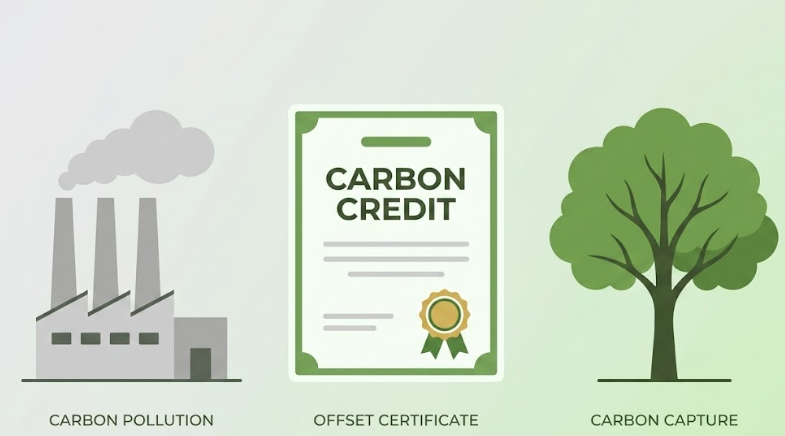
One carbon credit = one tonne of CO₂e. In 2026 an Indian carbon credit typically sells for roughly ₹50 to ₹4,400 per tonne (about $0.50–$50), depending on type. Compliance credits under India’s CCTS are expected around ₹800–1,200 per tonne; high-quality nature-based removal credits (ARR, agroforestry) sit at the top, around ₹1,500–4,400; REDD+ avoidance credits trade around ₹450–1,400; and older renewable-energy or cookstove credits can go for under ₹250. Full table below.
It is one of the most searched questions in the market, and one of the most misunderstood. People expect a single number. But carbon credits are not a uniform commodity like gold or crude oil each credit represents a specific project, in a specific place, with a specific quality and story. That is why quoted prices range from a few dollars to many times that, and why a single headline figure is almost always misleading.
Instead of chasing a number, the useful thing to understand is what drives the number. Once you know the levers, you can judge whether a price is fair, why a premium credit costs more, and if you are a developer how to design a project that earns the high end of the range.
Why There Is No Single Price
Two credits can both claim "one tonne of CO₂e" and trade at completely different prices. The tonne is the same unit; the confidence behind it is not. Price reflects that confidence plus the type of climate benefit, the age of the credit, and the extra value the project delivers to nature and communities.
The Six Drivers of Carbon Credit Price
Removals (e.g. afforestation/ARR) generally price above avoidance (e.g. some REDD+ or efficiency credits).
Credits under respected standards (Verra VCS, Gold Standard) with strong methodologies attract more trust and higher prices.
Newer credits, backed by modern measurement, tend to sell above older vintages.
Biodiversity, community livelihoods and SDG alignment add real premium buyers pay for the story, not just the tonne.
Credits with airtight additionality and durable permanence are worth more because they carry less reversal risk.
Transparent, high-resolution MRV lets a credit prove itself the strongest lever of all after the integrity crisis.
How the 2023 Crisis Reset Pricing
When investigations exposed over-crediting in parts of the REDD+ market, buyers stopped paying for volume alone. The market bifurcated: high-integrity, well-verified credits held or grew in value, while thinly documented credits were repriced sharply downward. The lesson for 2026 is blunt the market now pays for proof.
The flight to quality
Corporate buyers under reputational and regulatory scrutiny increasingly refuse credits they cannot stand behind. That demand for defensible, transparent credits is exactly why measurement quality has become the central price signal.
Carbon Credit Prices in India Specifically
Indicative 2026 price ranges per credit (1 tonne CO₂e) for the main credit types sold from or into India. Figures are market estimates, not exchange quotes; actual deals depend on standard, vintage, volume and verification quality. INR converted at roughly ₹88 per US dollar.
Carbon Credit Rate in India 2026 (per tonne CO₂e)
| Credit type | Price in INR | Price in USD | Market |
|---|---|---|---|
| CCTS compliance credit (CCC) | ₹800 – ₹1,200 | $9 – $14 | Indian compliance (CCTS), early estimates |
| ARR / afforestation & reforestation (removal) | ₹1,700 – ₹4,400 | $20 – $50 | Voluntary (Verra, Gold Standard) |
| Agroforestry | ₹1,500 – ₹4,000 | $17 – $45 | Voluntary |
| REDD+ (avoided deforestation) | ₹450 – ₹1,400 | $5 – $16 | Voluntary |
| Soil & agricultural carbon | ₹500 – ₹2,500 | $6 – $28 | Voluntary |
| Older renewable energy / cookstove credits | ₹50 – ₹250 | $0.50 – $3 | Voluntary (legacy avoidance) |
India sits at the intersection of two forces: a maturing domestic compliance market (the CCTS under the Indian Carbon Market framework) and a large voluntary market for nature-based credits (ARR, REDD+, agroforestry, blue carbon). Domestic compliance pricing will be shaped by policy and obligations, while voluntary nature-based credits price on the same global quality drivers above. For Indian developers, the practical takeaway is that co-benefits and verification quality both areas where Indian projects can excel are where the premium lives.
For developers: design for the premium
You cannot control global demand, but you can control quality. A conservative baseline, strong co-benefits and transparent digital MRV move your credits toward the premium end of the range and make them easier to sell.
How Verification Protects Your Price
Every downward repricing in this market has traced back to weak measurement. If a credit’s underlying carbon cannot be independently and transparently verified, buyers discount it to compensate for the risk. Satellite-based digital MRV (dMRV) removes that discount by making the tonne traceable canopy, biomass, baseline and permanence, all measured continuously and reproducibly.
Where Sylithe fits
Sylithe’s dMRV platform gives projects the transparent, high-resolution measurement that buyers now demand helping Indian ARR, REDD+ and agroforestry credits defend their integrity, and their price.
So, how much does a carbon credit cost in India? The right answer is: it depends on what you can prove. Stop looking for one number and start reading the drivers because in a market that finally pays for integrity, quality is price.