 New
New
From 2027, Indian airlines operating international routes must offset their emissions. Not voluntarily. Mandatorily.
CORSIA - ICAO's Carbon Offsetting and Reduction Scheme for International Aviation enters its mandatory phase in 2027. India's international aviation activity trajectory puts its carriers well above the threshold triggering compulsory participation.
For Air India, IndiGo, and any Indian carrier flying international routes, this means a legal obligation to purchase carbon offsets for every tonne of growth above the 2019-2020 baseline. The voluntary carbon market's standard registry certification does not meet CORSIA's bar.
Why Aviation Became the First Global Carbon Market
International aviation occupies a unique regulatory position. Unlike domestic industries, aviation emissions cross national borders continuously. That makes it difficult to regulate emissions entirely through national climate policies.
ICAO designed CORSIA specifically to solve this problem by creating the world’s first globally coordinated sectoral carbon market. Instead of each country imposing separate rules, CORSIA establishes a shared framework: common monitoring rules, verification standards, and eligible credit definitions.
Aviation is one of the hardest sectors to decarbonize quickly. Aircraft cannot transition rapidly to battery-electric systems at long-haul scale, and SAF supply remains constrained. That leaves offsetting as the primary near-term mechanism for controlling sector emissions growth.
The Compliance Timeline and What It Means Financially
The pilot phase (2021-2023) and first phase (2024-2026) were voluntary. The second phase, running from 2027 to 2035, is mandatory for countries above ICAO's activity threshold, with no opt-out.
Airlines that begin building qualifying offset portfolios now will lock in significantly lower prices than those forced to buy in spot markets when mandatory compliance begins in 2027 and global demand spikes simultaneously.
Why the 2019–2020 Baseline Matters So Much
CORSIA’s financial impact depends heavily on the baseline. The scheme measures growth relative to 2019–2020 international activity levels. This creates a major challenge for rapidly expanding aviation markets like India.
Indian aviation growth after the pandemic has been aggressive, with international route expansion and rising long-haul capacity. As carriers expand above pre-pandemic levels, the offset obligation grows proportionally, turning carbon into a variable operating cost similar to fuel.
Why Airlines Cannot Treat Carbon Credits As Commodities
Many airlines initially assume that any registry-issued carbon credit can satisfy compliance requirements. CORSIA challenges that assumption. The scheme places significant emphasis on quality, additionality, transparency, and accounting integrity.
As a result, airlines increasingly face a procurement challenge rather than a simple purchasing challenge. The objective is not merely to acquire credits. It is to acquire credits that remain eligible, verifiable, and defensible throughout the compliance cycle.
This distinction is creating a growing separation between generic voluntary credits and aviation-grade compliance credits. As institutional demand rises, quality is becoming a financial variable.
What Makes a Credit CORSIA-Eligible and Why Most Are Not
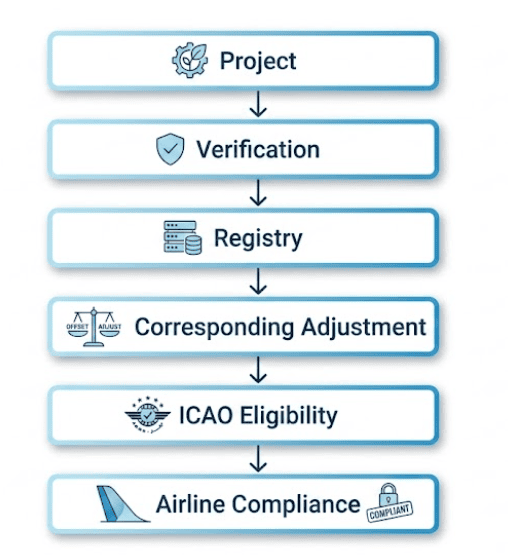
CORSIA-eligible emission units must be issued by programs formally approved by ICAO's Technical Advisory Body. Being listed on these registries is necessary but not sufficient.
The requirement that eliminates the largest share of available credits is the corresponding adjustment. Every credit must be backed by a government-level entry confirming that the underlying reduction has been removed from the host country's national Paris Agreement inventory.
The Supply Problem Few Airlines Are Prepared For
The market often assumes airlines will simply “buy offsets” when compliance begins. The reality is that CORSIA-compliant credits represent only a small fraction of the broader voluntary carbon market.
When the mandatory phase begins in 2027, dozens of international airlines may simultaneously compete for a limited pool of qualifying units. This surge could materially increase prices for high-integrity aviation-grade credits.
Why Corresponding Adjustments Are Reshaping Carbon Markets
Historically, voluntary carbon credits operated independently of national accounting. CORSIA changes that. Under ICAO rules, the host country must formally authorize the transfer to prevent double claiming.
The consequence is profound: carbon credits increasingly require sovereign-level authorization and international accounting alignment. This may significantly reduce the future supply of eligible credits while increasing the value of Article 6 authorized projects.
“CORSIA is the first mandatory global sectoral carbon market. The integrity standards it sets for eligible credits will define the floor for institutional carbon purchasing for the next decade.”
— Sylithe Research
Verification Standards That CORSIA Actually Requires
ICAO's Technical Advisory Body looks for continuous MRV systems, not periodic desk audits. Projects backed by satellite-based monitoring that provides ongoing evidence are increasingly preferred.
Why MRV Standards Are Becoming More Aggressive
The market is shifting away from static documentation and developer-submitted reporting. Instead, regulators expect continuous monitoring and timestamped evidence chains. This is especially important for forestry projects where permanence and leakage remain concerns.
Satellite-based MRV systems allow continuous observation of forest cover and land-use change. This is rapidly becoming the preferred verification model for aviation-grade credits.
SAF's Role and the Indian Constraint
Sustainable Aviation Fuel is central to long-term decarbonization, but near-term economics remain difficult. Globally, SAF production capacity is extremely limited relative to total jet fuel demand.
For Indian carriers, domestic commercial-scale SAF production remains limited. Offsetting is likely to remain the dominant compliance mechanism through the early mandatory phase while SAF adoption grows gradually over the longer term.
Why Early Offset Procurement May Become A Strategic Advantage
The airlines that secure high-integrity offset portfolios before mandatory demand accelerates may benefit from lower acquisition costs and reduced compliance risk.
Waiting until the mandatory phase begins could expose carriers to higher prices, tighter supply conditions, and increased competition from international airlines seeking the same limited pool of qualifying credits.
Carbon procurement is therefore evolving into a strategic planning function similar to fuel hedging and long-term fleet planning.
Competitive Implications for Indian Airlines
CORSIA compliance will not affect all airlines equally. Carriers with larger international networks and faster fleet expansion will face proportionally larger offset obligations, making carbon efficiency a competitive differentiator similar to fuel efficiency today.

The Bigger Shift Beyond Aviation
CORSIA matters beyond airlines because it establishes an international precedent for high-integrity carbon purchasing. The scheme effectively creates a hierarchy: generic voluntary credits versus institutionally acceptable compliance-grade credits.
CORSIA is not simply another sustainability reporting framework. It is the operationalization of carbon pricing within global aviation.
From 2027 onward, international growth carries a direct carbon compliance obligation backed by increasingly strict integrity standards. The airlines and project developers preparing now will enter the mandatory phase with a significant structural advantage.
The rest may discover too late that not all carbon credits are equal, and not all offset portfolios will remain compliant in the next generation of global carbon markets.
How Sylithe supports CORSIA compliance
We help Indian project developers build the satellite-backed MRV infrastructure needed for CORSIA eligibility, and help airline buyers assess whether specific offset projects meet ICAO evidence standards. Contact our research team to secure your Article 6 readiness.
Key Takeaways & Metrics
A summary of the core concepts discussed in this article.
| Concept | Relevance | Impact Level | Status |
|---|---|---|---|
| Methodology | Core to accurate MRV | High | Active |
| Integrity | Essential for credit value | Critical | Mandatory |
| Technology | Enables scale | High | Growing |
Data synthesized from Sylithe Research.