 New
New
The hard part of buying carbon credits is not the transaction. It is being able to look your board, your auditor and a journalist in the eye and prove that every tonne you claimed was real.
What Are Carbon Credits?
Key Takeaway
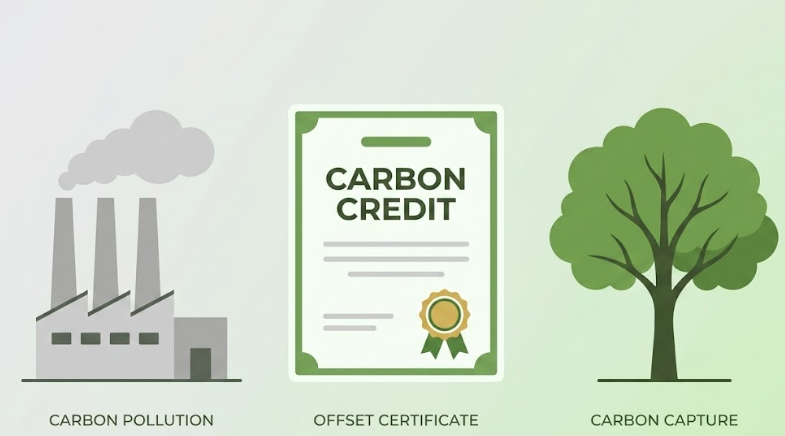
Carbon credits are tradable environmental assets representing one verified metric tonne (tCO₂e) of greenhouse gas emissions either removed from or prevented from entering the atmosphere. They allow organizations to compensate for emissions that are technically or economically difficult to eliminate while simultaneously financing climate‑positive projects around the world. However, not all carbon credits are created equal. A credit only has value if the underlying climate benefit is real, measurable, additional, independently verified, and maintained over time. A poorly designed project may issue thousands of credits while delivering little real climate impact, whereas a well‑managed project backed by transparent monitoring and rigorous verification can provide meaningful climate benefits and withstand scrutiny from regulators, investors, auditors, and the public. For Indian companies, carbon credits have evolved from being a voluntary sustainability initiative into a strategic business decision. Global customers increasingly evaluate suppliers based on ESG performance, investors are asking for credible decarbonization pathways, and climate‑related disclosure requirements are becoming more demanding. Purchasing high‑integrity carbon credits helps organizations address residual emissions while supporting biodiversity conservation, forest restoration, regenerative agriculture, rural livelihoods, and climate resilience. Buying carbon credits should never replace emissions reduction. Instead, they complement a broader net‑zero strategy by addressing unavoidable emissions that remain after operational improvements and energy efficiency measures have been implemented.
Why Do Companies Buy Carbon Credits?
Companies purchase carbon credits for reasons that extend far beyond environmental branding. Today, climate performance increasingly influences investment decisions, procurement policies, access to international markets, and corporate reputation. Organizations across sectors—including manufacturing, technology, pharmaceuticals, financial services, logistics, consumer goods, and energy—are integrating carbon credits into broader sustainability strategies to address residual emissions that cannot yet be eliminated through operational improvements alone. Carbon credits also allow companies to finance climate‑positive projects such as afforestation, agroforestry, wetland restoration, and biodiversity conservation while progressing toward publicly stated net‑zero commitments. When selected carefully, these projects create measurable environmental and social benefits that strengthen ESG reporting and stakeholder confidence. In India, additional drivers include Net‑Zero commitments, ESG reporting mandates (such as BRSR Core), investor expectations, export requirements, supply‑chain pressure, customer expectations, and the desire to demonstrate climate leadership. By purchasing verified, high‑integrity credits, companies can close the emissions gap, showcase proactive climate action, and mitigate reputational risk.
Compliance vs Voluntary Carbon Markets: Where Should Corporate Buyers Purchase Carbon Credits?
Not all carbon credits exist in the same market. One of the most common misconceptions among first-time buyers is assuming that every carbon credit is interchangeable. In reality, carbon credits are traded through two distinct ecosystems: the Compliance Carbon Market and the Voluntary Carbon Market (VCM). Although both aim to reduce global greenhouse gas emissions, they operate under different regulations, serve different participants, and follow different purchasing objectives.
Understanding the difference is essential for corporate sustainability teams because buying the wrong type of credit — or misunderstanding how it can be used — may create compliance issues, reputational risks, or ineffective climate strategies. For most Indian companies today, especially those pursuing ESG goals, voluntary net-zero commitments, or international sustainability reporting, the Voluntary Carbon Market remains the primary marketplace for purchasing high-integrity carbon credits.
What Is the Compliance Carbon Market?
A Compliance Carbon Market is established by governments or regulatory authorities to help achieve legally mandated emission reduction targets. Companies operating under these systems are required by law to limit their greenhouse gas emissions. If they exceed their permitted emission limits, they must purchase compliance credits or emission allowances to meet regulatory obligations. Unlike voluntary purchases, organizations cannot choose whether to participate — they are legally obligated to comply with the rules established by the governing authority.
Examples of compliance markets include: the European Union Emissions Trading System (EU ETS), the California Cap-and-Trade Program, the UK Emissions Trading Scheme, the China National Emissions Trading System, and India’s evolving Carbon Credit Trading Scheme (CCTS). These markets typically involve regulated industries such as power generation, steel, cement, aviation, oil and gas, chemicals, and heavy manufacturing. The primary objective of compliance markets is to achieve national climate targets through legally enforceable emission reductions rather than voluntary corporate sustainability initiatives.
What Is the Voluntary Carbon Market?
The Voluntary Carbon Market (VCM) allows companies, investors, financial institutions, and even individuals to purchase carbon credits voluntarily as part of broader sustainability and climate commitments. Participation is not legally required. Instead, organizations buy carbon credits to support net-zero commitments, offset unavoidable residual emissions, meet ESG objectives, strengthen climate disclosures, finance nature-based climate solutions, demonstrate environmental leadership, meet customer and investor expectations, and enhance corporate sustainability reporting.
Credits traded in the voluntary market are generated by independently verified projects such as Afforestation and Reforestation (ARR), Agroforestry, REDD+ forest conservation, Mangrove restoration, Blue Carbon initiatives, Wetland restoration, Grassland conservation, Renewable energy projects, Methane capture, and Improved cookstove projects. These projects are typically registered under internationally recognized standards such as Verra, Gold Standard, American Carbon Registry (ACR), and Climate Action Reserve (CAR), ensuring that each issued credit represents a measurable and independently verified climate benefit.
Which Market Do Most Indian Companies Use?
For the majority of Indian businesses today, the Voluntary Carbon Market is the preferred route for purchasing carbon credits. Organizations pursuing Science Based Targets (SBTi), corporate ESG goals, BRSR reporting, supplier decarbonization, or global net-zero commitments generally source credits from voluntary projects because they provide greater flexibility, broader project choices, and stronger opportunities to support biodiversity and community development alongside carbon removal.
Key Takeaway
As India’s Carbon Credit Trading Scheme (CCTS) continues to evolve, compliance markets are expected to play a larger role for regulated sectors. However, voluntary markets will continue to remain an important mechanism for financing nature-based climate projects and enabling companies to address emissions beyond regulatory requirements.
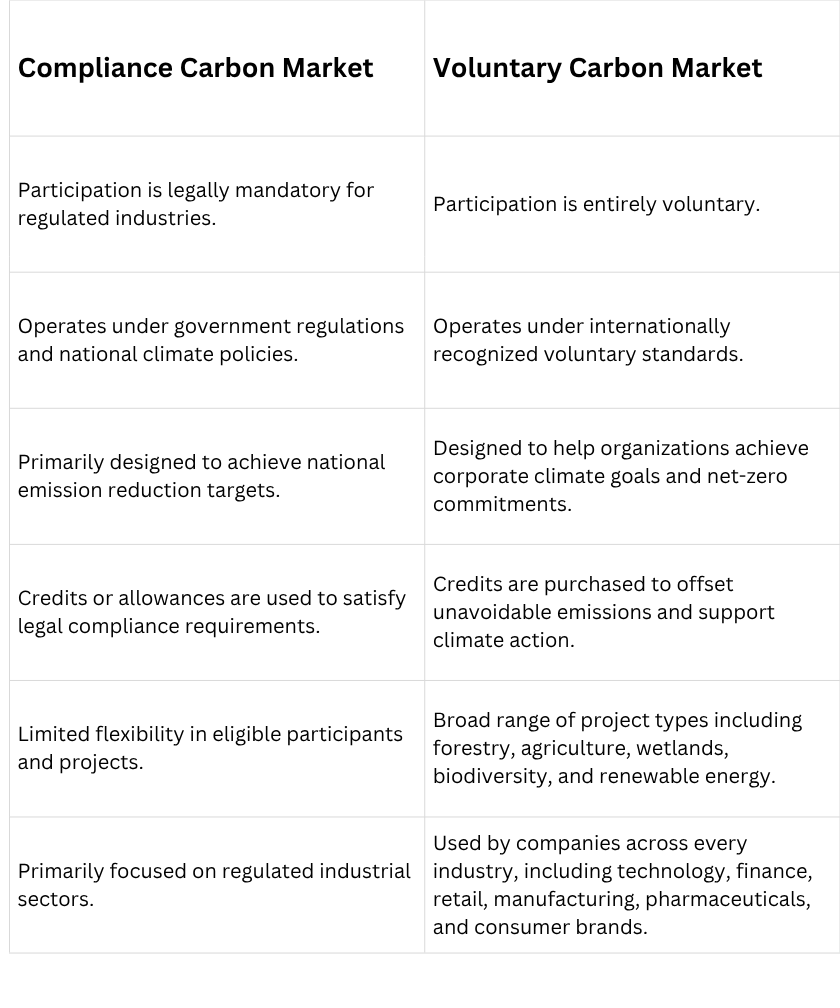
Key Differences Between Compliance and Voluntary Markets
| Compliance Carbon Market | Voluntary Carbon Market |
|---|---|
| Participation is legally mandatory for regulated industries. | Participation is entirely voluntary. |
| Operates under government regulations and national climate policies. | Operates under internationally recognized voluntary standards. |
| Primarily designed to achieve national emission reduction targets. | Designed to help organizations achieve corporate climate goals and net-zero commitments. |
| Credits or allowances are used to satisfy legal compliance requirements. | Credits are purchased to offset unavoidable emissions and support climate action. |
| Limited flexibility in eligible participants and projects. | Broad range of project types including forestry, agriculture, wetlands, biodiversity, and renewable energy. |
| Primarily focused on regulated industrial sectors. | Used by companies across every industry, including technology, finance, retail, manufacturing, pharmaceuticals, and consumer brands. |
Why High-Integrity Credits Matter in Both Markets
Whether credits are purchased within a compliance framework or through the voluntary market, quality remains the single most important consideration. A carbon credit should not be judged solely by the registry where it was issued. Corporate buyers should evaluate whether the underlying project demonstrates genuine additionality, conservative and scientifically defensible baselines, long-term permanence, minimal leakage risk, independent third-party verification, continuous monitoring, transparent documentation, biodiversity and community co-benefits, audit-ready evidence, and robust digital MRV where available.
For most organizations purchasing carbon credits today, the question is not simply whether a credit belongs to the compliance or voluntary market. The more important question is whether the underlying project is credible, transparent, and capable of withstanding rigorous due diligence. A well-designed voluntary carbon project supported by independent verification, continuous satellite monitoring, transparent baseline methodologies, and strong biodiversity and social outcomes often provides far greater long-term value than purchasing the cheapest available credit. Platforms powered by digital MRV and satellite intelligence can further strengthen this process by enabling organizations to independently verify land history, baseline assumptions, permanence, and ongoing project performance before making purchasing decisions.
Step 1 Build Your Carbon Strategy
Credits are not a substitute for cutting emissions. A credible climate strategy — and increasingly, disclosure frameworks — expect you to reduce what you can and use high-quality credits only for the emissions you genuinely cannot yet eliminate. Buying credits to avoid decarbonising is the fastest route to a greenwashing accusation. Before purchasing a single credit, define your scope: what emissions are you covering, over what timeframe, and how do your offset commitments sit within your broader science-aligned decarbonisation pathway?
The order that protects you
Measure your footprint, cut hard, then offset the unavoidable remainder with credits you can fully defend. That sequence is what auditors and stakeholders expect to see.
Step 2 Measure Emissions
You cannot offset what you have not measured. Before buying credits, conduct a rigorous GHG inventory using the GHG Protocol Corporate Standard or an equivalent framework. This should cover Scope 1 (direct emissions from owned or controlled sources), Scope 2 (indirect emissions from purchased electricity, heat, or steam), and — critically — Scope 3 (all other indirect emissions across your value chain). Scope 3 is often 70–90% of a company's total footprint and the hardest to reduce, making it the area where high-quality offsets play the most important role. Without a credible measurement baseline, your entire offset strategy is built on sand.
Indian companies subject to BRSR Core reporting, the Securities and Exchange Board of India's mandatory ESG disclosure framework for listed companies, are already required to disclose Scope 1 and Scope 2 emissions and are increasingly expected to address Scope 3. An accurate emissions inventory is not just a prerequisite for buying credits — it is a regulatory requirement and a foundation for investor trust.
Step 3 Decide What To Offset
Not every tonne of your emissions footprint is an appropriate candidate for offsetting. Once you have measured your full footprint and identified which emissions you can realistically reduce through operations, energy efficiency, renewable energy, or supply chain changes, the residual unavoidable emissions are your offset target. Setting this boundary clearly — and documenting why certain emissions are being offset rather than reduced — is what protects you from greenwashing accusations.
Many corporates prioritise offsetting their Scope 1 and 2 residual emissions first, then progressively address Scope 3 as measurement matures. Others purchase credits to cover specific activities — business travel, product lifecycle emissions, or event footprints — as part of targeted climate programmes. Whatever approach you take, document the rationale clearly: auditors and stakeholders will ask why specific emissions are being offset rather than reduced.
Step 4 Understand Credit Types
Not all carbon credits are the same. The two primary categories are Removal credits and Avoidance credits, and the distinction matters enormously for how buyers can use them and how defensible the purchase is.
Removal credits — generated by activities like afforestation, reforestation, agroforestry, blue carbon (mangrove restoration), and direct air capture — represent carbon dioxide that has been physically drawn out of the atmosphere and stored. These are the gold standard for buyers making science-based net-zero claims, because they reverse historical emissions rather than simply slowing future ones. ARR projects in India, for example, generate removal credits as trees grow and accumulate biomass.
Avoidance credits — generated by REDD+ (protecting forests from deforestation), renewable energy projects displacing coal, or industrial emission reduction — represent emissions that were prevented from entering the atmosphere. These credits are legitimate and valuable but face increasing scrutiny, particularly from buyers making net-zero claims, because they do not remove historical carbon from the atmosphere. Avoided deforestation (REDD+) credits have been under particular pressure following exposés of inflated baselines.
Within each category, credits also differ by methodology (Verra VCS, Gold Standard, CCTS), vintage (the year the reduction occurred), geography, co-benefits, and verification quality. Buyers with SBTi-aligned net-zero commitments are increasingly restricted from using avoidance credits for residual neutralization claims and must rely on high-quality removal credits. Understanding these distinctions before approaching the market saves significant due diligence effort.
Step 5 Evaluate Projects
Assess project credibility, co‑benefits, location risk, and alignment with your corporate values. Look for transparent MRV, clear additionality analysis, and robust community engagement.
Step 6 Due Diligence
Due diligence is the cornerstone of a safe purchase. Beyond the core five tests, dig deeper into financial viability, regulatory compliance, and long‑term risk. Ask every seller for the uncertainty quantification behind the claimed tonnes, not just the headline number.
Additionality
Additionality is the foundation of every credible carbon credit. It answers one simple but crucial question: Would this project have happened even without carbon finance? If the answer is yes, then the project is not creating any additional climate benefit, and the carbon credits it generates may have little environmental value. This is why buyers, registries, and independent auditors place significant emphasis on evaluating additionality before a project is approved.
Additionality can be demonstrated through several tests, including financial additionality, investment additionality, technological barriers, or regulatory barriers. Buyers should review the project's baseline studies, financial assumptions, and third-party validation reports to determine whether carbon revenue was genuinely necessary for the project to proceed. Projects that present transparent evidence and conservative assumptions are generally considered more credible and are more likely to maintain long-term market value.
Ultimately, purchasing credits from genuinely additional projects helps ensure that every credit represents real, measurable climate impact rather than activities that would have occurred regardless of carbon financing.
Financial & Investment
A strong carbon project should be financially viable while still demonstrating that carbon finance plays a meaningful role in its implementation and long-term success. Buyers should carefully examine the project's financial model, capital expenditure, operating costs, projected revenue streams, and funding sources to understand whether carbon credit revenue is essential for maintaining the project over its crediting period.
It is also important to assess the stability of future credit supply. Projects with uncertain funding, unrealistic financial assumptions, or heavy dependence on a single investor may face operational risks that could affect long-term performance. Buyers should consider whether adequate resources have been allocated for monitoring, verification, community engagement, and project maintenance throughout the project's lifetime.
Understanding the project's investment structure not only improves due diligence but also provides confidence that the project can continue delivering verified climate benefits for years to come.
Barrier & Regulatory
Beyond financial considerations, buyers should evaluate the legal, institutional, and operational barriers that may affect the project's long-term viability. Carbon projects often involve complex land ownership arrangements, community rights, government approvals, environmental permits, and contractual agreements that can significantly influence project implementation.
Land tenure disputes, unclear ownership records, overlapping forest rights, or unresolved legal claims can jeopardize project credibility and even invalidate future carbon credit issuance. Buyers should also consider potential regulatory changes, evolving carbon market policies, and government climate legislation that may impact project eligibility or future credit generation.
A comprehensive regulatory assessment reduces legal uncertainty and helps ensure that purchased credits remain valid, compliant, and defensible throughout their lifecycle.
Baseline
The baseline represents the estimated greenhouse gas emissions or carbon stock changes that would have occurred if the project had never been implemented. Since carbon credits are calculated by comparing actual project performance against this reference scenario, the quality of the baseline directly influences the number of credits that can be issued.
Buyers should be cautious of projects using overly optimistic or inflated baseline assumptions that exaggerate expected emissions or deforestation rates. Conservative and scientifically robust baselines provide a more accurate representation of climate impact and significantly reduce the risk of over-crediting.
Increasingly, advanced methodologies are moving toward dynamic baselines, which continuously adjust based on real-world environmental conditions rather than relying on static historical assumptions. Combined with satellite imagery, remote sensing, and AI-driven monitoring, dynamic baselines provide a more transparent and defensible approach to measuring project impact over time.
Permanence
One of the defining characteristics of high-quality carbon credits is permanence—the assurance that the carbon stored or emissions avoided today will continue delivering climate benefits for decades into the future. Nature-based projects are particularly exposed to reversal risks, including wildfires, floods, droughts, illegal logging, pest outbreaks, disease, and the broader impacts of climate change.
Corporate buyers should evaluate how project developers identify, monitor, and manage these risks throughout the project's lifetime. Strong projects typically implement comprehensive risk management strategies such as fire prevention plans, community forest protection programs, biodiversity conservation measures, insurance mechanisms, and registry-managed buffer pools that compensate for unexpected carbon losses.
Continuous satellite monitoring and digital MRV systems provide an additional layer of confidence by enabling near real-time detection of deforestation, land-use change, and other permanence risks. Projects that actively monitor and respond to these threats are generally better positioned to deliver durable and defensible climate outcomes.
Leakage
Leakage occurs when a carbon project reduces emissions within its project boundary but unintentionally causes emissions to increase elsewhere. For example, protecting one forest area may simply shift logging activities to a neighboring region, resulting in little or no net climate benefit.
Leakage can occur through activity shifting, market responses, agricultural expansion, or displacement of local communities and economic activities. Buyers should review whether the project has conducted a comprehensive leakage assessment and implemented appropriate mitigation strategies to minimize these indirect impacts.
High-quality methodologies require developers to quantify potential leakage, incorporate conservative adjustments into carbon accounting, and continuously monitor surrounding landscapes for evidence of displacement. Addressing leakage effectively ensures that claimed emission reductions represent genuine global climate benefits rather than localized improvements.
Co‑Benefits
Modern corporate buyers increasingly evaluate carbon projects not only for their carbon impact but also for the broader environmental and social benefits they generate. These additional outcomes—commonly referred to as co-benefits—can significantly strengthen the value proposition of a carbon project while supporting broader sustainability objectives.
Projects delivering meaningful co-benefits may contribute to biodiversity conservation, habitat restoration, watershed protection, soil health improvement, sustainable agriculture, rural employment, women's empowerment, indigenous community development, food security, and several of the United Nations Sustainable Development Goals (SDGs).
For many organizations, these wider impacts play an important role in ESG reporting, stakeholder engagement, investor communications, and corporate sustainability narratives. Well-documented co-benefits demonstrate that carbon finance is creating value beyond emissions reductions, making projects more attractive to buyers seeking measurable environmental and social impact.
Verification
Independent verification provides the assurance that a carbon project's claimed climate benefits have been measured accurately and comply with the requirements of the chosen carbon standard. Before credits are issued, projects undergo validation and verification by accredited Validation and Verification Bodies (VVBs) that assess project documentation, monitoring data, methodologies, and carbon accounting practices.
Corporate buyers should prioritize projects verified by reputable VVBs and supported by transparent, high-quality evidence. Increasingly, leading projects combine traditional field measurements with satellite imagery, AI-powered analytics, LiDAR, remote sensing, biomass estimation models, and digital Monitoring, Reporting, and Verification (dMRV) systems to provide continuous, audit-ready insights into project performance.
Rather than relying solely on periodic field visits or project documentation, digital verification technologies enable ongoing monitoring of forest cover, land-use change, canopy height, biomass growth, and permanence risks throughout the project lifecycle. This enhanced transparency helps buyers move beyond trust-based purchasing toward evidence-based due diligence, reducing greenwashing risk while increasing confidence in every carbon credit acquired.
Carbon Credit Buyer Checklist
Why It Matters
- Registry (e.g., Verra, Gold Standard, CCTS)
- Vintage (year of issuance)
- Methodology (project type and standard)
- Additionality assessment
- Baseline honesty
- Leakage analysis
- Permanence safeguards
- Monitoring plan (satellite & ground)
- Satellite data availability
- Biodiversity co‑benefits
- Community impact
- VVB credibility
- Risk assessment
- Retirement mechanism
- Legal documentation
- Price alignment with market
- Contract terms clarity
- Counterparty reputation
- Alignment with corporate net‑zero targets
- ESG reporting compatibility
- Audit trail setup
- Insurance or buffer pool
- Future resale or transfer options
- Alignment with stakeholder expectations
- Verification of MRV methodology
Carbon Credit Pricing
Carbon credit prices vary widely—from a few dollars to upwards of $50 per tonne—depending on factors such as methodology, location, biodiversity co‑benefits, MRV rigor, registry fees, market demand, vintage, and the presence of additional environmental or social outcomes. Premium projects in high‑biodiversity hotspots or with robust satellite verification command higher prices, while older vintage credits or those from less demanding registries may be cheaper. Understanding these drivers helps buyers balance cost with integrity.
Common Mistakes Companies Make
Why It Matters
- Buying the cheapest credits without assessing integrity
- Ignoring MRV and relying solely on developer claims
- Using brokers without independent verification
- Failing to retire credits in the buyer’s name
- Neglecting comprehensive documentation
- Skipping thorough due diligence
- Overlooking permanence and reversal risks
- Purchasing outdated vintages that may be retired
- Insufficient registry research
- Not checking additionality rigorously
- Disregarding biodiversity co‑benefits
- Assuming all voluntary credits are high quality
- Failing to align purchases with net‑zero timelines
- Not integrating credit purchases into ESG reporting
- Overlooking legal and tax implications
How AI Is Changing Carbon Credit Due Diligence
Artificial intelligence is transforming how buyers evaluate projects. Satellite imagery combined with AI algorithms can measure canopy height, estimate biomass, and detect forest disturbances in near‑real‑time. Synthetic‑aperture radar (SAR) and LiDAR provide 3‑D structure data, enabling dynamic baselines that adjust as land use changes. AI‑driven anomaly detection flags suspicious activity, while automated digital MRV platforms generate audit‑ready reports, dramatically reducing reliance on manual field surveys and increasing confidence in credit quality.
The Future of Corporate Carbon Buying
Emerging frameworks like Article 6 of the Paris Agreement, the International Carbon Reduction and Removal (ICVCM) standards, and carbon credit platforms (CCPs) are reshaping the market. Digital MRV, continuous satellite monitoring, and AI‑enhanced verification will become standard, driving transparency and reducing greenwashing. Companies that adopt these technologies early will gain a competitive edge in ESG reporting and climate leadership.
How Sylithe Helps
Sylithe's AI-powered digital MRV (dMRV) platform helps companies buy high-integrity carbon credits with confidence. Using satellite imagery, remote sensing, and AI-driven analytics, it independently verifies land history, baseline integrity, additionality indicators, carbon stock changes, and long-term permanence. The platform continuously monitors project performance, detects deforestation and reversal risks, and generates transparent, verification-ready evidence that supports procurement, ESG reporting, and corporate climate disclosures. With Sylithe, carbon credit due diligence shifts from relying on project claims to making evidence-based purchasing decisions backed by continuous monitoring.
Step 1 Build Your Carbon Strategy
Credits are not a substitute for cutting emissions. Credible climate strategy and increasingly, disclosure frameworks expects you to reduce what you can and use high-quality credits only for the emissions you genuinely cannot yet eliminate. Buying credits to avoid decarbonising is the fastest route to a greenwashing accusation.
The order that protects you
Measure your footprint, cut hard, then offset the unavoidable remainder with credits you can fully defend. That sequence is what auditors and stakeholders expect to see.
The Corporate Risk of Getting It Wrong
Why It Matters
- Reputational damage if an offset is later exposed as low-integrity.
- Regulatory and disclosure risk as scrutiny of climate claims tightens.
- Wasted budget on credits that deliver little real climate benefit.
- Loss of stakeholder and investor trust in your net-zero story.
How Sylithe helps buyers
Sylithe’s dMRV intelligence lets corporate buyers evaluate project quality with satellite-verified evidence checking land history, baselines and permanence before they commit. It turns "trust the developer" into "verify the tonne", de-risking every purchase.
Buying carbon credits in India is easy. Buying credits you can defend is a discipline: reduce first, understand what you are buying, run genuine due diligence, verify independently, and document everything. Do that, and your offsets strengthen your climate story instead of threatening it.