 New
New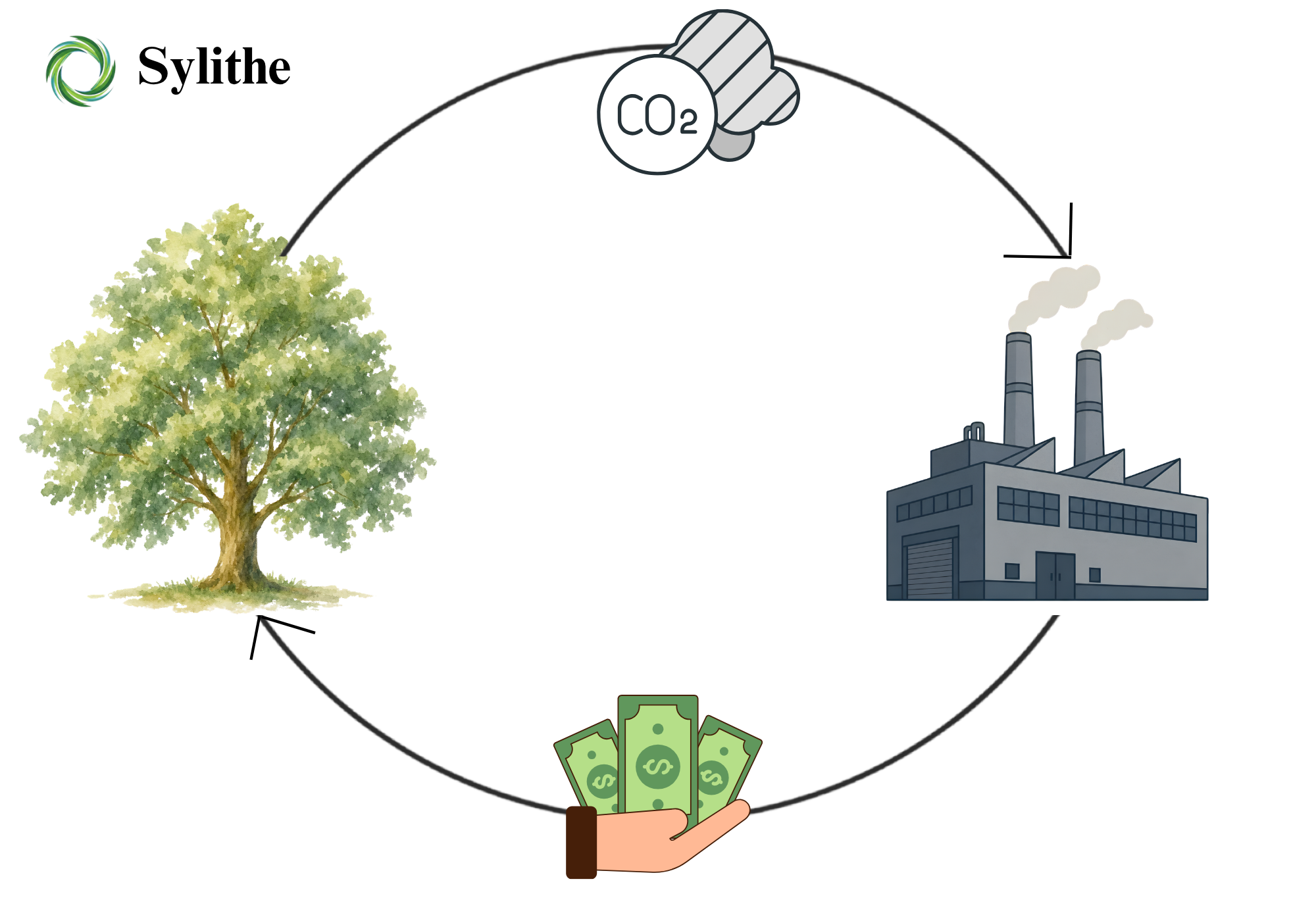
The land does not become money the day you plant it. It becomes money the day a buyer trusts the tonne you are selling. Everything between those two points is diligence — and diligence is where most Indian projects win or lose.
India has enormous nature-based carbon potential: degraded land waiting for afforestation, farmland ready for agroforestry, forests worth protecting, and coastlines ripe for mangrove restoration. But potential is not a credit. To sell carbon credits, a project has to be designed, measured, verified and registered in a way that a sceptical global buyer will pay a premium for. This guide walks the entire path.
What Are Carbon Credits?
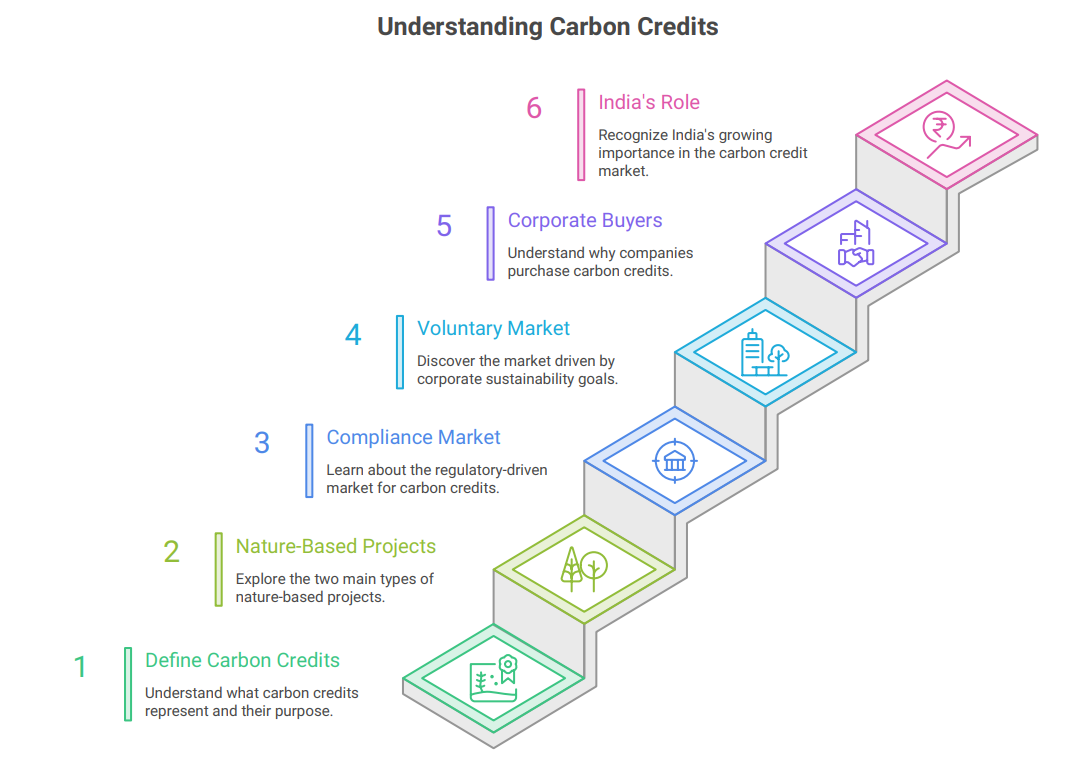
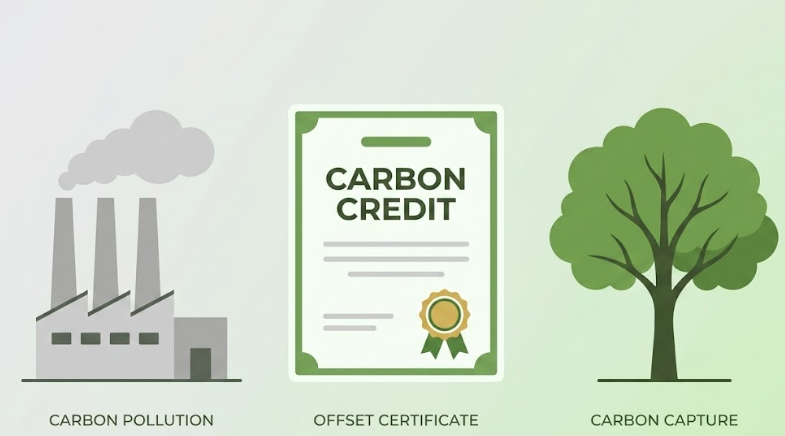
Carbon credits are tradable environmental assets representing one verified metric tonne (tCO₂e) of greenhouse gas emissions either removed from or prevented from entering the atmosphere. They allow organizations to compensate for emissions that are technically or economically difficult to eliminate while simultaneously financing climate-positive projects around the world.
Key Takeaway
However, not all carbon credits are created equal. A credit only has value if the underlying climate benefit is real, measurable, additional, independently verified, and maintained over time. A poorly designed project may issue thousands of credits while delivering little real climate impact, whereas a well-managed project backed by transparent monitoring and rigorous verification can provide meaningful climate benefits and withstand scrutiny from regulators, investors, auditors, and the public.
For Indian companies and project developers, carbon credits have evolved from being a voluntary sustainability initiative into a strategic business decision. Global customers increasingly evaluate suppliers based on ESG performance, investors are asking for credible decarbonization pathways, and climate-related disclosure requirements are becoming more demanding. Generating and selling high-integrity carbon credits supports biodiversity conservation, forest restoration, regenerative agriculture, rural livelihoods, and climate resilience while creating a new revenue stream from land that was previously unmonetised.
Nature-based projects fall into two broad categories. Removal credits generated by activities like ARR and agroforestry are credits where trees actively draw carbon dioxide out of the atmosphere and store it in biomass and soil. Avoidance credits generated by REDD+ projects represent emissions that were prevented by protecting existing forests from credible threats of deforestation. Removal credits generally command a premium over avoidance credits because their permanence is easier to quantify and they deliver a measurable physical sequestration benefit.
The quality of a carbon credit is determined by five foundational principles. Additionality: the emission reduction or removal would not have occurred without the carbon finance. Measurability: the climate benefit is precisely quantified using a recognised scientific methodology. Permanence: the carbon is stored for a sufficiently long period. Verifiability: an independent third-party can confirm the benefit occurred. Uniqueness: the credit has been issued once and can only be used by one buyer. Projects that satisfy all five principles attract premium buyers and command higher prices. Projects that cut corners on any one of them are increasingly being exposed and avoided.
India occupies a unique position in global carbon markets. With over 175 million hectares of degraded land, a vast smallholder agricultural base suited to agroforestry, coastal ecosystems rich in blue carbon potential, and a national ambition to create 33% forest and tree cover by 2030, the country has the raw material to become one of the world's most important suppliers of nature-based removal credits. The Carbon Credit Trading Scheme (CCTS) is now creating a domestic compliance market, while voluntary demand from global corporations continues to grow. Indian project developers who build high-integrity projects today are positioning themselves at the centre of this emerging market.
Who Can Sell Carbon Credits?
Selling carbon credits is not restricted to large corporations. Anyone with documented legal rights to land and the ability to enact verifiable environmental change can participate in carbon markets. The critical requirement is not acreage or capital it is the ability to prove that a real, additional, measurable and permanent climate benefit has occurred on land you legally control.
Why It Matters
- Private Landowners: Individuals or families with large tracts of degraded land suitable for planting. Legal title and clear land-use history are the first prerequisites.
- NGOs and Non-Profits: Organizations working on landscape restoration and community upliftment. Many NGOs have established the community trust needed to navigate FPIC requirements efficiently.
- CSR Projects: Corporate Social Responsibility initiatives that fund planting and want to claim or sell the resulting carbon impact. CSR projects must be careful about double-counting the corporate funder and the credit seller cannot both claim the same tonne.
- Government Agencies: State forest departments or municipalities reclaiming wasteland. Government projects face unique additionality challenges since government entities often have regulatory mandates to restore land.
- FPOs (Farmer Producer Organizations): Collectives of smallholder farmers adopting agroforestry practices. Aggregation through FPOs allows individual farmers who could never afford verification costs to access carbon markets collectively.
- Agroforestry Companies: Businesses integrating timber or fruit trees into agricultural systems. These projects combine carbon revenue with commercial timber or fruit production.
- Plantation Companies: Commercial forestry operations adopting improved forest management. These projects must carefully demonstrate that the management improvement goes beyond business-as-usual.
- Mining Restoration: Companies restoring abandoned mine sites with vegetation. These projects often have strong additionality because the alternative leaving the land degraded is well-documented.
- Corporate Sustainability Teams: Businesses utilizing surplus corporate land for ecological restoration. Internal carbon projects allow companies to generate credits they can use or sell.
The single most important thing any of these entities must establish at the outset is clear, documented legal rights to the land and its carbon benefits. Land tenure disputes are the number one reason Indian projects fail validation. Before spending a rupee on consultants, PDD writers, or MRV systems, establish that you can legally sell the carbon from this land — and that no one else can claim it.
Compliance Market vs Voluntary Market
Carbon markets operate on two parallel tracks, and Indian project developers must understand both to make strategic decisions about where to register their projects and whom to sell to.
The Compliance Market is government-mandated. Companies in regulated sectors are required by law to reduce their emissions or purchase allowances and credits to cover their remaining emissions. India's Carbon Credit Trading Scheme (CCTS), currently being operationalized by the Bureau of Energy Efficiency (BEE), will create a domestic compliance market where heavy emitters in sectors like steel, cement, aluminium and petrochemicals must participate. Credits generated under Indian methodologies and approved by the domestic registry will be required for compliance buyers.
The Voluntary Carbon Market (VCM) is demand-driven by corporate sustainability commitments. Companies purchase VCM credits to meet voluntary net-zero targets, improve ESG scores, demonstrate climate leadership to investors, satisfy supply chain requirements from global brands, and strengthen their annual sustainability disclosures. The two dominant global registries are Verra (which operates the Verified Carbon Standard or VCS) and Gold Standard.
| Dimension | Compliance Market (CCTS) | Voluntary Carbon Market (VCM) |
|---|---|---|
| Who participates | Regulated heavy emitters (steel, cement, aluminium, etc.) | Any company with a voluntary climate commitment |
| Driven by | Government law and regulation | Corporate ESG strategy and buyer demand |
| Registries | India national registry (BEE) | Verra (VCS), Gold Standard, ACR, CAR |
| Key standards | Indian methodologies (BEE approved) | VM0047, VM0007, AMS-I.D, etc. |
| Credit price | Set by regulation and market mechanisms | Negotiated; driven by quality and co-benefits |
| Verification | Accredited Indian VVBs | Accredited international VVBs |
| Article 6 link | Requires Corresponding Adjustment | Currently optional, increasingly expected |
| Buyer motivation | Legal compliance | Voluntary net-zero, ESG, reputation |
Indian project developers must decide early which market they are targeting. Registering on Verra or Gold Standard gives access to a larger pool of international voluntary buyers who often pay premium prices for high co-benefit projects. Registering under the domestic CCTS framework ensures access to the domestic compliance market. Some projects pursue both, though this requires careful management of corresponding adjustments under Article 6 of the Paris Agreement to avoid double-counting.
Types of Carbon Projects in India
India's diverse ecology supports several types of nature-based carbon projects, each with specific methodologies, monitoring requirements, buyer profiles, and risk profiles. Understanding which project type fits your land and objectives is the foundation of a financially viable carbon strategy.
ARR (Afforestation, Reforestation and Revegetation): ARR projects plant trees on land that has been non-forested for a defined period, typically ten years. This is a removal credit the trees physically sequester carbon dioxide from the atmosphere and store it in above-ground biomass, below-ground roots, litter, and soil. ARR projects are typically registered under Verra's VM0047 methodology. The key eligibility requirement is proving through historical satellite imagery that the land has been non-forest for the required period. ARR credits are in strong demand from buyers seeking removal credits to meet science-based targets.
REDD+ (Reducing Emissions from Deforestation and Forest Degradation): REDD+ projects protect existing forests that are under a credible and documented threat of deforestation. Instead of measuring carbon that trees accumulate, REDD+ measures the carbon that would have been released had the deforestation threat not been addressed. These are avoidance credits. Buyers are increasingly scrutinizing REDD+ baselines after several high-profile cases revealed inflated baselines. High-integrity REDD+ projects with dynamic, satellite-monitored baselines and independent verification continue to attract strong demand.
Agroforestry: Agroforestry integrates trees with crops or pastureland, generating removal credits as trees grow. Agroforestry projects often deliver exceptional co-benefits: increased farm income from timber or fruit, improved soil health, biodiversity corridors, and food security for smallholder farmers. Digital MRV tools that can track individual tree growth from satellite data have made agroforestry MRV far more cost-effective.
Mangroves and Blue Carbon: Coastal mangrove restoration and protection generates blue carbon credits. Mangroves sequester carbon at rates four to ten times higher per hectare than terrestrial forests. They also store enormous quantities of carbon in their waterlogged soils. Blue carbon projects deliver exceptional biodiversity co-benefits — supporting fish breeding grounds, coastal protection, and wildlife habitat. The risk is that mangrove carbon is vulnerable to tidal changes, storms, and sea-level rise.
Soil Carbon: Regenerative agriculture practices — zero tillage, cover cropping, biochar application, composting — increase organic carbon in agricultural soils. Soil carbon projects are growing in interest because of their potential scale across India's vast agricultural land. The challenge is that soil carbon is difficult to measure accurately and reversible if farming practices change.
| Project Type | Credit Type | Risk | Typical Buyer | MRV Complexity | Price Range (USD/tCO₂e) |
|---|---|---|---|---|---|
| ARR | Removal | Permanence (fire, disease) | SBTi-committed corporates | Medium | $15–$40 |
| REDD+ | Avoidance | Baseline inflation scrutiny | Corporates, compliance buyers | High | $8–$25 |
| Agroforestry | Removal | Farmer retention, land use change | ESG buyers, supply chain | High | $12–$35 |
| Blue Carbon (Mangroves) | Removal + Avoidance | Storm, tidal, sea-level rise | Premium ESG, nature finance | High | $20–$50 |
| Soil Carbon | Removal | Reversibility, measurement uncertainty | Agri-sector, food companies | Very High | $10–$30 |
| Grassland / Wetland | Avoidance + Removal | Land use change | Biodiversity finance | Medium | $8–$20 |
Is My Land Eligible?
Use this basic decision flow to understand your project potential. Land eligibility is the foundation of everything that follows — an ineligible site means wasted development cost.
Do you own or legally manage the land, including the right to sell the carbon generated on it? (Yes = Proceed; No = Resolve tenure before proceeding further)
Is the land currently a Forest (>30% canopy cover) or Non-Forest? This determines your methodology pathway.
Is it under documented and credible threat of deforestation? (Yes = REDD+ eligible candidate; No = Ineligible for REDD+, consider Improved Forest Management)
Has it been bare or degraded with no significant tree cover for 10+ years? (Yes = Strong ARR candidate; No = May still qualify depending on methodology; requires detailed screening)
Can you integrate trees into the farming system on a long-term basis with documented farmer commitment? (Yes = Agroforestry candidate)
Select the appropriate standard (e.g., Verra VM0047 for ARR, VM0007 for REDD+) and proceed to feasibility.
Conduct a satellite-based land history analysis covering the last 15–20 years to confirm land-use claims before committing to development costs.
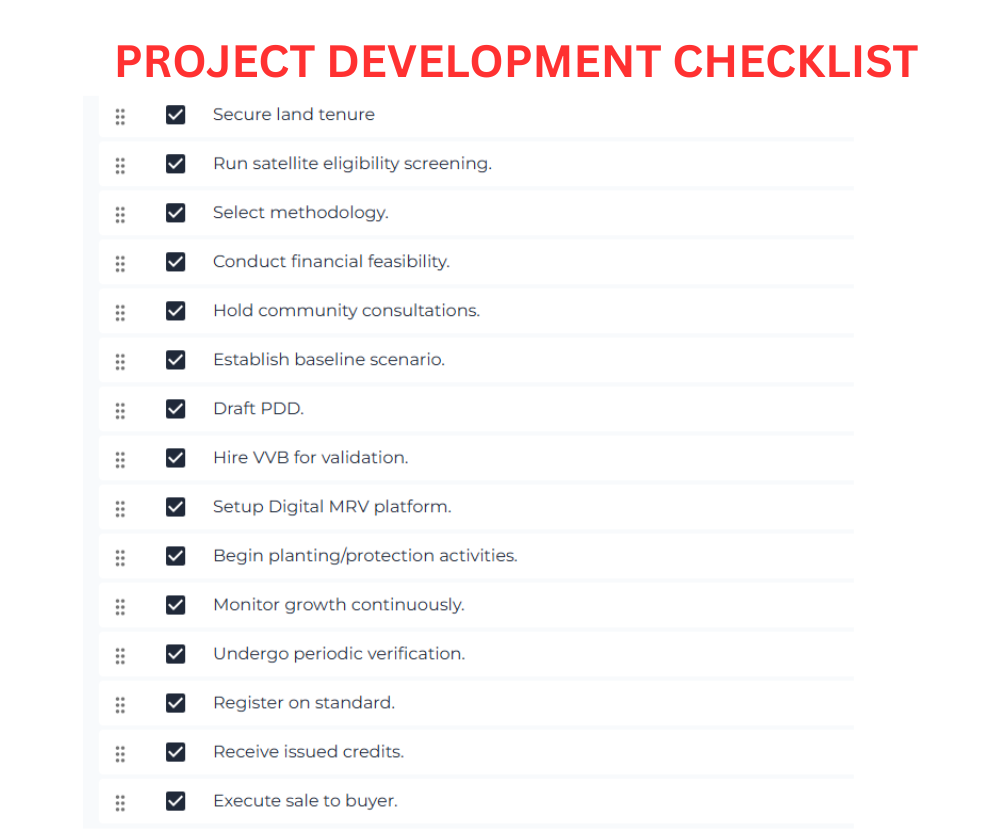
12 Steps to Selling Carbon Credits
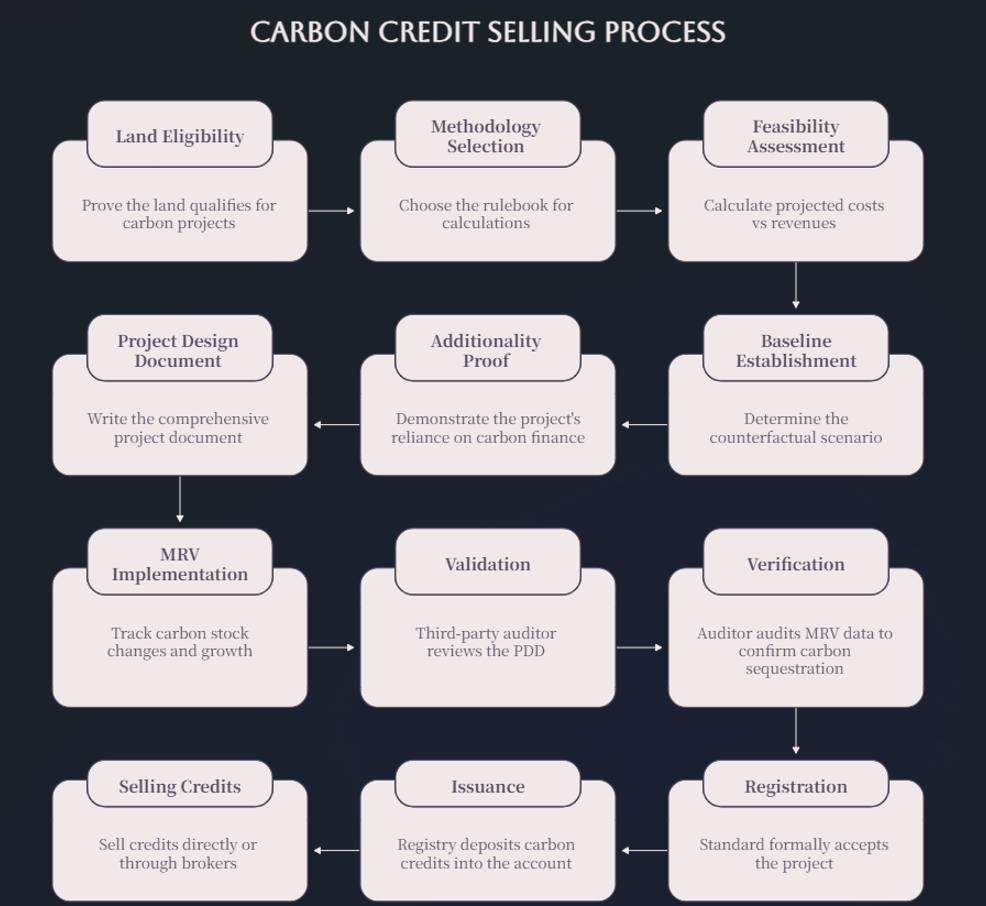
Here is the step-by-step lifecycle of a carbon project, from initial screening to credit sale. Each step has dependencies on the previous one, and cutting corners at any stage will cost you at verification.
Why It Matters
- Step 1 — Land Eligibility: Prove the land qualifies. For ARR, this means historical satellite imagery confirming the land was non-forest for the required period. For REDD+, this means documenting the deforestation threat through deforestation rate analysis, land-use change drivers, and policy context.
- Step 2 — Methodology Selection: Choose the rulebook. The methodology you select dictates your baseline calculation, additionality test, MRV requirements, and crediting period. Getting this right sets the trajectory of the entire project.
- Step 3 — Feasibility Assessment: Calculate projected costs versus expected credit revenues over the crediting period (typically 20–30 years). Include all costs: PDD writing, validation, annual MRV, periodic verification, registry fees, and community obligations.
- Step 4 — Baseline Establishment: Establish what would have happened without the project. The baseline must be honest and defensible. An inflated baseline yields more credits in the short term but creates catastrophic reputational and regulatory risk.
- Step 5 — Additionality Demonstration: Prove the project relies on carbon finance to exist and goes beyond business as usual. This typically requires demonstrating a financial barrier, investment barrier, or regulatory barrier test.
- Step 6 — Project Design Document (PDD): Write the comprehensive master document detailing every aspect of your project. A PDD for a mid-sized ARR project runs to 80–150 pages, covering land boundaries, baseline calculations, additionality evidence, MRV plan, risk assessment, stakeholder engagement, and co-benefits.
- Step 7 — MRV System Implementation: Set up your Monitoring, Reporting, and Verification system. Ideally a Digital MRV platform combining satellite imagery, AI-driven biomass estimation, canopy height mapping, and automated alert systems. MRV must begin at the start of the project activity.
- Step 8 — Stakeholder Engagement and FPIC: Conduct Free, Prior, and Informed Consent (FPIC) consultations with all affected communities. Failed FPIC is a validation-stopper.
- Step 9 — Validation: A third-party VVB reviews your PDD to ensure your project design complies with the methodology. Expect Corrective Action Requests (CARs) — responding thoroughly and quickly keeps the timeline on track.
- Step 10 — Ongoing Monitoring: During the crediting period, continuously monitor the project area. Generate annual monitoring reports documenting carbon stock changes, biomass accumulation, permanence risks, and leakage.
- Step 11 — Verification and Issuance: The VVB audits your monitoring data and confirms the carbon was actually sequestered. Once the VVB issues a verification report, the registry deposits serialised carbon credits into your account.
- Step 12 — Selling Credits: You can sell credits directly to corporate buyers through negotiated forward purchase agreements, through brokers, through carbon exchanges and marketplaces, or through spot market transactions.
Project Development Timeline
Carbon project development is not a quick flip. It requires patience, structured execution, and adequate capitalisation through the pre-revenue phase. Here is a realistic timeline for a mid-sized ARR project.
Why It Matters
- Month 1: Screening and Feasibility — Satellite analysis of land history, initial carbon modeling, land tenure verification, and economic feasibility calculation.
- Month 2: Methodology Selection — Deciding the standard and ruleset, confirming eligibility, and scoping the PDD requirements.
- Month 3–4: PDD Drafting — Writing the Project Design Document, conducting stakeholder consultations, establishing baseline, and documenting additionality.
- Month 5–6: Validation — VVB audits the project design. Expect 30–60 days for VVB review, plus time to respond to CARs.
- Month 7–9: Registry Registration — Formal listing on the registry following successful validation.
- Year 1–5: Monitoring Period — Growing trees, tracking biomass via digital MRV, generating annual monitoring reports, maintaining community engagement.
- Year 5+: First Verification and Issuance — VVB confirms carbon accumulation, registry issues credits based on verified volumes.
- Post-Issuance: Sale and Repeat — Monetizing issued credits, then continuing the monitoring-verification-issuance cycle for the duration of the crediting period.
Pre-Revenue Financing
Most ARR projects take 3–7 years to generate their first credit issuance. Projects must be capitalised to cover development, validation, monitoring, and verification costs during this period. Forward purchase agreements with buyers who pay upfront against future credit delivery are a common financing mechanism.
How Much Does It Cost?
Understanding what drives the costs in carbon project development is essential. The biggest mistake developers make is undercapitalizing the MRV and audit phases — precisely the parts that determine whether your credits actually get issued.
Why It Matters
- Consultants and PDD Writing: Expert fees for carbon modelling, additionality analysis, baseline establishment, stakeholder consultation, and the 80–150 page PDD.
- Validation and Verification Bodies (VVBs): Third-party auditors charge fees for both the initial design validation and every subsequent verification event. Top-tier VVBs charge premium rates.
- MRV Infrastructure: Traditional MRV relies on expensive field surveys. Digital MRV using satellite imagery, AI, and cloud computing cuts ongoing MRV costs dramatically — often by 60–80% — while covering 100% of the project area continuously.
- Registry Fees: Account setup, project listing fees, and per-credit issuance fees charged by Verra, Gold Standard, or the national CCTS registry.
- Field Surveys and Biomass Inventory: Even with digital MRV, some field measurement is required to calibrate models and satisfy VVB requirements.
- Legal and Land Rights: Fees for confirming land tenure, resolving disputes, and drafting carbon rights agreements with landowners and communities.
- Community Consultation and FPIC: Conducting genuine Free, Prior, and Informed Consent meetings and maintaining community benefit-sharing agreements.
Digital MRV Saves Capital
Traditional field-survey MRV creates a 5-year monitoring blind spot between verifications. Digital MRV uses satellite imagery, AI-driven canopy height models, SAR-based biomass estimation, and LiDAR to monitor the entire project area continuously at a fraction of the cost. Projects using digital MRV generate higher quality, more auditable data that buyers trust more and VVBs verify faster.
Due Diligence: What Buyers and VVBs Check
Corporate buyers are terrified of greenwashing. They do not just buy tonnes of carbon; they buy reputational safety and the ability to defend their climate claims in front of boards, investors, auditors, and the press. Every element of your project will be scrutinised.
Additionality
Additionality is the single most important concept in carbon markets and the most abused. A project is additional if the emission reduction or removal would not have occurred in the absence of carbon finance. If the trees would have grown anyway — because the landowner was planning to plant for timber, or because government regulations require reforestation — then the carbon credit has no additionality and no real climate value.
Additionality is typically demonstrated through one of three tests. The Financial Barrier test asks whether the project is financially viable without carbon revenue. If the project earns a decent return from timber or agricultural production alone, it may fail the financial additionality test. The Investment Barrier test shows that carbon finance is the decisive factor that makes the investment attractive. The Regulatory and Institutional Barrier test demonstrates that the activity goes beyond what is legally required.
Common additionality mistakes that Indian projects make include claiming additionality for commercial timber plantations that are profitable without carbon revenue, failing to demonstrate a genuine financial barrier because project economics were not modelled transparently, and retroactively claiming additionality for projects that were already underway before carbon finance was secured. Projects that fail additionality scrutiny not only get rejected at validation — they damage the credibility of the developer for future projects.
Baseline Integrity
The baseline is the counterfactual scenario — what would have happened to the land without the project. The difference between the baseline and the project scenario is the credited emission reduction or removal. A conservative, honest baseline generates fewer credits but creates durable value. An inflated baseline generates more credits in the short term but creates catastrophic risk.
Static baselines are set at project inception and do not change over the crediting period. They can become outdated if conditions change significantly. Dynamic baselines update periodically — typically every 5–10 years — to reflect changing land-use patterns, satellite-verified deforestation rates, and policy changes. Dynamic baselines are more defensible and increasingly preferred by sophisticated buyers.
Control areas are a tool for making baselines more honest. A control area is a geographically similar, unprotected area monitored alongside the project area. Projects that use satellite-monitored reference regions and control areas produce baselines that are transparent, auditable, and resistant to the greenwashing accusations that have plagued opaque, consultant-generated baselines.
Permanence
Permanence refers to how long the carbon stays sequestered. Trees can burn in wildfires. Floods can kill a plantation. Disease can devastate a forest. Illegal logging can reverse decades of carbon accumulation overnight. Climate change itself is increasing all of these risks across Indian landscapes.
The primary mechanism for managing permanence risk is the buffer pool. Before credits are issued to you, the registry withholds a percentage — typically 10–20% depending on risk assessment — into a pooled insurance mechanism. If your forest burns down and the carbon is released back into the atmosphere, the buffer pool credits are cancelled to compensate.
Sophisticated buyers now look for continuous satellite monitoring of project permanence. Satellite-based monitoring can detect fire damage, illegal clearing, disease spread, and flooding in near-real-time, allowing rapid response before reversals become catastrophic. Projects that can demonstrate continuous permanence monitoring command premium prices.
Leakage
Leakage occurs when protecting or planting in one area simply displaces the harmful activity to another area. Activity shifting leakage happens when communities that were farming or logging your project area simply move to adjacent land and continue the same activities there. Market leakage occurs when reducing the supply of timber from one region raises prices, making it more profitable to log elsewhere. Forest displacement is a specific form of leakage where deforestation pressure moves from your protected forest to other forests.
Methodologies require projects to quantify and deduct leakage from their credit claims. A high-integrity project has a transparent, conservative leakage accounting methodology — and satellite monitoring of the project boundary and surrounding landscape to detect displacement.
Co-Benefits and SDGs
Co-benefits are environmental and social benefits generated by the project beyond carbon sequestration. They are not optional extras — they are what separates a $10 commodity credit from a $40 premium credit. Buyers want to put a compelling story in their annual report. A well-documented co-benefit package transforms your credit from a carbon accounting entry into a reputational asset for the buyer.
Biodiversity co-benefits include habitat restoration for native species, creation of wildlife corridors, protection of endangered species, and restoration of ecosystem services. Community co-benefits include jobs created for local communities, income for smallholder farmers, women's empowerment, food security improvements, and access to ecosystem services. Water co-benefits include watershed protection, groundwater recharge, and improved water quality. SDG alignment maps project co-benefits to UN Sustainable Development Goals, making it easy for buyers to incorporate the project into their SDG reporting.
Verification Quality
Verification is the independent audit that confirms your carbon claims are real. The quality of your verification body matters. Not all accredited VVBs are equal — buyers increasingly specify which VVBs they trust. Modern verification increasingly uses satellite data, AI analysis, and remote sensing to validate ground-level MRV data. Projects that invest in digital MRV infrastructure provide VVBs with the data they need to complete verification faster and at higher confidence levels, which translates directly into faster credit issuance.
Carbon Credit Buyer Checklist
Before any corporate buyer signs a purchase agreement, they — or their due diligence advisor — will work through approximately 25 critical questions. Build your project to answer every one of these before approaching buyers.
Why It Matters
- Registry: Is the project registered on a globally recognised registry (Verra, Gold Standard) or the CCTS registry?
- Vintage: What year were the emissions reduced or removed? Buyers increasingly avoid credits older than 5–7 years.
- Methodology: Which methodology was used, and is it approved by the registry for this project type and location?
- Additionality: How is additionality demonstrated? Financial barrier, investment barrier, or barrier test?
- Additionality Independence: Was the additionality assessment conducted by an independent party?
- Baseline: Is the baseline static or dynamic? How was it calculated? What reference data was used?
- Baseline Honesty: Has the baseline been independently reviewed? Is it conservative relative to peer projects?
- Leakage: How is leakage quantified? What is the leakage deduction applied to credit claims?
- Permanence: What permanence risks exist? How large is the buffer pool contribution?
- Monitoring Frequency: How often is the project monitored? Continuous satellite monitoring or periodic field surveys only?
- Satellite Coverage: Is 100% of the project boundary monitored via satellite? What spatial resolution?
- Biodiversity: Does the project have a biodiversity co-benefit assessment? What species are benefiting?
- Community Benefit: How are local communities benefiting financially and socially from the project?
- FPIC: Is Free, Prior, and Informed Consent documented and accessible for buyer review?
- VVB: Who verified the project? Is the VVB accredited and independent from the project developer?
- Verification Report: Is the verification report publicly available on the registry?
- Risk Assessment: Is there a documented risk register covering fire, flood, disease, political, and regulatory risks?
- Retirement: Will the credit be retired in the buyer's name on the public registry at purchase?
- No Double Counting: Is there a corresponding adjustment preventing double-counting against India's NDC?
- MRV Auditability: Can a third party reproduce your carbon calculations from your monitoring data?
- SDG Alignment: Are co-benefits mapped to specific UN SDGs with quantified metrics?
- Impact Reporting: Does the project provide annual impact reports for buyer ESG disclosure use?
- Price Transparency: Is the price competitive with comparable project type, vintage, and registry?
- Forward Purchase: Is the project offering forward purchase contracts with delivery guarantees?
- Developer Track Record: Does the developer have a track record of successfully issuing credits at scale?
Carbon Credit Pricing
One of the most common questions from Indian project developers is: how much will my credits sell for? The honest answer is that carbon credit pricing is not determined by a single market rate — it is determined by a complex interaction of project quality signals that sophisticated buyers evaluate and price accordingly.
The most important pricing factor is project type and methodology. Removal credits — particularly from ARR and blue carbon projects — consistently command significant premiums over avoidance credits. This is because removal credits represent physical carbon drawdown that can be quantified with precision, whereas avoidance credits require trusting a counterfactual baseline. ARR credits from well-managed projects verified with digital MRV regularly sell at $15–$40 per tonne. Blue carbon credits from rigorously verified mangrove restoration projects have sold for $30–$60 per tonne in recent transactions. In contrast, commodity renewable energy avoidance credits that meet only minimum verification standards sell for $2–$8 per tonne.
Biodiversity co-benefits significantly increase prices. Projects that can demonstrate measurable improvements in native species populations, protection of endangered species, or restoration of biodiversity corridors attract buyers from the biodiversity finance community who are willing to pay substantial premiums. The growing Nature Markets — driven by frameworks like the Taskforce on Nature-related Financial Disclosures (TNFD) and the Kunming-Montreal Global Biodiversity Framework — are creating new demand for credits that generate both carbon and biodiversity benefits.
MRV quality is increasingly a pricing factor in its own right. Buyers who have been burned by phantom credits from projects with opaque manual MRV are specifically seeking projects that use continuous satellite monitoring, AI-verified biomass estimation, and digital audit trails. These buyers pay a transparency premium — they are buying not just the carbon, but the ability to defend the purchase to their board and auditors.
Registry choice affects pricing because different registries have different reputations for rigor. Verra and Gold Standard credits are more liquid and typically priced higher than credits from less established registries. ICVCM Core Carbon Principle (CCP) approved credits — which have passed an additional layer of integrity assessment — command the highest prices in the market.
Vintage — the year the emissions reduction or removal occurred — matters significantly. Buyers prefer recent vintages within the last 3–5 years because they represent climate action taken recently. Projects that verify and issue credits promptly after accumulation typically achieve better prices than those banking credits for years before sale.
Community co-benefits resonate strongly with buyers in consumer-facing sectors — fashion, food and beverage, retail, and financial services — whose customers care about the social impact of their company's sustainability choices. A project that employs 500 women from tribal communities, funds children's education from carbon revenue, and restores watershed services that 10,000 farmers depend on is a marketing asset for the buyer. These projects can command 20–50% premiums over comparable projects without documented community benefits.
Project scale also affects pricing dynamics. Very large projects (100,000+ tonnes per year) give buyers the volume they need to meet significant portions of their offset requirements in a single transaction, reducing transaction costs and simplifying procurement. Smaller projects can still access the market through aggregation platforms or brokers, but typically accept lower prices to compensate buyers for the additional procurement overhead.
Common Mistakes to Avoid
The following mistakes are responsible for the majority of stranded Indian carbon projects — projects that spent significant capital on development and failed at validation, verification, or sale.
Why It Matters
- 1. Starting the project before establishing additionality: Planting trees before carbon finance is secured and additionality is documented makes it nearly impossible to prove additionality later. The most common reason Indian ARR projects fail validation.
- 2. Using inflated baselines to maximise credit claims: Projects that set unrealistically high deforestation baselines or biomass baselines will be cross-referenced against satellite data by VVBs and buyers — inflated baselines are increasingly being identified and rejected.
- 3. Ignoring MRV entirely until verification approaches: Carbon must be continuously monitored from the start of the project activity. Attempting to reconstruct monitoring data retrospectively for a verification event produces data that no credible VVB will accept.
- 4. Not retiring credits after purchase: Credits that are sold but not formally retired on the public registry can be resold. Buyers who do not verify retirement are exposed to the risk that the same tonne has been claimed by multiple organisations.
- 5. No documentation of FPIC: Failing to conduct or properly document Free, Prior, and Informed Consent from affected communities is an automatic validation failure for any credible registry.
- 6. No due diligence on land tenure: Projects built on disputed land, leased land without explicit carbon rights, or government land without proper authorisation are structurally invalid. Land tenure problems discovered at validation are rarely resolvable without starting over.
- 7. Ignoring permanence risks: Not accounting for fire risk, flood risk, disease susceptibility, or political risk in the project design and buffer pool calculation leads to unexpected credit cancellations that destroy developer credibility.
- 8. Buying outdated vintages: Selling credits older than 7–10 years as if they are current-vintage is increasingly unacceptable to buyers, even if the credits are technically valid.
- 9. Poor GIS boundary management: Overlapping project boundaries with existing registered projects, protected areas, or other land claims is a common source of validation failures for Indian projects.
- 10. Not checking additionality rigorously before starting: Commercial plantations that generate income from timber or agricultural products often fail financial additionality tests. Screening additionality before committing to development costs saves enormous wasted effort.
- 11. Ignoring leakage in project design: Particularly for REDD+ projects, failing to model and account for activity shifting leakage to adjacent areas results in credit overstatement that is increasingly caught by VVBs.
- 12. Failing to document biodiversity impact: Projects that cannot demonstrate and document biodiversity co-benefits are leaving premium pricing on the table. Biodiversity assessment should be built into the project design from the start.
- 13. Underestimating MRV and verification costs: Projects budgeted assuming traditional field-survey MRV will be cheap typically run into cost overruns that make the project uneconomic. Digital MRV is now the preferred approach precisely because it reduces ongoing costs.
- 14. Treating carbon credits as short-term revenue: Carbon projects span 20–30 years. The developer who commits to a project for the full crediting period and maintains monitoring quality throughout will significantly outperform the developer who treats it as a short-term revenue opportunity.
- 15. Partnering with brokers without transparent pricing: Brokers who aggregate your credits without transparent pricing leave you undercompensated. Always understand the full price chain — what buyers are paying and what you receive.
How AI Is Changing Carbon Credit Due Diligence
Artificial intelligence is fundamentally transforming how carbon credits are generated, verified, and evaluated — and this transformation is particularly significant for Indian nature-based projects where the scale of the landscape makes traditional monitoring methods prohibitively expensive.
Satellite monitoring has moved from periodic snapshots to continuous, automated surveillance of every project area. Platforms combining multiple satellite data streams — optical imagery from Sentinel-2 and Landsat, synthetic aperture radar (SAR) from Sentinel-1, and LiDAR from NASA's GEDI mission — can now monitor entire project boundaries at resolutions of 10 metres or better, updated weekly. This coverage was simply not achievable with traditional field surveys, which covered sample plots representing perhaps 1% of the project area.
AI-driven canopy height models (CHMs) extract three-dimensional forest structure information from satellite data streams. By analysing the texture, shadow patterns, and spectral signatures of vegetation in optical imagery — and cross-referencing with SAR backscatter that penetrates cloud cover — AI models can estimate tree heights across entire landscapes with accuracy comparable to field measurements. When combined with GEDI LiDAR spaceborne data, canopy height estimates can be produced at scales that would take years and hundreds of millions of rupees to replicate with ground-based surveys.
Biomass estimation using AI has moved from species-level field measurement to landscape-scale modelling. Above-ground biomass (AGB) — the primary store of carbon in forest trees — can now be estimated from canopy height using allometric relationships calibrated against field data. AI models trained on thousands of ground plots across diverse Indian forest types can apply these calibrations across millions of hectares, producing biomass estimates with quantified uncertainty bounds.
Dynamic baselines powered by AI represent a fundamental improvement in the integrity of REDD+ accounting. AI-powered dynamic baselines use continuous satellite monitoring of reference regions, machine learning models trained on historical deforestation patterns, and automated detection of land-use change drivers to update baselines periodically. A dynamic baseline that reflects what is actually happening in the landscape is far more defensible to VVBs and buyers than a consultant-generated static baseline set at project inception.
Near-real-time deforestation and disturbance alerts have transformed permanence monitoring. AI systems trained on time-series satellite data can detect forest loss events — from fire, illegal logging, disease outbreaks, or flooding — within days of their occurrence. Projects using these alert systems can respond rapidly to threats, limiting the extent of carbon reversal events and providing buyers with continuous confidence that their purchased credits remain sequestered.
AI anomaly detection is changing how VVBs validate project claims. VVBs can now run AI models that cross-reference project-reported biomass estimates against independent satellite-derived estimates, flagging statistical anomalies that suggest measurement error or misrepresentation. Developer-reported monitoring data that passes AI cross-validation is considerably more credible — and this credibility translates directly into faster verification cycles and higher buyer confidence.
Automated digital MRV platforms generate audit-ready reports that dramatically reduce the human labour cost of verification preparation. Instead of project teams spending weeks compiling monitoring data into VVB-ready formats, digital MRV platforms automate data collection, quality control, calculation, and report generation. This automation cuts the cost and time of verification preparation by 60–80% for projects that have invested in proper digital MRV infrastructure from project inception.
For Indian project developers, the practical implication is clear: projects that invest in AI-powered digital MRV from the start of project activities will generate higher quality data, pass verification faster, command higher prices from buyers who recognise the reduced risk, and achieve significantly better project economics over the full crediting period than projects relying on traditional field survey MRV.
Digital MRV vs Traditional MRV
Relies heavily on manual field visits, tape measures, and spreadsheets. Highly expensive, slow, covers only 1% of the land area (extrapolated), and creates a 5-year monitoring blind spot between verifications. Generates data that is difficult to independently verify. Creates catastrophic audit risk when field teams make measurement errors or sampling design flaws only become apparent at verification.
Uses satellite data, AI models, SAR, LiDAR and cloud computing. Lower long-term costs, continuous monitoring across 100% of the project boundary, near-real-time permanence alerts, and creates an immutable, transparent audit trail. VVBs can independently cross-validate claims. Report generation is automated. The entire data chain from satellite pixel to issued credit is transparent and defensible.
What Makes High-Integrity Carbon Credits?
The market is shifting decisively from volume to quality, driven by the Integrity Council for the Voluntary Carbon Market (ICVCM) and their Core Carbon Principles (CCPs). High-integrity credits share a specific set of verifiable characteristics that distinguish them from commodity credits.
Why It Matters
- Strict Additionality: Irrefutable proof the project needed carbon finance, supported by transparent financial modelling and independent review.
- Conservative and Dynamic Baselines: Baselines that err on the side of under-crediting rather than over-crediting, updated periodically to reflect changing conditions.
- Continuous Monitoring: Satellite-verified biomass and permanence monitoring covering 100% of the project boundary throughout the crediting period.
- Zero Double Counting: Credits registered once, tracked on a public registry, retired in the buyer's name, and covered by corresponding adjustments where required.
- Independent and Top-Tier Verification: Verified by accredited VVBs using methodology-compliant verification procedures and modern data validation tools.
- Transparent Audit Trail: Data chain from monitoring to credit issuance is publicly accessible and independently reproducible.
- Robust Co-Benefit Documentation: Quantified and independently verified biodiversity, community, and ecosystem co-benefits mapped to SDGs.
- Permanence Insurance: Adequate buffer pool contribution and active management of reversal risks.
Future of Carbon Markets in India
India is transitioning from being primarily a supplier for the Voluntary Carbon Market to operating its own compliance market while simultaneously positioning itself as a major Article 6 trading partner. Understanding these parallel developments is essential for project developers making long-term investment decisions today.
The Carbon Credit Trading Scheme (CCTS) is India's domestic compliance market under development. Once fully operational, it will require heavy emitters in regulated sectors to reduce emissions or purchase domestic carbon credits. Developers who have already built registerable projects under Indian methodologies will be positioned to supply this compliance demand.
Article 6 of the Paris Agreement is opening government-to-government carbon trading. India can issue Internationally Transferred Mitigation Outcomes (ITMOs) to foreign governments in exchange for financial or technology transfers. Projects that understand Article 6 mechanics and are designed to be eligible for ITMO authorization will have a significant competitive advantage.
The ICVCM Core Carbon Principles (CCPs) are becoming the global quality standard for voluntary credits. Buyers who have experienced reputational damage from purchasing low-quality credits are now specifically requiring CCP-eligible credits. Indian project developers who build projects to CCP standards will access the premium buyer segment that is willing to pay $20–$50+ per tonne.
Nature markets are expanding beyond carbon. The Taskforce on Nature-related Financial Disclosures (TNFD) and the Kunming-Montreal Global Biodiversity Framework are creating frameworks for companies to disclose and address their biodiversity impacts. Indian project developers who document biodiversity and ecosystem service co-benefits today are positioned to generate revenue from these emerging markets as they mature.
AI and digital MRV will become the standard infrastructure for carbon project monitoring within the next five years. Methodologies are already evolving to require or incentivise satellite-based monitoring. VVBs are integrating AI cross-validation into their verification processes. Projects that have not adopted digital MRV by 2027 will find it increasingly difficult to attract premium buyers or complete verification efficiently.
How Sylithe Helps
How Sylithe helps developers
Sylithe gives project developers tools to screen land eligibility and land history up front, then provides audit-grade dMRV — canopy height mapping, biomass estimation from SAR and LiDAR, dynamic baselines, and near-real-time permanence monitoring — to take a project to verification at a fraction of the traditional cost. Every tonne Sylithe helps generate comes with a transparent, satellite-verified data trail that buyers trust and VVBs can audit. List your project and let the platform do the heavy lifting.
Documents Needed & Checklist
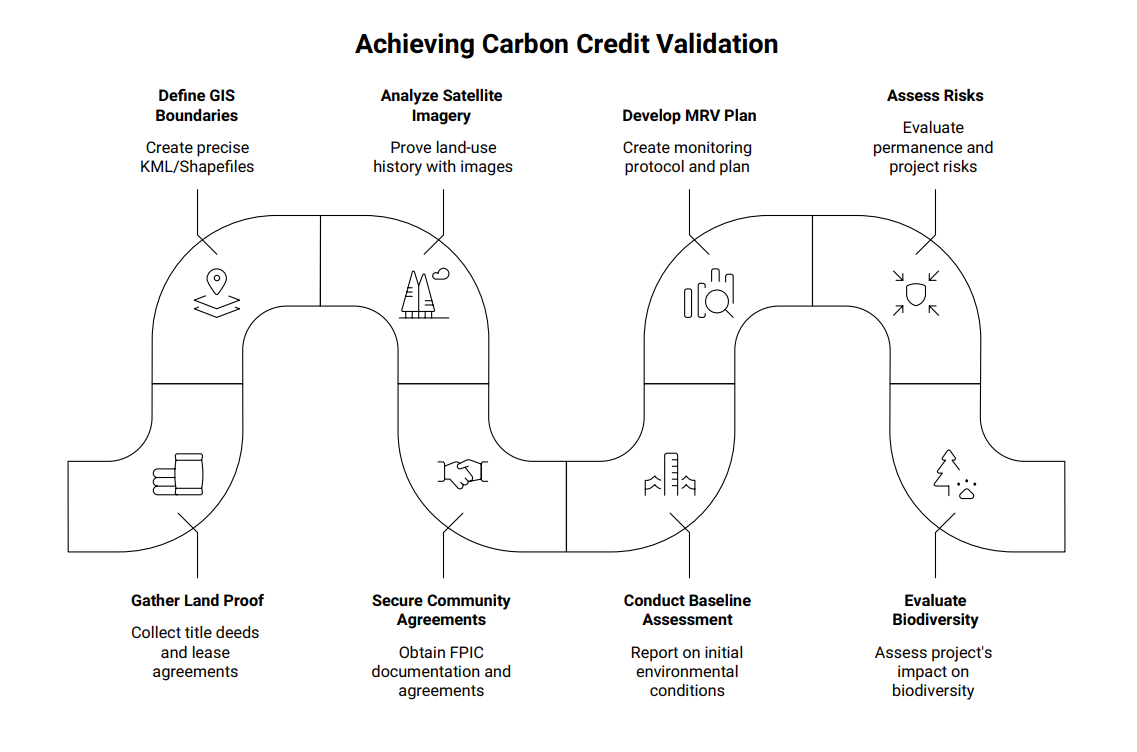
Prepare these documents before engaging a consultant or VVB. Gaps in any of these at validation will cost you time, money, and credibility.
Why It Matters
- Land ownership proof (title deeds, lease agreements with explicit carbon rights provisions).
- Precise GIS boundary files (KML/Shapefiles with accurate, non-overlapping polygon boundaries).
- Historical satellite imagery archive (covering 15–20 years, proving land-use history for eligibility and baseline).
- Community agreements and FPIC documentation (meeting minutes, consent forms, benefit-sharing agreements).
- Baseline assessment report (with methodology-compliant calculations and reference region data).
- Additionality demonstration (financial model, barrier analysis, regulatory review).
- Comprehensive MRV plan and monitoring protocol (covering biomass, permanence, leakage, and co-benefits).
- Risk and permanence assessment (fire, flood, disease, political, regulatory risks with quantified buffer pool contribution).
- Biodiversity impact assessment (species inventory, habitat mapping, co-benefit quantification).
- Stakeholder engagement records (consultation records, grievance mechanism, benefit distribution plan).
- Legal opinions on land tenure and carbon rights.
- The Project Design Document (PDD) — the master technical document integrating all of the above.
- Digital MRV system documentation (satellite data sources, AI models, validation methodology, uncertainty quantification).