 New
New
Every year, organizations announce ambitious net-zero commitments. Yet achieving these goals is becoming increasingly difficult as companies realize that reducing emissions alone is not enough. Some emissions simply cannot be eliminated. This is where Carbon Dioxide Removal (CDR) technologies become essential.
Among the growing list of carbon removal solutions, biochar is quietly emerging as one of the most scientifically credible and permanent options available. While technologies like Direct Air Capture often dominate headlines, biochar combines carbon storage, waste management, regenerative agriculture, and rural economic development in a single process. Despite its growing importance, many sustainability professionals still know surprisingly little about how biochar works or why climate experts consider it one of the most promising carbon removal pathways.
What Exactly is Biochar?
Biochar is a carbon-rich, porous solid material produced when organic biomass is heated at high temperatures in a low-oxygen or oxygen-free environment. The raw materials—known as feedstocks—include agricultural waste such as crop residues and husks, forestry residues like branches and wood chips, sawdust from timber processing, and other organic biomass that would otherwise be burned in open fields or left to decompose.
Instead of burning these materials openly or allowing them to naturally decompose—both of which release stored carbon back into the atmosphere as CO2 or methane—the biomass undergoes a process called pyrolysis. This is the key distinction that transforms ordinary organic waste into a climate solution.
Common Biochar Feedstocks
- Agricultural waste: rice husks, wheat straw, corn cobs, sugarcane bagasse, cotton stalks
- Forestry residues: branches, bark, wood chips, logging slash
- Crop leftovers: post-harvest agricultural residues that would otherwise be burned
- Sawdust and timber processing by-products from mills and woodworking industries
- Energy crops and dedicated biomass grown specifically for sustainable pyrolysis
Understanding Pyrolysis: The Science Behind Biochar
Pyrolysis is a thermochemical process that heats organic materials at temperatures typically between 300°C and 700°C in the absence of oxygen. Without oxygen, the material cannot combust. Instead, the heat breaks down the complex organic molecules into simpler compounds. Think of it as controlled thermal decomposition rather than burning.
The pyrolysis process produces three distinct outputs from a single biomass feedstock. The solid residue—biochar—is the stable, carbon-rich material that forms the basis of carbon removal. A liquid fraction called bio-oil captures energy-rich organic compounds that can be further refined or used as fuel. Finally, syngas is a combustible gas mixture that can be used to generate heat or electricity, often powering the pyrolysis unit itself.
Carbon stored in plants is rapidly released as CO2 and methane back into the atmosphere, contributing to greenhouse gas emissions with no lasting climate benefit.
Carbon is locked into a stable solid structure that resists decomposition for centuries, permanently removing it from the active carbon cycle while generating useful energy by-products.
Unlike ordinary charcoal—which is also produced by heating wood without oxygen—biochar is specifically engineered for long-term carbon storage and environmental applications. The production conditions, feedstock selection, and quality targets are designed to maximize carbon stability and soil compatibility rather than energy output.
"Pyrolysis does not simply burn biomass—it transforms temporary biological carbon into permanent geological carbon, locking it away for centuries."
Why Biochar is Different from Traditional Carbon Offsets
To understand why biochar is gaining recognition in climate finance, it helps to compare it with other common carbon offset approaches. Not all carbon credits are created equal, and the differences in permanence, additionality, and environmental integrity are significant.
Forest Carbon Projects
Forest protection and reforestation projects remain among the most widely traded carbon offsets globally. They hold genuine climate value when implemented correctly, but they carry well-documented limitations. The carbon stored in forests is vulnerable to wildfire, drought, disease, and illegal logging. Once a forest burns or is cleared, decades of sequestration can be erased within days.
Permanence risk is a central challenge in forest carbon accounting. Credits may be issued years before the sequestration is truly permanent, creating financial and environmental liabilities if reversal events occur. Additionally, deforestation can shift geographically rather than stop entirely—a risk known as leakage.
Renewable Energy Credits
Renewable energy credits (RECs) represent the avoided emissions from replacing fossil fuel generation with clean energy. They are valuable and necessary in the energy transition, but they represent emission avoidance rather than carbon removal. They do not remove historical CO2 that is already in the atmosphere. For companies pursuing genuine net-zero pathways, avoidance credits must be complemented by actual removal.
Biochar vs Other Carbon Offset Types
A comparison of key climate attributes across common carbon credit categories.
| Attribute | Forest Projects | Renewable Energy Credits | Biochar |
|---|---|---|---|
| Type | Avoidance / Storage | Avoidance | Removal |
| Permanence | Decades (reversible) | N/A | Centuries (stable) |
| Reversal Risk | High (fire, logging) | Low | Very Low |
| Removes historical CO2 | Partially | No | Yes |
| Co-benefits | Biodiversity, water | Energy access | Soil health, waste reduction |
| MRV complexity | High | Low | Medium-High |
Comparison synthesized by Sylithe Research based on published carbon market literature.
"Biochar does not simply avoid emissions or protect existing carbon stores—it actively removes carbon from the atmosphere and locks it away for centuries."
The Science Behind Long-Term Carbon Storage
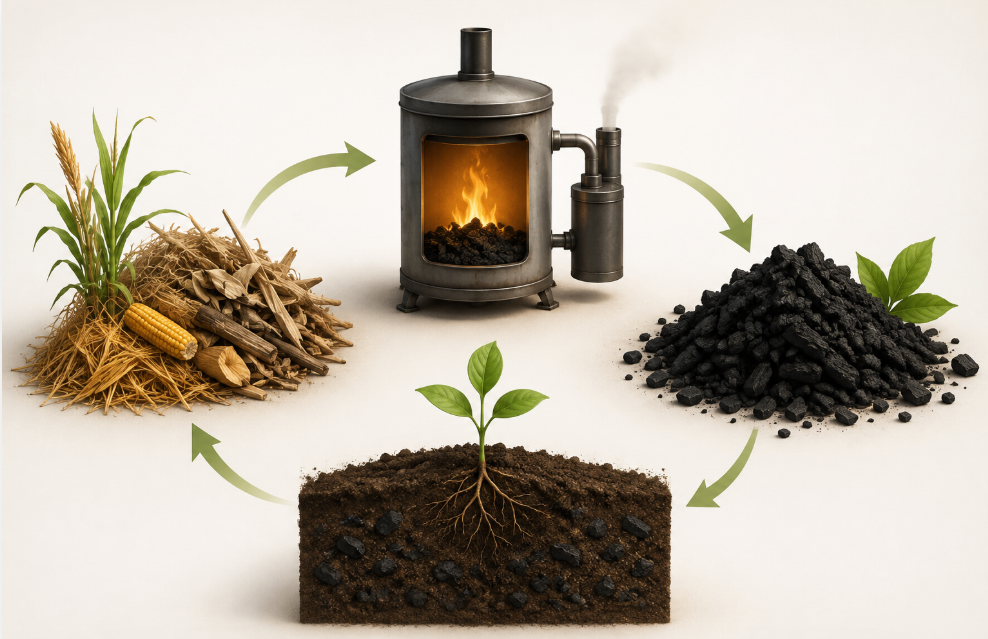
To understand why biochar stores carbon so effectively and for so long, it helps to understand how carbon moves through ecosystems. Plants absorb carbon dioxide from the atmosphere through photosynthesis, converting it into sugars, cellulose, and other biological molecules. This carbon is temporarily held in living biomass throughout the plant's life.
When plants die or residues are generated, two things typically happen. Either the organic material decomposes through microbial activity, releasing the carbon back to the atmosphere as CO2 over years or decades. Or it is burned—intentionally or accidentally—releasing the carbon in days or hours. In both cases, the carbon captured during photosynthesis returns to the active carbon cycle relatively quickly.
Pyrolysis fundamentally disrupts this cycle. When biomass is heated at high temperatures in the absence of oxygen, the biological molecules are broken down and reorganized into a highly stable, aromatic carbon structure. This structure is chemically resistant to microbial decomposition—the same process that breaks down ordinary organic matter in soil. The carbon is no longer in a biologically active form; it has been converted into something closer to charcoal or coal in terms of stability, but with a much more porous and reactive surface.
How Long Does Biochar Store Carbon?
Scientists estimate that biochar can retain carbon in soils for 500 to 1,000+ years under typical environmental conditions. This estimate comes from radiocarbon dating of naturally occurring charcoal and biochar-like materials found in archaeological sites around the world. While the exact duration depends on production conditions, feedstock quality, soil chemistry, and climate, the scientific consensus is that biochar represents one of the most durable carbon storage mechanisms available at reasonable cost.
This durability is a direct result of the aromatic carbon structure formed during pyrolysis. Standard soil organic matter—leaves, roots, compost—has a half-life measured in years or decades. Biochar carbon, by contrast, has a mean residence time measured in centuries. It persists long after the agricultural cycle that produced the feedstock has ended.
"Where most organic carbon cycles back to the atmosphere within decades, biochar converts temporary biological carbon into a form so stable it persists across human generations."
Beyond Carbon Removal: Additional Environmental Benefits
The environmental case for biochar extends well beyond its carbon storage potential. When applied to soil, biochar delivers a range of practical agricultural and ecological benefits that make it genuinely useful independent of its climate function. This multi-benefit profile is one reason it is gaining particular interest in developing agricultural economies.
Healthier Soil
Biochar's highly porous structure creates an enormous surface area within the soil. This porosity provides habitat for beneficial soil microorganisms, improves soil aeration, and enhances the overall biological activity of degraded or compacted soils. Studies across tropical and subtropical agricultural regions have shown measurable improvements in soil microbial diversity following biochar application, particularly in highly weathered, nutrient-poor soils.
Better Water Retention
Biochar's porous structure also dramatically increases the water-holding capacity of soils, particularly in sandy or degraded soils that drain quickly. This is especially valuable in regions facing increasing drought frequency, where improving soil moisture retention directly translates to greater agricultural resilience. Crops growing in biochar-amended soils often show better survival rates during dry periods and reduced dependence on irrigation.
Reduced Fertilizer Dependency
Biochar can improve nutrient retention in soil by attracting and holding positively charged nutrient ions—such as nitrogen, potassium, and phosphorus—reducing the rate at which they are leached away by rainfall. While biochar itself contributes few nutrients, it creates favorable conditions for nutrient cycling and can reduce the total quantity of synthetic fertilizers needed to achieve equivalent crop yields. This has important economic implications for smallholder farmers with limited input budgets.
Reduced Open Burning
Agricultural residue burning remains one of the most significant and intractable sources of air pollution in many agricultural regions globally. Crop stubble, rice husks, sugarcane residues, and other post-harvest materials are routinely burned in open fields due to a lack of economically viable alternatives. Converting these residues into biochar through pyrolysis offers a direct replacement for open burning—reducing particulate emissions, black carbon deposition, and greenhouse gas releases while creating a valuable soil amendment.
Agricultural Waste Utilization and Circular Economy
Biochar production fits naturally into a circular economy model. Organic waste from farms, forests, and food processing facilities—material that would otherwise require disposal or that generates emissions through decay—becomes an input for a value-added product. The bio-oil and syngas produced alongside biochar during pyrolysis can generate energy, further reducing the operational cost of production. Communities and agricultural cooperatives can create local economic value from waste streams that currently have none.
"Biochar does not choose between environmental and agricultural goals—it delivers both simultaneously, transforming waste into long-term value for soil, climate, and community."
Challenges Biochar Still Faces
A balanced assessment of biochar requires honest engagement with the barriers that currently limit its deployment at scale. Despite strong scientific evidence and growing policy interest, the biochar sector faces practical challenges that climate professionals and project developers need to understand.
Key Challenges in Biochar Scaling
- Feedstock availability: Consistent, sustainably sourced biomass supply is not guaranteed in all geographies. Competition for feedstocks with other uses—energy, composting, animal feed—can limit project viability.
- Quality consistency: Biochar properties vary significantly depending on feedstock type, pyrolysis temperature, and production duration. Inconsistent quality makes it harder to standardize carbon accounting and agronomic claims.
- Certification and MRV: Robust monitoring, reporting, and verification frameworks for biochar are still maturing. Methods for measuring carbon permanence and soil application rates are improving but not yet fully standardized globally.
- Scalability: Most current biochar production operates at relatively small scales. Achieving the deployment levels needed to make a meaningful climate contribution requires significant capital investment and infrastructure development.
- Policy development: Carbon markets and regulatory frameworks for biochar credits are still developing. Policy uncertainty affects investment timelines and the commercial case for large-scale projects.
These challenges are not insurmountable. The biochar sector is actively developing solutions across all of them—from mobile pyrolysis units that reduce feedstock transportation costs, to improved certification standards from organizations like the European Biochar Certificate and Verra's biochar methodology under development. The trajectory is toward greater standardization and credibility, but the work is ongoing.
Where the Biochar Industry is Heading
The biochar sector is evolving rapidly, driven by increasing demand for durable carbon removals in corporate net-zero strategies and growing regulatory interest in high-permanence carbon dioxide removal. Several trends are reshaping what biochar projects look like and what standards they are held to.
Emerging Trends Shaping the Biochar Sector
- Mobile pyrolysis units: Compact, transportable pyrolysis systems are being deployed directly at agricultural sites, eliminating biomass transportation costs and enabling smaller-scale distributed production that suits smallholder farming contexts.
- Digital monitoring and carbon accounting: Improved digital platforms are enabling more transparent tracking of feedstock origin, production conditions, biochar application rates, and long-term soil monitoring—strengthening the MRV infrastructure needed for credible carbon credit issuance.
- Stronger certification frameworks: Voluntary standards bodies and carbon registries are developing more rigorous biochar-specific methodologies that address permanence measurement, feedstock sustainability, and co-benefit documentation.
- Integration with regenerative agriculture: Biochar is increasingly being positioned not as a standalone climate intervention but as an integrated component of broader regenerative agriculture systems that improve soil health, reduce synthetic inputs, and build long-term farm resilience.
- Growing corporate demand: As more companies commit to sourcing genuinely durable carbon removals to meet net-zero targets, biochar is attracting increased interest from corporate buyers willing to pay premium prices for scientifically credible, verifiable carbon credits.
"Biochar is not waiting for future technology to become viable. The science works today. What is developing is the infrastructure, standards, and commercial frameworks to deploy it at meaningful scale."
Conclusion
Biochar is not a replacement for emissions reduction. No carbon removal technology is. The fundamental priority of any credible climate strategy must remain rapid, deep decarbonization across all sectors. Carbon removal is a necessary complement to that work—not a substitute for it.
What biochar offers is a complementary solution that transforms unavoidable biomass waste into long-term climate value while delivering multiple environmental co-benefits. When organic matter that would otherwise burn in a field or decompose in a landfill is instead converted into stable carbon and applied to degraded soils, the result is a cascade of benefits: emissions avoided, carbon permanently stored, soils restored, water retained, and rural livelihoods supported.
For sustainability professionals and climate finance practitioners, the key takeaway is that biochar deserves serious consideration alongside other carbon dioxide removal pathways. It is scientifically well-understood, commercially available today, increasingly certified through credible standards, and capable of delivering durable carbon storage that most other removal approaches cannot match.
"Biochar is one of the few climate solutions that works with nature rather than around it—turning what was waste into what becomes permanence."
Monitoring Biochar and Nature-Based Carbon Projects
Whether you are developing biochar carbon projects, regenerative agriculture initiatives, or broader nature-based solutions, Sylithe provides satellite-grade digital MRV, automated monitoring, and investor-ready reporting to support credible carbon accounting and verification.
Biochar at a Glance: Key Facts and Characteristics
A summary of the most important biochar concepts for climate professionals and sustainability practitioners.
| Topic | Key Facts | Why It Matters |
|---|---|---|
| What is biochar | Carbon-rich solid produced through pyrolysis of organic biomass | Stable form of carbon that resists decomposition |
| How it is made | Pyrolysis at 300-700C in low-oxygen conditions | Produces biochar, bio-oil, and syngas simultaneously |
| Carbon permanence | Estimated 500-1,000+ years in soil | One of the most durable carbon removal pathways available |
| Feedstocks | Agricultural residues, forestry waste, sawdust, crop leftovers | Diverts waste from open burning and landfill |
| Soil benefits | Improved structure, water retention, nutrient availability | Supports agricultural resilience and regenerative farming |
| Key challenges | Feedstock consistency, MRV standards, scalability | Active development improving certification and monitoring frameworks |
| Carbon market role | High-permanence carbon dioxide removal credit | Growing demand from corporate net-zero buyers |
Framework synthesized by Sylithe Research based on published biochar literature and carbon market standards.