 New
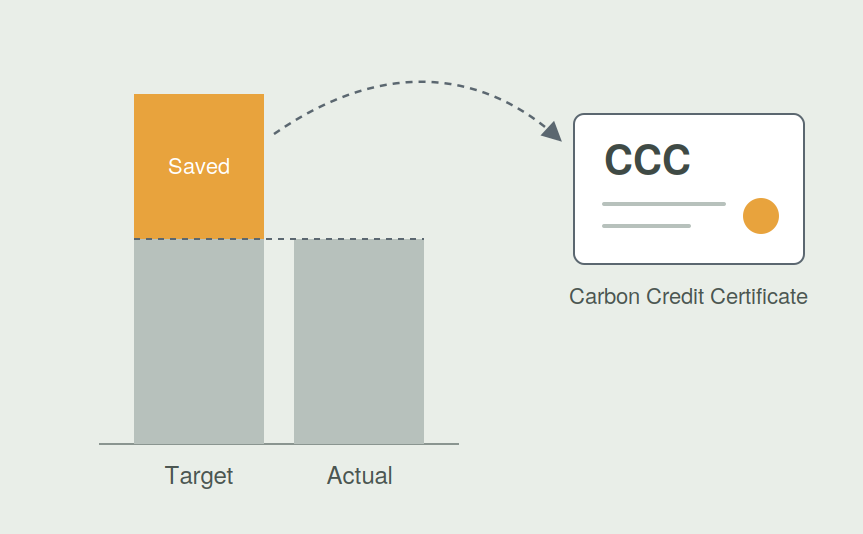
In October 2026, the Bureau of Energy Efficiency (BEE) released the Draft Detailed Procedure for Transaction of CCCs under Compliance Mechanism for public comments. The draft sets out how Carbon Credit Certificates (CCCs) issued under the Carbon Credit Trading Scheme (CCTS) will be registered, traded on power exchanges, settled and surrendered.
CCTS was notified in 2023, and CERC notified the trading regulations in February 2026. The draft addresses the remaining operational questions: how entities register with the ICM Registry, when and how bids are placed, and how trades are settled. The final procedure may differ, but the draft indicates what obligated entities should prepare for.
Draft document
Draft – Detailed Procedure for Transaction of CCCs under Compliance Mechanism
Bureau of Energy Efficiency, October 2026
Who runs carbon credit trading in India
The draft assigns defined roles to four institutions, alongside the participating entities.
Runs the ICM Portal and ICM Registry software, issues CCCs, shares entity data with the Registry and handles cyber security.
Holds CCC accounts, checks every sell bid against holdings, settles trades, extinguishes surrendered CCCs and publishes the defaulter list.
Run the monthly auction, discover the market clearing price and volume, handle pay-in and pay-out, and issue purchase certificates.
Approves exchange bye-laws and fees, and has final say on revocations and any changes to the procedure.
Who can buy and sell carbon credits
The draft lists five types of participants. Only one of them can sell.
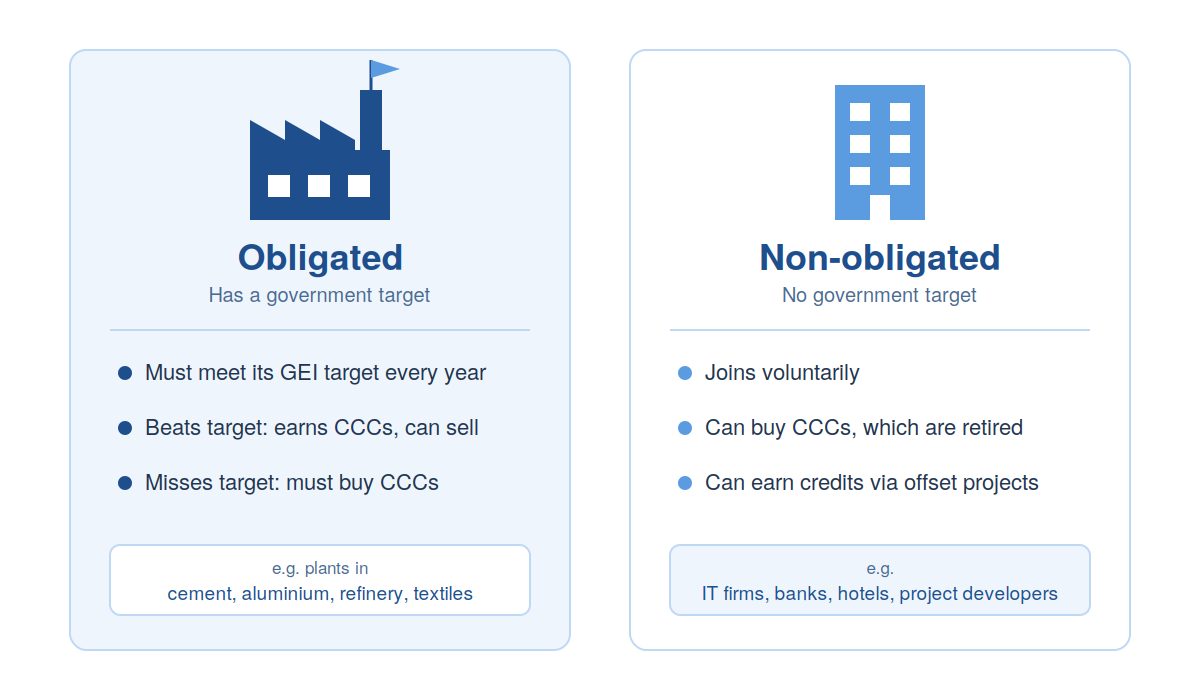
| Participant | Can buy? | Can sell? |
|---|---|---|
| Obligated entity issued CCCs for beating its GEI target | No | Yes |
| Obligated entity that missed its GEI target | Yes | No |
| Obligated entity buying ahead for future compliance years | Yes | No |
| Non-obligated entity (voluntary purchaser) | Yes | No |
| Other entities notified by BEE and approved by CERC | As approved | As approved |
An obligated entity that misses its target must cover the shortfall by buying CCCs from the compliance market, as required by Clause 11(7) of CCTS 2023.
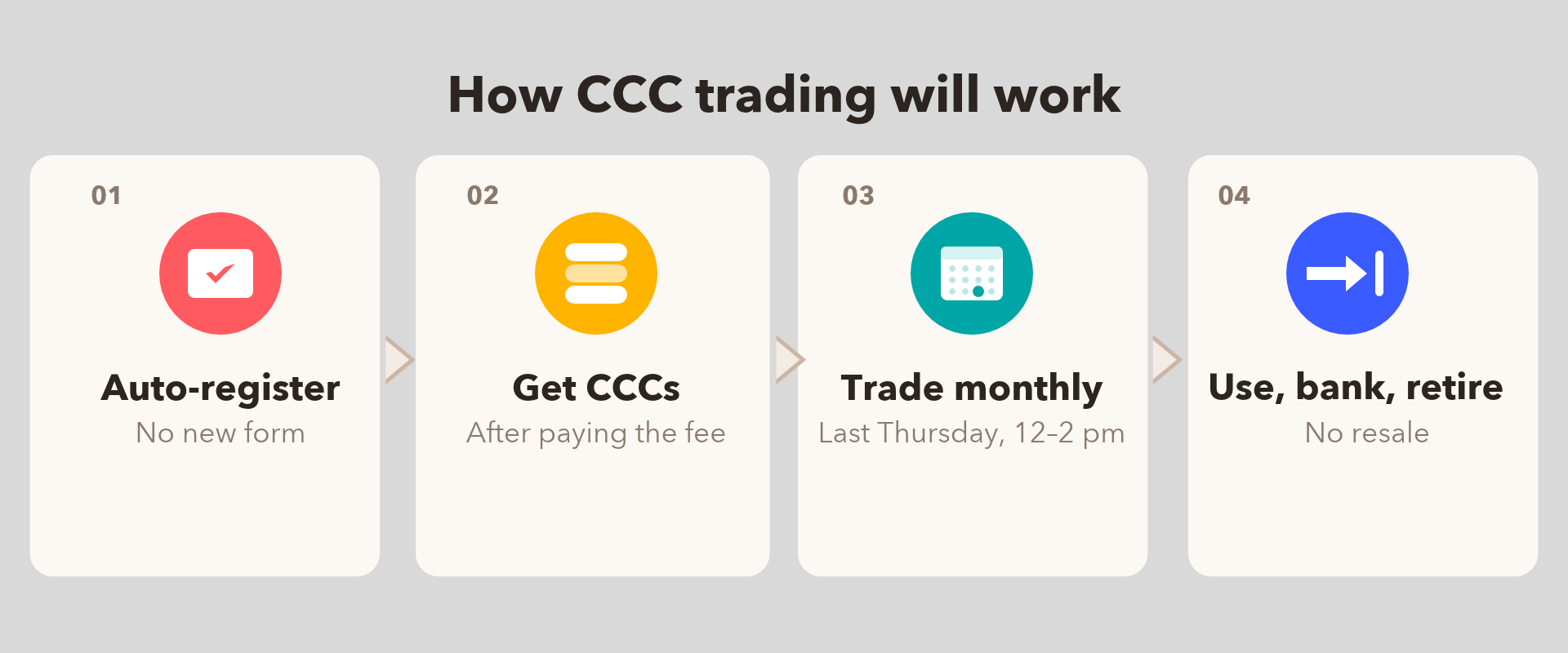
Step 1: Registration would be automatic
There is no new application form. Any obligated or non-obligated entity already registered with BEE on the ICM Portal would be pushed to the ICM Registry through an API. The Registry would then:
- Register the entity using the data already on the ICM Portal.
- Issue an electronic Certificate of Registration for that compliance year.
- Share the list of registered entities with the power exchanges and BEE.
Registration stays valid unless revoked. But entities still need to register within the timeline BEE announces. If the deadline is missed, the Registry may revoke the registration. Sellers would lose access to the exchange, and buyers that needed CCCs would face penalties under the GEI Target Rules, 2025.
Keep your records current
Any change in name or legal status must be reported to BEE within 15 days. Name changes need supporting documents such as a board resolution and the Registrar of Companies certificate. BEE updates legal-status changes within 7 days and passes them on to the Registry and exchanges.
Step 2: CCCs are credited to your Registry account
Once BEE issues CCCs for a compliance year, they land in the entity's Registry account only after it pays the crediting fee (plus GST) set by CERC. All fees are paid electronically, and the Registry sends an invoice through the ICM Portal.
Each certificate gets a unique serial number built from four parts: compliance year, serial number, the obligated entity's registration number and the date of issue. That makes every CCC traceable from issuance to retirement.
From here, the holder has two choices: bank the CCCs for later use, or sell them to another obligated or voluntary buyer before they expire.
Step 3: How a carbon credit trading day works
Under the draft, CCCs trade on the last Thursday of every month. If that day is a public or bank holiday, trading moves to the next working day. BEE would publish the holiday list for each year by 31 December of the year before.
The auction is a closed, double-sided uniform price auction. Buyers and sellers submit sealed bids, and everyone who clears pays or receives the same price. Sellers can bid on several exchanges at once, as long as the total does not exceed what they hold.
Proposed trading session timeline
| Time | What happens |
|---|---|
| 11:00 | Registry freezes every obligated entity's CCC holdings |
| 12:00 – 14:00 | Bidding window open on all exchanges |
| 14:30 | Exchanges send all buy and sell bids to the Registry |
| 15:00 | Registry checks sell bids against holdings and flags defaulters |
| 16:00 | Exchanges publish the market clearing price (MCP) and volume (MCV) |
| 16:15 | Exchanges send the Transaction Confirmation Report to the Registry |
| 16:45 | Registry debits sellers, credits buyers and unfreezes holdings |
| 10:00 next day | Exchanges send the MIS report |
After each session, exchanges must publish demand and supply curves on their websites, giving participants visibility into market conditions. Trades are settled on a First-In-First-Out (FIFO) basis, meaning the oldest CCCs in an account move first.
Step 4: What happens after you buy carbon credits
The draft places firm limits on purchased CCCs. A CCC bought on an exchange cannot be sold again.
Uses CCCs to meet its GEI target. Any excess is banked for future compliance years, but can never be resold.
CCCs are moved into its account and then extinguished straight away. No banking and no resale.
At the end of each compliance year, BEE tells the Registry how many CCCs each obligated entity must surrender. The Registry extinguishes them, and whatever remains is treated as banked CCCs for that year.
CCCs can be issued, banked, sold once and retired. They cannot be resold.
Defaults, bans and revocation
The Registry checks every seller's total bids across all exchanges against its frozen holdings. If the bids exceed the holdings, the seller is treated as a defaulter for that session and all its bids are voided. They are left out of price discovery entirely.
- More than 3 defaults in a quarter leads to a 6-month trading ban.
- 7 working days to fix a default after a Registry notice.
- 14 working days' notice before any revocation.
Registration can also be revoked if an entity fails to pay fees, cannot show it can meet its obligations, breaks the regulations, or is ordered off by CERC, the Ministry of Power or MoEFCC. The proposed process is:
The Registry sends a notice. The entity has 7 working days to fix the default.
If not fixed, the Registry asks CERC for permission to revoke, with BEE's recommendation.
The entity gets at least 14 working days' notice and a chance to present its case.
Existing CCCs stay valid under CCTS but cannot be traded while the revocation lasts.
The Registry would publish the list of barred entities every month. Penalties under the Energy Conservation Act, 2001 and the Environment (Protection) Act, 1986 can apply on top.
What obligated entities should do now
- Read the draft and send comments. This is the stage where industry feedback can still shape the final rules.
- Check your ICM Portal profile. Your Registry account is built from it, so CIN, PAN, GST, TAN and contact details must be correct.
- Budget for the crediting fee. Issued CCCs only reach your account after it is paid.
- Decide early: bank or sell. Sellers need to know their surplus before the 11:00 freeze.
- Never over-bid. Track total sell bids across all exchanges against your Registry balance.
- Plan purchases for the full compliance cycle. Excess CCCs can be banked but never sold back.
Why it matters
Once finalised, these rules complete the trading pipes for India's compliance carbon market. What flows through them depends on how many CCCs BEE actually issues, and that depends on verified emissions data. Every certificate on the exchange traces back to a measured, reported and verified cut in emissions intensity.
Why It Matters
- CCC supply depends on verified GEI performance, so the quality of emissions data now affects revenue.
- Entities that demonstrate reductions early will have certificates to sell; others will buy at the price discovered in the auction.
- With no resale allowed, buyers need to forecast their shortfall accurately. Over-buying locks up cash.
Official References
- Draft – Detailed Procedure for Transaction of CCCs under Compliance Mechanism (October 2026) — Bureau of Energy Efficiency
- Detailed Procedure for Compliance Mechanism under the Indian Carbon Market — Bureau of Energy Efficiency
- Explanatory Memorandum: CERC (Terms and Conditions for Purchase and Sale of Carbon Credit Certificates) Regulations — Central Electricity Regulatory Commission