 New
The Green Credit Programme pays for results, not effort. A company only earns credits if the trees it funds are still standing and the canopy has closed after five years.
The Green Credit Programme is a government scheme in India that rewards companies for restoring degraded forest land. A company takes up a land parcel identified by a state forest department, restores it with trees, and after at least five years can claim Green Credits if the land has reached 40% canopy density. One credit is given for each surviving tree older than five years. Credits cannot be sold, but they can be used once for compensatory afforestation, CSR, or a plantation obligation under law, and shown in ESG reporting. The biggest risk is that the plantation fails, so choosing the right parcel and tracking it every year is essential.
1. What Is the Green Credit Programme?
The Green Credit Programme (GCP) is a scheme run by India's Ministry of Environment, Forest and Climate Change (MoEF&CC). The Green Credit Rules were notified by the Government of India on 12 October 2023 under the Environment Protection Act, 1986.
The official GCP portal describes it as a mechanism to encourage voluntary plantation activity across the country. Forest departments register degraded forest land on a web portal, which builds a "land bank" of areas suitable for planting. Organisations and individuals then pick plantation blocks from this list, restore them, and earn Green Credits as a reward.
Almost anyone can take part. The portal lists government institutions, public sector units, private companies, NGOs, philanthropies, individuals and registered groups of individuals as eligible entities.
Three groups are involved:
- The Ministry of Environment, which makes the rules.
- The Indian Council of Forestry Research and Education (ICFRE), which is the GCP administrator. Its Green Credit Cell in Dehradun runs the portal and registry, sets the methodologies, and issues the credits after verification.
- State forest departments, which register the degraded forest land parcels that can be restored under the scheme.
The company that funds and carries out the restoration is called the applicant. It registers on the portal, picks a parcel, restores it, and later files a claim for credits.
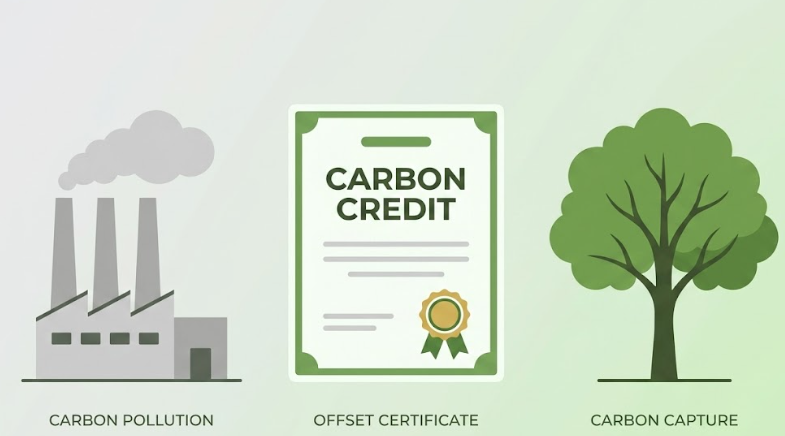
2. Green Credits vs Carbon Credits: What Is the Difference?
People often mix these up, so it is worth being clear.
Green Credits vs Carbon Credits
| Green Credit | Carbon Credit | |
|---|---|---|
| What it represents | A surviving tree on a restored parcel that meets the canopy rule | One tonne of CO2 reduced or removed |
| Run by | Ministry of Environment (GCP) | Carbon standards such as Verra, Gold Standard, or India's CCTS |
| Can it be sold? | No, except between a holding company and its subsidiaries | Yes, in carbon markets |
| Main uses | Compensatory afforestation, CSR, plantation obligations, ESG reporting | Offsetting emissions, compliance targets |
| Time to earn | At least five years | Depends on the project and standard |
The two schemes do not connect. A Green Credit cannot be turned into a carbon credit or used in a carbon market. If you want to understand carbon credits in more detail, see our guide on what carbon credits are.
3. What Changed in 2025?
The first tree plantation methodology came out in February 2024. It was based mainly on tree counts. It referred to a planting density of around 1,100 trees per hectare, and credits could be assessed about two years after planting. The original design also left room for trading credits.
Critics pointed out the problem quickly: counting planted saplings says very little about whether a forest is actually coming back. On 29 August 2025, a revised methodology was notified, followed by guidelines for eco-restoration on 1 September 2025. The main changes, as reported from the notification, were:
- Five years minimum. A claim can only be filed after at least five years of restoration work on the parcel.
- 40% canopy density. The parcel must reach a minimum canopy density of 40% before any credit is issued.
- Surviving trees, not saplings. One Green Credit is awarded for each new tree older than five years. Credits also take into account the change in canopy density.
- No fixed planting density. The 1,100 trees per hectare benchmark was dropped.
- No trading. Credits became non-tradable and non-transferable, except between a holding company and its subsidiaries. Links to carbon markets were ruled out.
- More responsibility on the applicant. Reports on the change say the company seeking credits now has to make sure the plantation is raised and looked after, working with the state forest department that holds the land.
Parcels where a company had already paid against a demand raised under the earlier system continue to follow the earlier arrangements. For anyone starting now, the 2025 rules apply.
In short, the scheme moved from "how many trees did you plant" to "how much forest did you actually grow". That is good for the environment, but it shifts much more risk onto the company.
4. How Does a Company Earn Green Credits? Step by Step
The company registers as an applicant on the Ministry of Environment's Green Credit portal.
State forest departments list degraded forest land parcels available for restoration. The company selects one or more parcels to take up.
The cost of restoration is agreed and paid, and a restoration plan is fixed for the parcel, covering species, planting and protection.
Trees are planted and looked after: watering, protection from grazing and fire, and replacing plants that die.
After at least five years, the company submits a claim report to the administrator in the required format and pays the verification fee.
ICFRE, through designated agencies, checks canopy density and surviving trees. If the parcel meets the 40% canopy rule, credits are issued.
Notice where the uncertainty sits. The company pays and works for five years in steps 3 and 4, but only finds out in step 6 whether any credits will be issued. Everything that happens on the land in between decides the result.
5. How Much Does the Green Credit Programme Cost a Company?
There is no single price, because the cost depends on the parcel: its size, location, soil, slope, rainfall and how much protection it needs. But the costs fall into a few clear groups:
- Restoration cost. Saplings, site preparation, planting, fencing and labour. This is usually the largest part and is fixed when the parcel is taken up.
- Maintenance over five years. Watering, weeding, protection from grazing and fire, and replanting failed patches. Since credits depend on what survives, the applicant has to plan and budget for this.
- Verification fee. Paid to the administrator when filing the claim, at a rate set by the administrator in consultation with the government.
- Monitoring and documentation. Surveys, records and evidence to show how the parcel is doing each year.
- The hidden cost of failure. If the parcel does not reach 40% canopy density, the money already spent may produce few or no credits.
The last point is the one most budgets leave out. A cheaper parcel on poor land can turn out far more expensive per credit than a well-chosen one, because fewer trees survive.
6. What Can You Use Green Credits For?
Under the 2025 methodology, a Green Credit from tree plantation can be exchanged once for one of these purposes:
- Compensatory afforestation, when forest land is diverted for non-forest use under the Van (Sanrakshan Evam Samvardhan) Adhiniyam, 1980.
- CSR requirements under applicable law, based on the cost spent on forest restoration.
- Tree plantation obligations linked to the approval of a project or activity under applicable law.
Credits can also be reported under the leadership indicators of ESG reporting, such as in a company's BRSR. Once a credit has been exchanged, it is extinguished and cannot be used again.
Because credits cannot be sold, a company should only take up as much land as it can use itself, or share within its group through the holding and subsidiary exception. Before relying on credits for any specific obligation, check with the relevant authority that it will be accepted for that purpose.
7. Why Do Green Credit Plantations Fail?
Planting trees is the easy part. Getting them to survive for five years and form a closed canopy is much harder, especially on land that is degraded to begin with. ICFRE inspection reports from 2025, covering 169 sites across 10 states and reported by the investigative outlet ISignal, showed several kinds of problems:
- Unsuitable sites. At least eight sites were found unsuitable, including one that already had dense canopy, one that was already a mature eucalyptus plantation, and several that were too rocky for planting.
- Plans not followed. At some sites, far fewer saplings were planted than approved, or different species were planted from those in the plan, or planting happened next to the approved site instead of on it.
- Land disputes. Some parcels had pending claims under the Forest Rights Act, or led to conflict with local communities who used the land.
- Slow funding. Only a small share of the pledged funds had been used at the time, with delays in releasing money to the field.
On top of this come the usual risks of any plantation: drought, fire, grazing, pests and poor aftercare. Researchers have also warned that a push for fast, dense tree cover can harm grasslands and other open ecosystems that are wrongly labelled as "degraded".
None of this means the scheme cannot work. It means a company has to treat parcel selection and monitoring as seriously as the planting itself.
8. How to Choose a Good Land Parcel
The single best decision a company can make is choosing the right parcel. Before committing, look at:
- Starting canopy. If the parcel already has a lot of tree cover, there is little room to show improvement. If it has almost none on very poor soil, reaching 40% in five years will be hard.
- Land history. Satellite images from past years show whether the land has been cleared, burned, farmed, or encroached on, and whether earlier plantations failed there.
- Soil, slope and water. Rocky ground, steep slopes and low rainfall all reduce survival. Check whether there is any water source for the dry season.
- Ecosystem type. Make sure the land is genuinely degraded forest, not a natural grassland or wetland that should stay open.
- People and rights. Check for pending Forest Rights Act claims, grazing use, and nearby settlements. Disputes can stop work or damage the plantation later.
- Access. The field team needs to reach the parcel all year to water, protect and replant.
Much of this can be checked from the satellite archive before any money is spent, which is far cheaper than finding out in year four.
9. How to Track Canopy Density Over Five Years
Canopy density is the share of the ground covered by tree crowns when seen from above. A 40% canopy means that, looking down on the parcel, tree crowns cover at least 40% of the area.
The mistake most companies make is waiting until year five to measure it. By then, it is too late to fix anything. A better approach is to measure every year and watch every season:
- Baseline in year 0. Record the starting canopy and land condition before planting, so every later change has a reference point.
- Canopy every year. Measure canopy density block by block and compare it with the path needed to reach 40% by year five.
- Health every season. Use regular satellite images to spot blocks where vegetation is drying out or dying, while there is still time to water, protect or replant.
- Ground checks. Visit sample plots to count surviving trees and confirm what the satellite shows.
- Keep the records. Store every map, image and survey with its date, so the full history is ready when you file the claim.
This is the work Sylithe does for companies in the programme. Sylithe screens a parcel from the satellite archive before you commit, tracks canopy density against the 40% target every year, flags failing blocks each season, maps them down to the hectare for your field team, and puts the full record together into one evidence pack at claim time. Sylithe does not issue Green Credits; verification and issue stay with the administrator. You can see how this works on the Green Credit section of our corporates page.
10. Is the Green Credit Programme Worth It for Companies?
It depends on why you are joining.
It makes sense if your company has a real use for the credits, such as a compensatory afforestation requirement, a CSR budget you want to put into restoration, or a plantation obligation linked to a project approval. It also suits companies that want restoration work they can report with measured results, rather than sapling counts.
Think carefully if you are hoping to sell credits later (you cannot), you need results in less than five years, or you do not have the capacity to manage and watch a plantation for that long.
So far, participation has been led by public sector companies in oil, coal and power. Private companies have been slower to join, partly because of the long timeline and the uncertainty over results. Good parcel selection and steady monitoring are the main ways to reduce that uncertainty.
11. Checklist Before You Commit to a Parcel
Get clear answers to these questions before you sign up for a parcel:
- 1.What will we use the credits for?Compensatory afforestation, CSR, a plantation obligation, or ESG reporting? Confirm it will be accepted for that use.
- 2.What is the starting canopy and land history?Check past satellite images for clearing, fire, encroachment or failed plantations.
- 3.Can this land realistically reach 40% canopy in five years?Look at soil, slope, rainfall and water access.
- 4.Is it genuinely degraded forest?Make sure it is not a natural grassland or wetland.
- 5.Are there any rights claims or local disputes?Check for Forest Rights Act claims and grazing use.
- 6.Who will maintain the plantation for five years?Agree clearly with the forest department who does what, and have a plan and a budget for the full five years.
- 7.How will we measure progress every year?Decide now how canopy and survival will be tracked, and how records will be kept for the claim.
Green Credits reward forests that grow, not trees that are planted. The companies that succeed will be the ones that pick the right land and watch it closely for five years.
Plan Your Green Credit Parcel with Sylithe
Thinking about a Green Credit parcel? Sylithe can screen it before you commit and track its canopy every season until claim. Visit sylithe.com/corporates or write to info@sylithe.com.
Sources: Official Green Credit Programme portal (moefcc-gcp.in, About GCP), maintained by ICFRE. Ministry of Environment, Forest and Climate Change, Green Credit Rules, 2023, and the methodology for calculating Green Credit for tree plantation (29 August 2025), as summarised by ANI, Mongabay India and Lexplosion. ICFRE inspection findings as reported by ISignal (2025). Rules may change; check the Green Credit portal for the latest position.