 New
New
What began as two separate ecosystems one driven by law, the other by ambition is merging into a single carbon economy where integrity and verification are the only currencies that matter.
Carbon markets are the essential mechanism for staying within our global carbon budget. By attaching a price to pollution, they convert climate action from a corporate social responsibility expense into a core business consideration one with direct balance sheet consequences.
But for most of the past two decades, this mechanism has operated in two largely separate registers: a compliance world governed by law and penalties, and a voluntary world governed by ambition and reputation. That separation is ending.
Two Markets, One Problem
To understand where carbon markets are going, it helps to understand why they developed in parallel rather than as a single integrated system.
Created by government legislation. Participation is compulsory for covered sectors. Allowances are legal instruments priced by supply-cap scarcity. Non-compliance triggers fines and criminal liability.
Entered voluntarily by companies seeking to demonstrate climate leadership. Credits issued by private bodies like Verra and Gold Standard. Driven by corporate sustainability and investor pressure.
These two markets have historically operated with different instruments, registries, and buyers. A EUA (EU allowance) and a VCS credit (Verra-certified offset) are not interchangeable. But they are increasingly subject to the same institutional demand for verified, permanent, non-double-counted carbon reduction.
The Compliance Engine: Cap, Trade, and Fines
Compliance markets operate on a fundamental principle the cap that is both their greatest strength and the primary source of their price signal. The cap sets a ceiling on total emissions from covered sectors, declining each year to create structural scarcity.
How the EU ETS operates: Allowances (EUAs) are classified as derivatives under MiFID II and traded on regulated venues like the European Energy Exchange (EEX). Most allowances are now auctioned rather than distributed for free, creating a material cost signal for heavy industry.
| System | Coverage | Status | Price Signal |
|---|---|---|---|
| EU ETS | Power, industry, aviation, shipping | Established | €50–100+/t |
| UK ETS | Power, industry, aviation | Established | £30–70/t |
| China ETS | Power sector (phase 1) | Expanding | ¥50–90/t |
| California C&T | Multi-sector, linked with Québec | Established | $20–35/t |
| India CCTS | Energy-intensive industries | Emerging | TBD |
The Voluntary Surge: From CSR to Institutional Asset Class
Demand for the Voluntary Carbon Market (VCM) is expected to grow 15-fold by 2030 and potentially 100-fold by 2050. The capital volumes involved are moving from the sustainability budget to the treasury function from a reputational expense to a financial instrument.
"The era of buying cheap offsets to neutralize a press release is ending. Institutional buyers are now demanding the same level of verification from voluntary credits as compliance auditors demand from EUA surrenders."
Why Carbon Credits Are Becoming Financial Assets
Carbon credits are increasingly behaving like financial assets rather than environmental certificates. Their value depends on quality, scarcity, regulatory acceptance, and buyer confidence.
Institutional investors now evaluate carbon portfolios using many of the same concepts applied to traditional asset classes: risk, liquidity, verification quality, counterparty exposure, and long-term value preservation.
This shift is driving greater demand for transparency, auditability, and continuous monitoring across both compliance and voluntary markets.
Reduction vs. Removal: A Critical Distinction
A fundamental quality distinction is emerging between credits that prevent emissions (Reduction) and credits that actively remove carbon from the atmosphere (Removal). This distinction is reshaping procurement strategy.
Projects that prevent emissions that would otherwise have occurred avoided deforestation (REDD+), clean cookstoves. Lower cost, but subject to additionality and permanence challenges.
Projects that actively extract CO₂ from the atmosphere reforestation, soil carbon, biochar, direct air capture. Higher cost, more verifiable, and increasingly required for Net Zero claims.
The Three Barriers to High-Integrity Carbon
Registry Fragmentation: No single carbon dashboard exists. Managing a credit through to final retirement ensuring it is surrendered once and only once requires operational expertise most teams lack.
**[[Additionality|additionality-carbon-credits-explained]]** Uncertainty: A credit is only valuable if the reduction would not have happened anyway. Counterfactual scenarios are inherently uncertain, eroding confidence where claims are weak.
Methodology Opacity: Technical documentation for a single project can run to hundreds of pages. Opacity makes pricing inefficient and creates information asymmetries that favor sellers over buyers.
Article 6 and the Architecture of Convergence
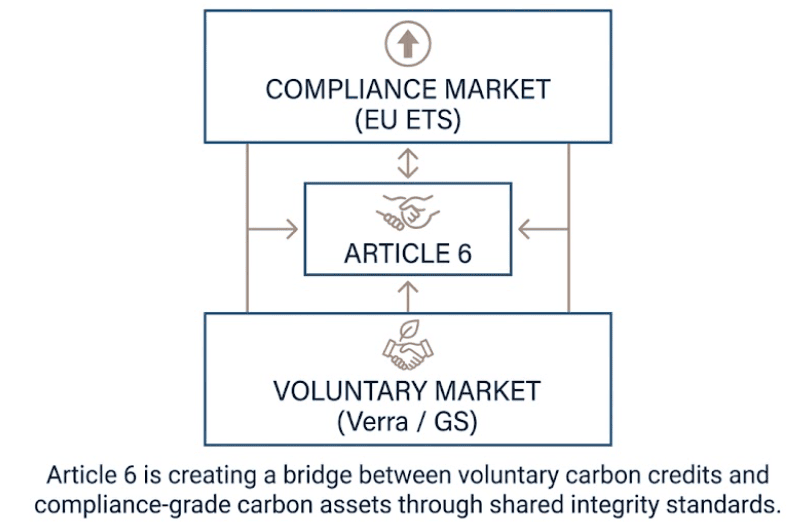
Article 6 of the Paris Agreement builds the bridge between compliance and voluntary markets. High-quality voluntary credits that carry a Corresponding Adjustment verified transfers removed from a national inventory are worth more because they prevent double-counting.
Allowance-based, legally mandated. Hard cap, penalty enforcement, exchange-traded. Sovereign-backed price signal. MiFID II financial instruments.
Project-based, disclosure-driven. Nature-based and tech-based removals. Article 6 corresponding adjustments. Institutional procurement mandates.
The Rise Of The Institutional Carbon Buyer
The profile of carbon market participants is changing rapidly. Early buyers were often sustainability teams focused on voluntary commitments. Today, treasury teams, procurement departments, investment committees, and risk managers increasingly influence carbon purchasing decisions.
Institutional buyers demand stronger evidence, deeper due diligence, and more sophisticated risk assessment. This is accelerating the market shift toward compliance-grade standards even within voluntary markets.
The Sylithe Strategy: Enabling the Full Trade Lifecycle
A successful climate strategy requires end-to-end competence across the full trade lifecycle from target-setting and credit selection through registry operations and monitoring.
01 Strategy & Science-Based Targets: Aligning procurement with science-based trajectories (SBTi) rather than arbitrary offset volumes. Identifying which timeline the strategy must satisfy under BRSR or CSRD.
02 Market Access & Registry Navigation: Securing operational access to EEX, ICE, Verra, and Gold Standard. Building the infrastructure to transact across multiple platforms without reconciliation gaps.
03 Transfer, Retirement & Certificate Management: Managing the physical movement of credits to produce a verifiable retirement certificate. Retirement must be timed to match reporting periods.
04 Controls & Monitoring: Implementing a risk management framework across the trading lifecycle counterparty risk, methodology risk, and permanence risk for nature-based solutions.
The Convergence Timeline: What to Expect
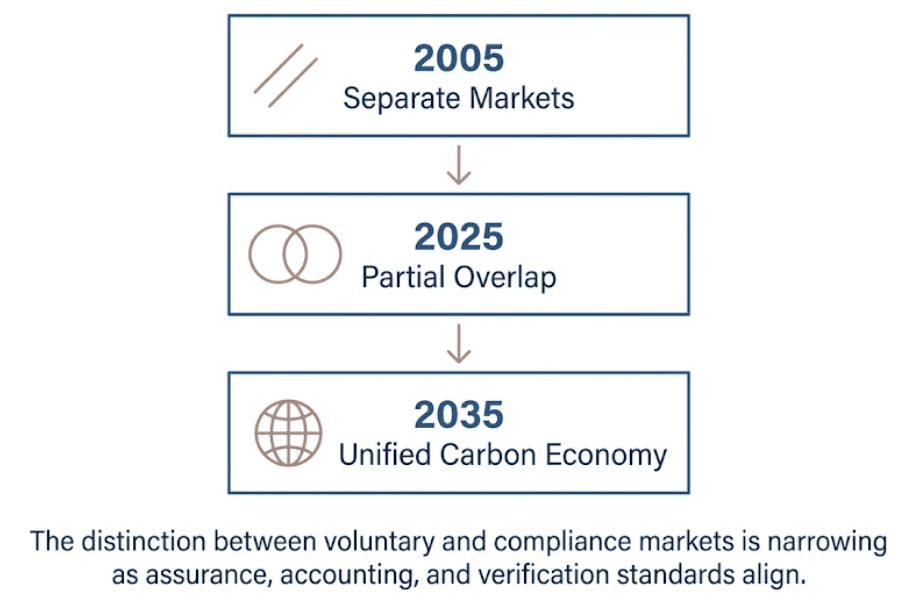
CSRD assurance requirements come into force. Article 6 market infrastructure begins operationalizing. Greenwashing enforcement actions intensify across EU and UK jurisdictions.
China ETS expands into steel and chemicals. EU CBAM fully operational, pricing embedded carbon in imports. Voluntary demand reaches projected 15× 2020 levels.
Most G20 economies operating carbon pricing. Residual emissions from hard-to-abate sectors become the primary demand driver for both compliance and voluntary markets.
The distinction between voluntary and compliance carbon largely dissolves. Carbon accounting is universal, mandated, and audited at the same standard as financial accounting.
The era of voluntary storytelling is ending. Carbon markets are becoming a unified infrastructure one where the integrity of every credit, the verifiability of every retirement, and the permanence of every tonne claimed will be subject to intense scrutiny.
At Sylithe, we provide the verification layer that converts a voluntary claim into a compliance-grade asset. Whether you are navigating EEX auctions, Verra retirements, or the emerging Article 6 corridor, we ensure your carbon position is real, permanent, and audit-proof.
Master the Trade Lifecycle
Struggling with registry fragmentation or trade lifecycle gaps? Contact the Sylithe advisory team for a technical scoping session to secure your carbon position.