 New
New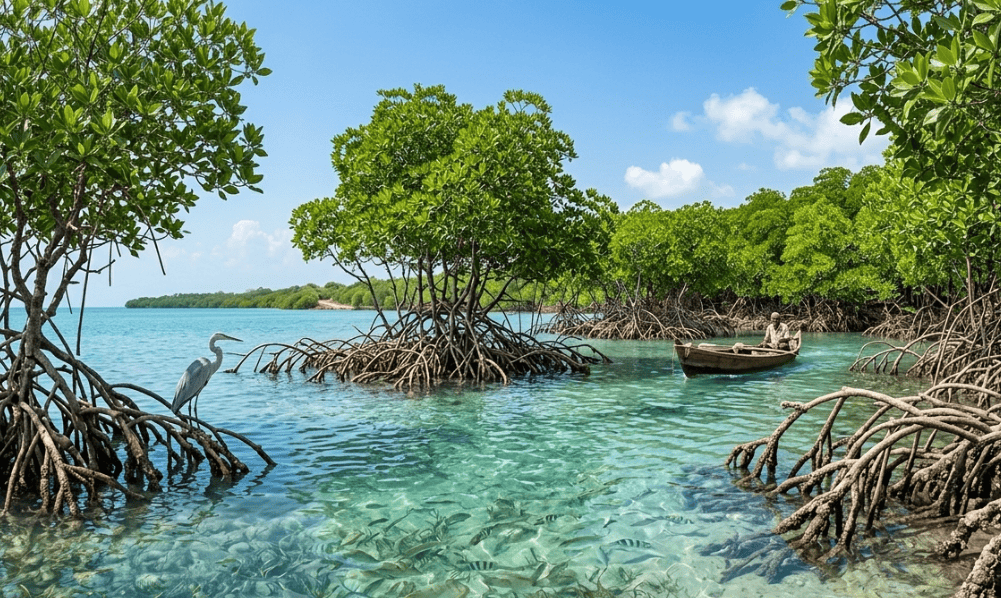
Mangrove ecosystems can sequester and store significantly more carbon per hectare than many terrestrial forest systems, particularly when sediment carbon is included. With 7,500km of coastline, India sits on a blue‑carbon goldmine. The mud is our most valuable climate asset.
While most carbon projects happen on land, the most efficient carbon sinks on Earth are at the water's edge. Coastal ecosystems mangroves, seagrasses, and salt marshes are powerhouses of carbon burial. They don't just store carbon in their wood; they trap organic matter in their root systems and bury it in waterlogged, anaerobic sediments where it cannot rot and release CO2.
For India, Blue Carbon is not just a climate opportunity; it is a national security priority. Our coastline is home to 250 million people who are increasingly vulnerable to rising sea levels and intensifying cyclones. Blue Carbon projects provide the financing needed to restore the 'Bio-Shields' that protect these communities, while simultaneously generating high-value carbon credits.
The Mangrove Miracle: Sequestration at Scale
A mangrove forest is a specialized carbon factory. It lives in a high-stress, saline environment and allocates a massive amount of energy to its root systems (pneumatophores). This 'Below-Ground Biomass' is much larger than in terrestrial trees. But the real magic happens in the sediment.
Because mangrove soils are flooded by the tide twice a day, they are oxygen-poor (anaerobic). In a normal forest, fallen leaves and dead wood rot quickly and release CO2. In a mangrove, they are buried in the mud and preserved. This means a mangrove forest can keep 'Stacking' carbon for thousands of years, creating soil layers that are metres thick and incredibly carbon-dense.
Why Blue Carbon Is Different From Forest Carbon
Forest carbon accounting focuses almost entirely on the carbon stored in tree trunks, branches and leaves – the living above‑ground biomass. Blue carbon, by contrast, adds two massive hidden pools: the dense root systems that extend into water‑logged soils, and the sediments that trap organic material for centuries. Because the sediment is anoxic, carbon decomposition is dramatically slowed, allowing hundreds of tonnes of carbon per hectare to accumulate below the surface. This dual‑pool nature means that a hectare of mangrove can store two to three times the carbon of a mature tropical forest, even if the above‑ground biomass is comparable.
The Four Carbon Pools of Blue Carbon Ecosystems
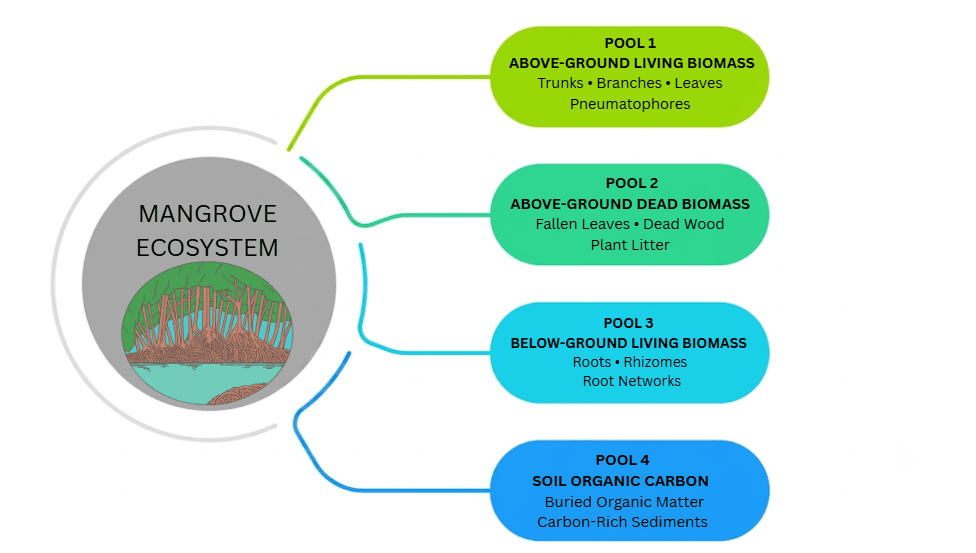
The diagram shows how carbon is partitioned across four pools: above‑ground biomass (tree trunks and leaves), underwater biomass (roots and seagrass rhizomes), root systems, and deep sediment carbon. The sediment pool holds the largest long‑term store because anaerobic conditions dramatically slow decay.
Where India's Blue Carbon Opportunity Actually Exists
Why It Matters
- West Bengal – Sundarbans
- Gujarat – Gulf of Kutch
- Tamil Nadu – Pichavaram & Gulf of Mannar
- Andaman & Nicobar – Mangroves + Seagrass
Why Blue Carbon Credits Trade at a Premium
In the 2026 carbon market, 'Generic' credits are being replaced by 'High-Impact' credits. Blue Carbon is the gold standard of high-impact nature-based solutions. Buyers (particularly in the finance and insurance sectors) are willing to pay $30-$50 per tonne for Blue Carbon because of the 'Insurance Value' it provides to coastal infrastructure.
Why It Matters
- Storm Surge Mitigation: A healthy mangrove belt can reduce the height of a storm surge by up to 30%.
- Fisheries Support: Mangroves and seagrasses are "Nurseries" for 70% of the commercial fish species in the Indian Ocean.
- Water Filtration: These ecosystems trap sediments and pollutants before they reach the open ocean, protecting coral reefs.
The MRV Challenge: Measuring Carbon in the Mud
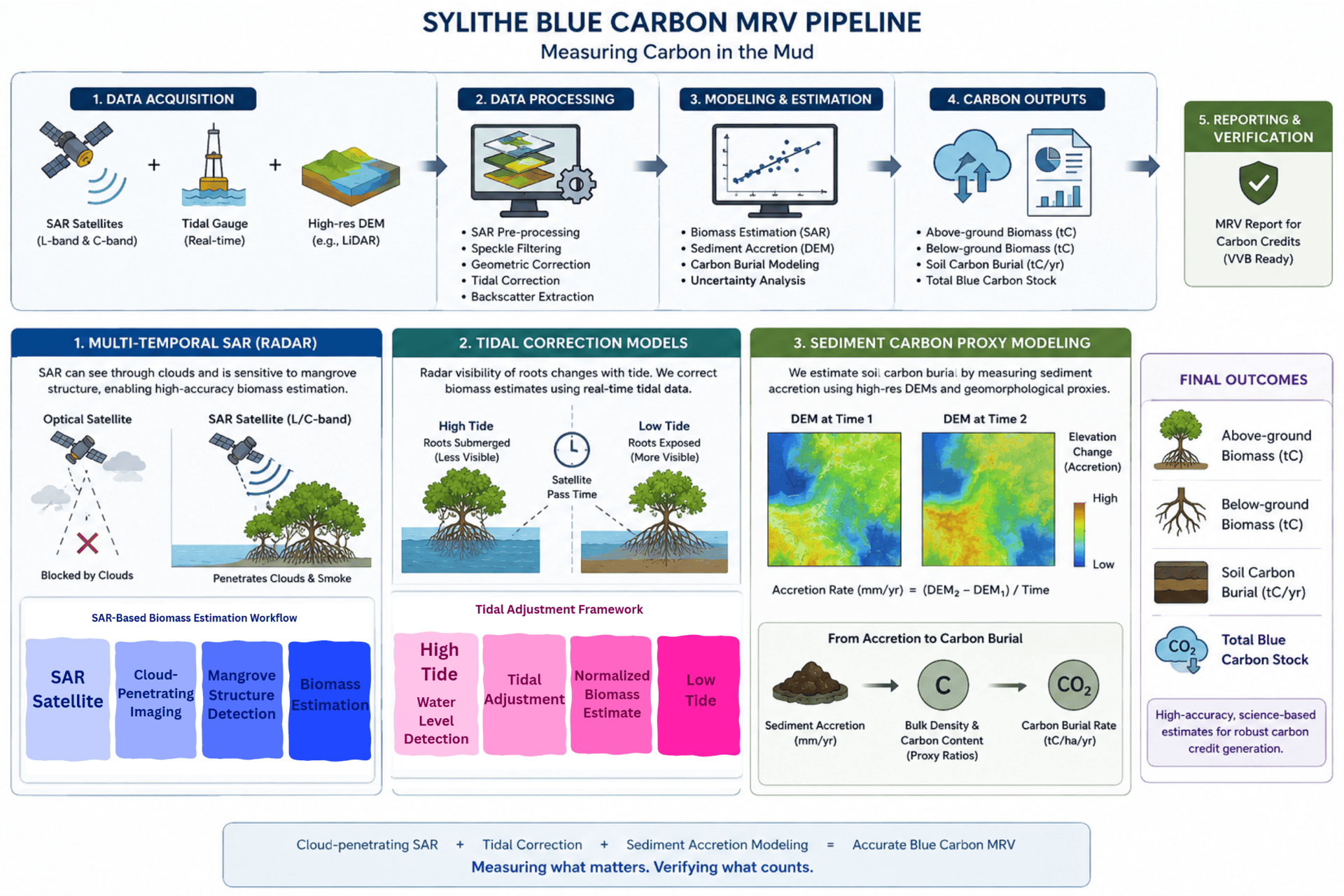
Measuring Blue Carbon is technically harder than terrestrial carbon. You can't just count trees, which is why verifying mangrove carbon from space is a discipline of its own. Sylithe's Blue Carbon monitoring pipeline uses three specific technologies to solve this.
1. Multi-Temporal SAR (Radar)
Mangrove regions are notoriously cloudy. Optical satellites like Sentinel-2 are often useless during the monsoon when most growth happens. We use L-band and C-band Radar (SAR) which can see through clouds and smoke. SAR backscatter is highly sensitive to the complex structure of mangrove roots and branches, allowing us to estimate biomass with 90% accuracy without needing to set foot in the swamp.
2. Tidal Correction Models
If a satellite passes over during high tide, the mangrove roots are underwater and invisible to the radar. If it passes at low tide, they are exposed. We integrate real-time tidal gauge data into our algorithms to 'Correct' the biomass estimate based on the water level at the exact second of the satellite pass.
3. Sediment Carbon Proxy Modeling
Since we can't core every square metre, we use 'Geomorphological Proxies'. We measure the rate of 'Accretion' (how much new mud is being trapped) using high-resolution digital elevation models (DEMs). If a mangrove forest is expanding and trapping sediment, we can use established ratios to estimate the carbon burial rate in the soil.
Seagrass: The 'Hidden' Blue Carbon
While mangroves get the headlines, seagrasses are the unsung heroes of Indian Blue Carbon. India has approximately 500 sq km of seagrass meadows, primarily in the Gulf of Mannar and the Andaman and Nicobar Islands. These meadows sequester carbon in their extensive rhizome (root) networks. Measuring them requires 'Bathymetric Mapping' using specific light bands (Coastal Blue) that can penetrate clear water to see the density of the seagrass on the seabed.
The Path Forward for Indian Coastal States
States like West Bengal, Odisha, and Gujarat have the opportunity to turn their coastlines into 'Climate Resilience Hubs'. By using Blue Carbon finance, they can fund large-scale restoration projects that don't depend on government budgets. The key is to move from 'Small Pilot Projects' to 'Jurisdictional Programs' that cover entire delta systems.
Blue Carbon is not just a credit; it is a coastal defense strategy that pays for itself.
Monetise your coastal restoration
Sylithe provides the most advanced Blue Carbon monitoring pipeline in India. We combine intertidal SAR with tidal-corrected biomass modeling to provide high-integrity verification for mangrove and seagrass projects. If you are ready to unlock the value of India's coastal carbon, we should talk.