 New
New
SEBI has effectively made Scope 3 value chain data a board-level audit item for every company in the Nifty 1000. The clock started in FY2024.
BRSR Core is one of the most consequential regulatory developments in Indian corporate sustainability in a decade and one of the least understood in operational terms. Most sustainability officers know that SEBI requires assured disclosures on nine KPIs. Far fewer have mapped which specific data sources generate those disclosures, what independent assurance actually requires in terms of evidence, or what the value chain data obligation means for their procurement relationships.
This article maps each of the nine BRSR Core KPIs to its data source requirements, explains what reasonable assurance looks like in operational terms for each indicator, and addresses two specific questions that are underappreciated in most BRSR coverage: how nature-based interventions appear in and affect BRSR Core disclosures, and what the RBI's Sustainable Lending Framework for MSMEs means when read alongside BRSR Core value chain obligations.
Which Companies Must Comply With BRSR Core?
The BRSR Core mandate is not applied to all listed entities simultaneously. SEBI has adopted a phased rollout based on market capitalization, ensuring the largest entities lead the adoption curve. For FY2023-24, the top 150 listed companies were required to obtain reasonable assurance. This expands to the top 250 in FY2024-25, top 500 in FY2025-26, and eventually covers the entire top 1000 listed companies in India. Additionally, the value chain disclosure mandate (covering 75% of spend) follows a similar phased approach with a one-year lag, giving companies time to onboard their supply chains.
BRSR Core vs GRI vs ISSB vs CSRD
Global Sustainability Reporting Frameworks Comparison
How BRSR Core compares to international standards.
| Framework | Geography | Mandatory | Assurance Level |
|---|---|---|---|
| BRSR Core | India | Yes (Top 1000) | Reasonable Assurance |
| GRI | Global | Voluntary (mostly) | Varies / Limited |
| ISSB (IFRS S1/S2) | Global | Adoption by jurisdictions | Varies |
| CSRD | European Union | Yes (in EU) | Limited, moving to Reasonable |
The Nine BRSR Core KPIs: A Functional Map
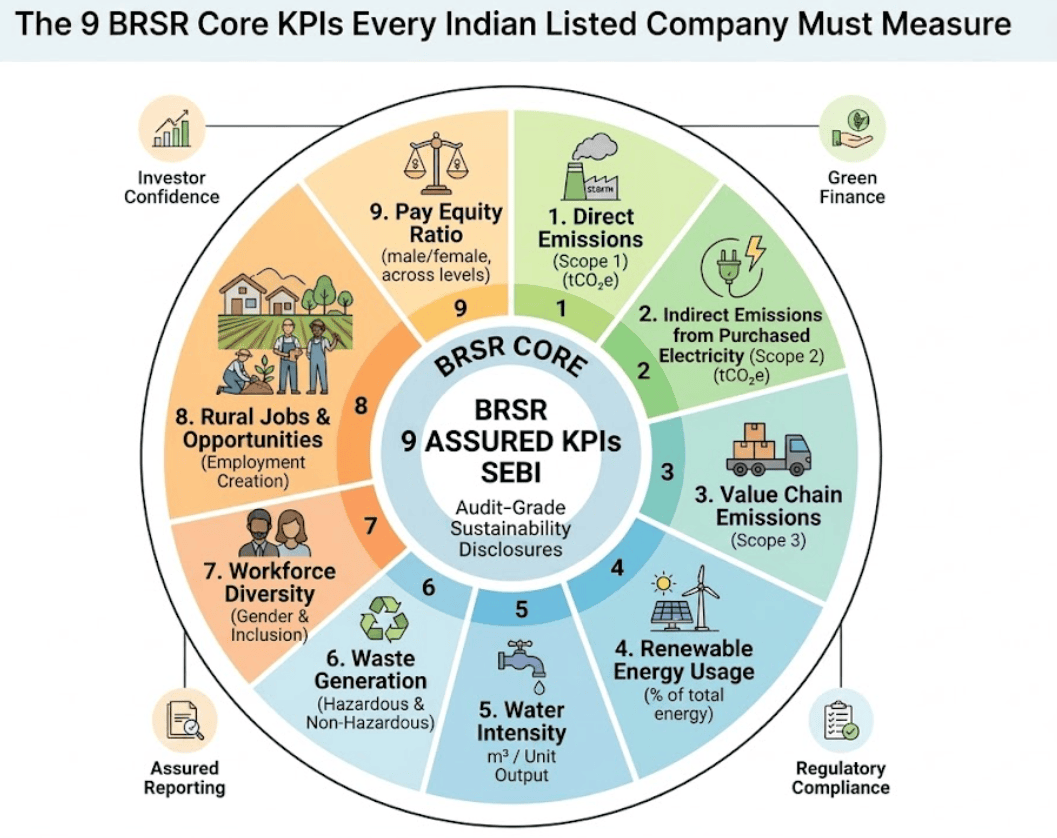
SEBI's circular on BRSR Core identifies nine Key Performance Indicators that must be disclosed with third-party assured data. The nine indicators span GHG emissions, energy transition, resource efficiency, and social equity. For the purposes of this article, we focus primarily on the six environmental KPIs most directly relevant to carbon markets, climate finance, and nature-based solutions.
| KPI | Category | Disclosure Unit | Assurance Standard |
|---|---|---|---|
| 1. Scope 1 GHG emissions | Environmental | tCO₂e per year | Reasonable assurance |
| 2. Scope 2 GHG emissions | Environmental | tCO₂e per year (location & market based) | Reasonable assurance |
| 3. Scope 3 value chain GHG | Environmental | tCO₂e per year (top 75% spend) | Reasonable assurance |
| 4. Renewable energy transition | Environmental | % of total energy from renewables | Reasonable assurance |
| 5. Water intensity | Environmental | Cubic metres per unit output | Reasonable assurance |
| 6. Waste generation | Environmental | MT per year by category | Reasonable assurance |
| 7. Diversity and inclusion | Social | Gender & differently-abled (%) | Limited or reasonable |
| 8. Job creation small towns | Social | Number of jobs created | Limited or reasonable |
| 9. Pay equity ratio | Social | Ratio median to lowest pay | Reasonable assurance |
KPI 1 and 2: Scope 1 and 2 GHG Emissions Data Sources and Assurance
Scope 1 emissions direct emissions from company-owned sources are the most straightforward of the nine KPIs from a data source perspective. Primary data comes from fuel consumption records (diesel, petrol, LPG, coal, natural gas), process emissions data for industrial operations (cement clinker production, steel smelting, chemical manufacturing), and fugitive emission monitoring for refrigerants and methane. The calculation methodology follows GHG Protocol Corporate Standard, using IPCC or sector-specific emission factors.
Reasonable assurance of Scope 1 data requires the assurance provider to test the underlying metering and measurement systems not just verify the calculation spreadsheet. For industrial operations, this means reviewing fuel purchase records, energy meter calibration logs, production tonnage records, and the emission factor selection rationale. It may include physical site visits to verify metering infrastructure. This level of scrutiny is significantly more demanding than the 'plausibility check' that characterises limited assurance.
Scope 2 emissions emissions from purchased electricity and heat require both location-based and market-based calculations. Location-based Scope 2 uses the average grid emission factor for the grid(s) from which electricity was purchased (India's CERC publishes annual national grid emission factors). Market-based Scope 2 uses the emission factor of specific contractual instruments Renewable Energy Certificates (RECs), Power Purchase Agreements (PPAs), or bundled green tariffs. Companies that have purchased RECs or entered renewable PPAs will show lower market-based Scope 2 than location-based and BRSR Core requires disclosure of both.
KPI 3: Scope 3 Value Chain Emissions The Most Demanding KPI
Scope 3 KPI 3 is the most operationally demanding of the nine BRSR Core indicators. It requires companies to calculate GHG emissions from their value chain both upstream (purchased goods and services, transportation, business travel) and downstream (use of sold products, end-of-life treatment) for at least the top 75% of procurement spend.
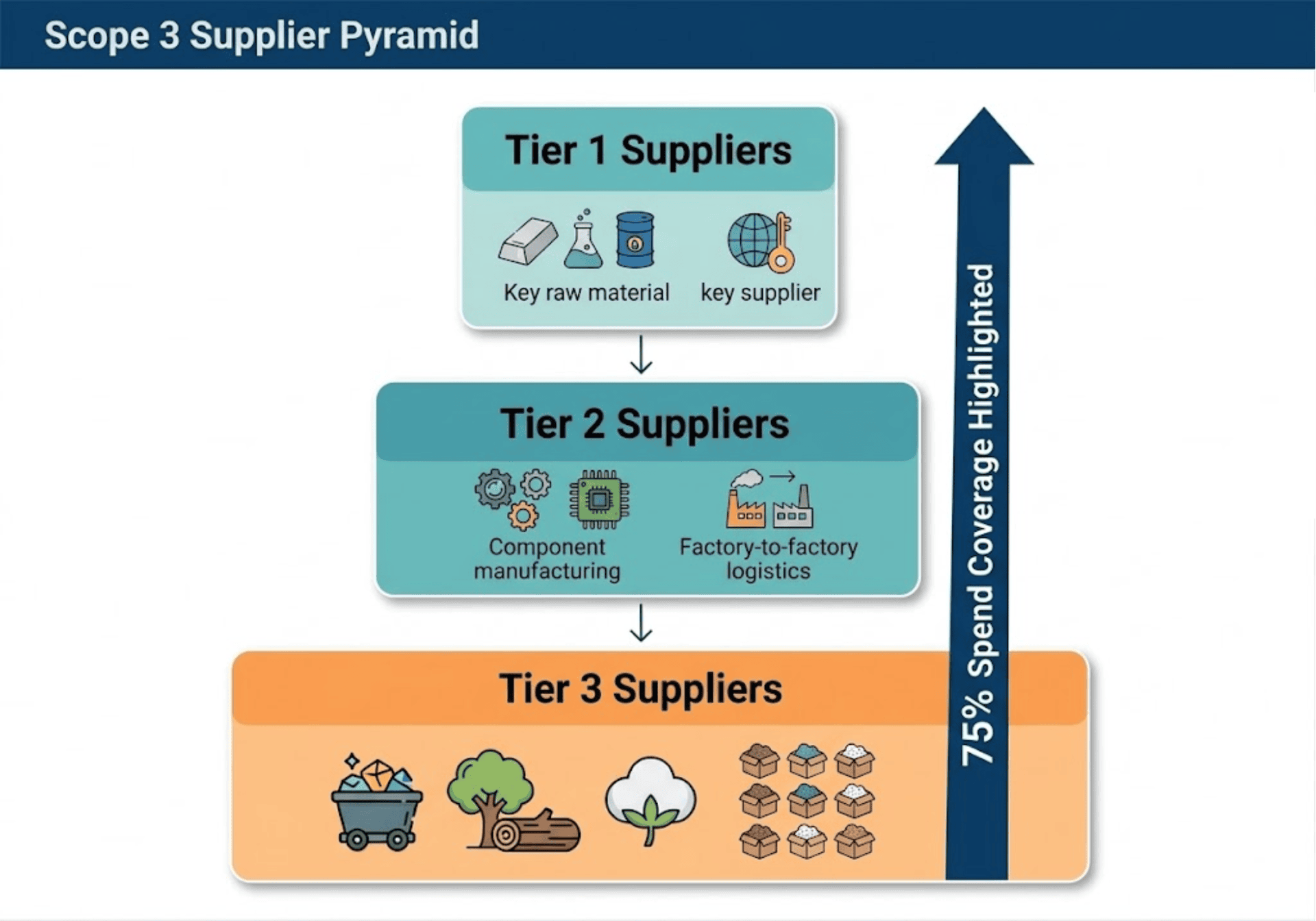
The '75% by spend' rule is a practical scoping mechanism, but it does not make the task simple. For a large Indian conglomerate with procurement spend of ₹5,000 crore across 3,000 suppliers, the top 75% by spend likely involves 600–800 suppliers. Each of those suppliers must either provide primary emission data or be modelled using spend-based or activity-based Scope 3 calculation methods. The accuracy of spend-based methods is significantly lower than primary data but for many companies in the first years of compliance, spend-based estimation is the only practical approach.
Reasonable assurance of Scope 3 data is technically challenging because much of the data originates outside the reporting company's direct control. Assurance providers must evaluate the data collection process, the representativeness of supplier data, the appropriateness of estimation methods used for suppliers that did not provide primary data, and the boundary completeness of the Scope 3 inventory. SEBI has not yet provided detailed guidance on the minimum acceptable Scope 3 methodology for reasonable assurance purposes companies should engage their assurance provider early in the FY to agree on methodology before data collection begins.
What 'top 75% by spend' means operationally
Rank your suppliers by total annual procurement spend. Sum from the top until you reach 75% of total spend. Every supplier in that list must provide Scope 3 emission data or be estimated using an agreed methodology. For most Nifty 500 companies, this means 50–200 supplier engagement campaigns per year. Start with Tier-1; plan for Tier-2 in year three.
KPIs 4, 5, and 6: Energy Transition, Water, and Waste
KPI 4 renewable energy transition requires disclosure of the percentage of total energy consumption sourced from renewable sources, covering both electricity and heat. This drives companies to maintain renewable energy procurement records (REC purchase logs, PPA energy delivery data, rooftop solar generation metering) and document the boundary of what counts as 'renewable' under applicable definitions. For companies with diverse energy sources across multiple facilities, the facility-level aggregation is a significant data management challenge.
KPI 5 water intensity requires disclosure of water withdrawal, water consumption, and water discharge volumes per unit of production or revenue, with breakdowns by water source (freshwater, recycled, rainwater). For water-intensive industries like textile dyeing, beverages, and chemicals, this KPI creates direct connection between BRSR disclosure and emerging regulatory frameworks on water use rights and watershed conservation.
KPI 6 Waste Generation requires disclosure of total waste generated by type (hazardous, non-hazardous, biomedical, e-waste) and waste disposal method. For manufacturing companies, this means integrating waste manifests, disposal contractor records, and recycling certification data into the sustainability reporting system not simply compiling annual totals from memory at year end.
What Reasonable Assurance Actually Looks Like in Practice
Reasonable assurance is the highest standard of independent verification available equivalent in rigour to a financial audit. In practice, it means the assurance provider must obtain sufficient appropriate evidence to conclude, with high confidence, that each disclosed figure is free from material misstatement. For sustainability data, this standard requires access to underlying data systems, direct testing of measurement methodology, evaluation of internal controls, and in many cases, physical site verification.
The difference from limited assurance the standard that characterises most sustainability reporting verification today is significant. Limited assurance requires the assurance provider to conclude that nothing has come to their attention that indicates material error. Reasonable assurance requires them to actively seek and address potential errors. The procedures involved, the documentation required, the time invested, and the cost are all substantially higher under reasonable assurance.
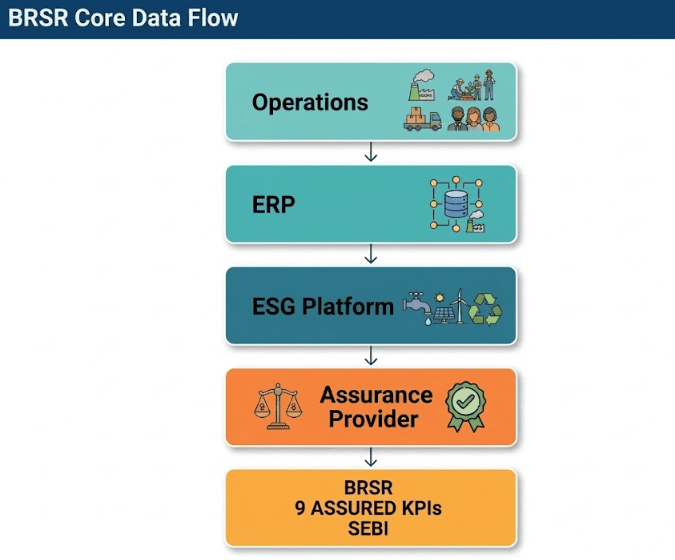
For companies currently disclosing BRSR data with limited assurance or self-reporting, the transition to reasonable assurance for Core KPIs requires a fundamental upgrade to internal data management. Companies need metered data collection rather than estimation; calibrated and documented measurement systems; formal internal controls over data aggregation; and a data management audit trail that an external assurer can independently test. Companies that have invested in digital monitoring infrastructure automated energy metering, digital waste tracking, connected GHG measurement systems will find the transition to reasonable assurance significantly cheaper and faster than companies relying on spreadsheet-based annual data collection.
How Companies Can Prepare For Reasonable Assurance
Why It Matters
- Implement automated metering infrastructure for energy and water.
- Establish clear, documented audit trails from primary data source to final aggregated KPI.
- Deploy dedicated ESG software systems capable of handling Scope 3 data collection securely.
- Onboard suppliers early through capacity building and digital reporting portals.
- Adopt continuous digital monitoring rather than relying solely on end-of-year data collation.
Why Investors Care About BRSR Core Data
The financial sector's interest in BRSR Core goes far beyond regulatory compliance. Institutional ESG funds require robust, comparable data to justify their portfolio allocations. Furthermore, the burgeoning market for sustainable bonds and green loans often ties interest rates or borrowing capacity directly to performance on KPIs like energy transition and water intensity. Credit rating agencies are also increasingly incorporating assured sustainability data into their risk models, directly affecting a company's cost of capital.
How Nature-Based Interventions Appear in BRSR Core Disclosures
Nature-based solutions appear in BRSR Core disclosures primarily through their interaction with the GHG emission KPIs. When a company purchases verified carbon credits from an Indian NbS project afforestation, mangrove restoration, or REDD+ and retires those credits against its Scope 1 or 2 emissions, the disclosure question is: how does this affect the BRSR Core KPI number?
Key Takeaway
The answer depends on which GHG Protocol accounting treatment the company uses. Under the GHG Protocol, 'gross' Scope 1 and 2 emissions are disclosed without offset deductions. Carbon credits are disclosed separately as removals or offsets reducing 'net' emissions but not the gross figure. BRSR Core KPIs as SEBI has specified them require gross emission figures, meaning NbS credit purchases do not reduce the core disclosure number. They do, however, reduce the net emission figure relevant to net-zero claims, sustainability bond frameworks, and investor-facing climate commitments.
Where NbS investments appear most prominently in BRSR is in Principle 6 disclosures biodiversity, ecosystem services, and environmental impact. Companies implementing afforestation, watershed restoration, or biodiversity offset programmes can disclose these activities as positive environmental investments provided they are backed by verifiable monitoring data. An NbS project monitored by Sylithe's dMRV pipeline generates the satellite-verified activity record and co-benefit documentation that makes Principle 6 disclosure audit-defensible under reasonable assurance.
The RBI SLF-MSME Connection: Green Lending and BRSR Data
RBI's Sustainable Lending Framework for MSMEs (SLF-MSME) creates a direct regulatory connection between BRSR Core value chain disclosures and access to green finance for small businesses in the supply chain. Under SLF-MSME, banks offering green loans to MSMEs at preferential rates can require borrowers to demonstrate sustainability performance and the most straightforward way for an MSME to demonstrate sustainability performance is through data collected as part of a large listed company's BRSR value chain disclosure process.
This creates a virtuous circle: large companies need BRSR Scope 3 data from their MSME suppliers; MSME suppliers that provide sustainability data get access to preferential green lending; better MSME sustainability performance improves the large company's Scope 3 numbers. The bottleneck is the data collection infrastructure MSMEs need simple, low-cost tools to measure and report their sustainability performance in a format compatible with both their large buyer's BRSR requirements and their lender's green loan criteria.
BRSR Core is not a disclosure exercise. It is the regulatory architecture that makes sustainability data a financial audit item. Companies that treat it as a compliance checkbox will face assurance failures. Companies that treat it as an infrastructure investment will lead the market.
BRSR Core data readiness assessment
Sylithe supports listed companies mapping their BRSR Core KPI data sources, identifying gaps between current data collection practices and reasonable assurance standards, and integrating nature-based carbon project monitoring into BRSR-defensible disclosure frameworks. If your company is approaching the reasonable assurance requirement for the first time and your data management is not yet audit-ready, we should talk.