 New
New
Every credit bought by a European company from an Indian forest project is now caught in a sovereign accounting crossfire. Here is who wins.
The COP29 agreement in Baku in November 2024 was the moment Article 6 of the Paris Agreement moved from perpetual negotiation to an operational rulebook. After nine years of failed attempts to finalise the carbon trading provisions Glasgow 2021 produced an incomplete text, Sharm el-Sheikh 2022 kicked decisions forward, Dubai 2023 again stalled on methodology authority Baku produced agreed text on the mechanics that actually matter for Indian project developers: corresponding adjustment formats, ITMO reporting standards, Article 6.4 Supervisory Body authority, and the levy structure for the Adaptation Fund.
Coverage of the Baku outcome ranged from triumphalist to cryptic. Most articles cited the agreement without explaining what was actually settled mechanically, or what the implications are for a developer in Odisha or Jharkhand deciding whether to pursue Article 6 authorisation for an existing forest project. This article fills that gap.
We break down what Article 6.2 and 6.4 each settled at Baku, explain the corresponding adjustment mechanic in operational terms, map which Indian project types are eligible and which are not, present real price data from post-Baku markets, and set out what developers must do before India's first ITMO authorisation window opens.
Article 6.2 vs 6.4: Two Mechanisms, Two Outcomes at Baku
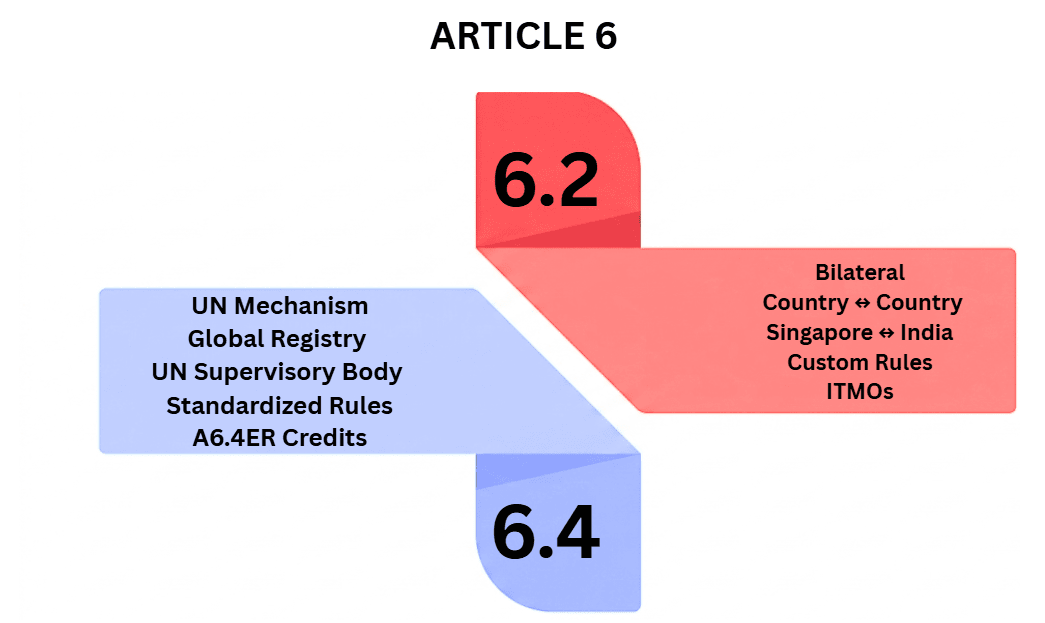
Article 6 created two distinct international carbon trading mechanisms that Baku addressed in different ways. Article 6.2 governs bilateral carbon trading between governments India and Singapore agreeing on project types, verification standards, and transfer volumes. Article 6.4 is a centralised UN mechanism replacing the Kyoto CDM, with a single global ruleset governed by a Supervisory Body. Each has different compliance requirements and market dynamics for Indian developers.
What Article 6.2 settled at Baku
Baku agreed standardised ITMO reporting formats for Article 6.2 bilateral trading specifically the electronic Initial Report (eIR) and First Transfer Report. These documents specify exactly what information must accompany each credit transfer: project identification, vintage year, approved methodology, corresponding adjustment confirmation from both host and acquiring countries, and the emission reduction quantum in tCO₂e. These formats had been in dispute since Glasgow failed to finalise them in 2021. Their finalisation is a genuine operational breakthrough: bilateral carbon agreements between countries can now proceed to actual credit transfers without waiting for additional UNFCCC administrative guidance.
For India, which has been in various stages of bilateral Article 6.2 discussions with Singapore, Japan, South Korea, and the UAE, the Baku outcome clears the administrative pathway for formalising those discussions into executable credit transfer arrangements. Several conversations that had been stalled pending ITMO format clarity are now expected to advance to MOU and bilateral agreement stages in 2025–26. The sectors most likely to feature in early India bilateral agreements are green hydrogen, sustainable transport, and high-integrity nature-based solutions.
What Article 6.4 settled at Baku
Baku granted the Article 6.4 Supervisory Body expanded authority to approve methodologies directly without requiring a full CMA (Conference of the Parties serving as the Meeting of the Parties) decision for each one. This is a structural change from earlier drafts that would have required a COP-level vote for every new methodology, effectively replicating the slowest elements of the CDM. Under expanded Supervisory Body authority, the mechanism can now function more like the Verra Methodology Committee evaluating, consulting on, and approving crediting methodologies on a rolling basis.
Under the CDM, methodology approval took 2–5 years for novel project types. With expanded Supervisory Body authority, the anticipated review cycle is 12–18 months still significant, but operationally viable for project pipeline planning. Indian NbS methodologies for REDD+, agroforestry, and grassland management that have been submitted or are in development for Article 6.4 consideration now have a credible pathway to approval with predictable timelines.
The OMGE levy and Adaptation Fund share what developers must model
Every Article 6.4 credit transfer triggers a mandatory 2% OMGE (Overall Mitigation in Global Emissions) levy those credits are permanently cancelled rather than transferred to the buyer. This ensures the mechanism delivers net atmospheric benefit. An additional 5% of credits goes to the Adaptation Fund as a share of proceeds. Net effect: a project generating 100,000 tCO₂e transfers approximately 93,000 sellable credits. Developers must model these deductions into financial projections gross credit generation and net sellable volume are materially different under Article 6.4.
The Corresponding Adjustment: Mechanics That Every Developer Must Understand
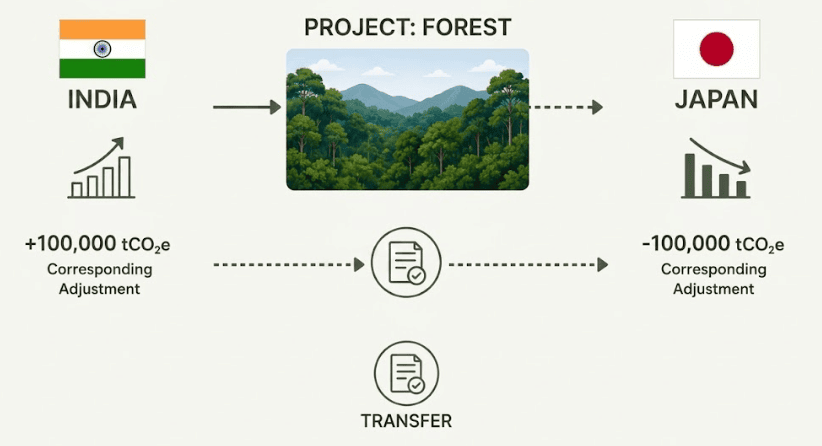
The corresponding adjustment (CA) mechanism is the core architectural innovation of Article 6 relative to the Kyoto CDM. Under Kyoto, a project in India could sell credits to a company in Japan without any deduction from India's national carbon ledger both countries effectively counted the same reduction. Article 6 ends that by requiring that any credit used for NDC compliance by a buyer country must be matched by an upward adjustment in the seller country's national inventory.
In operational terms: an Indian REDD+ project in Odisha generates 200,000 tCO₂e of verified emission reductions in 2025. The developer wishes to sell 100,000 as ITMOs to a Japanese corporation for use in NDC-aligned procurement. India's government through the National Designated Authority authorises the transfer. At the point of transfer, India records a +100,000 tCO₂e upward adjustment in its own national GHG inventory. Japan records a -100,000 tCO₂e claim. One tonne, one sovereign accounting entry, zero double-counting.
The remaining 100,000 credits from the same project not authorised for ITMO transfer can be sold in the voluntary market without corresponding adjustments. India does not adjust its inventory for those credits because it is not authorising their use for NDC compliance by another country. Those credits carry Verra or Gold Standard certification, but not the ITMO designation that commands the sovereign premium. A project can therefore operate simultaneously in both markets selling a portion as ITMOs and the remainder as voluntary credits provided it has BEE or NDA authorisation for the ITMO tranche.
Explore this data interactively below. Sort and filter as needed.
| Credit Type | Buyer Country Records | India Records | Approx. Price (2025–26) |
|---|---|---|---|
| Article 6 ITMO (authorised) | -1 tCO₂e against NDC | +1 tCO₂e inventory adjustment | $18–35/tonne |
| Voluntary credit (not authorised) | No sovereign NDC claim | No adjustment required | $6–12/tonne NbS |
| CCTS domestic credit | N/A domestic compliance only | Internal DC compliance | ₹800–1,200/tonne |
“A corresponding adjustment turns a voluntary carbon claim into a sovereign financial commitment. No government will make that commitment for projects where the data is ambiguous.”
— Sylithe Policy Analysis
Why Governments Care About Double Counting
Double counting was one of the biggest criticisms of earlier international carbon market mechanisms. Without corresponding adjustments, both the host country and the buyer could claim the same emissions reduction, weakening the integrity of global climate accounting.
Article 6 attempts to solve this problem by linking project-level transactions to sovereign carbon inventories. This creates a direct accounting relationship between governments and ensures climate benefits are not claimed twice.
For developers, this means authorization is no longer only a project issue. It is a national accounting issue. Governments must be confident that every exported ITMO aligns with broader NDC strategies and domestic climate targets.
Which Indian Project Types Qualify for ITMO Authorisation and Which Do Not
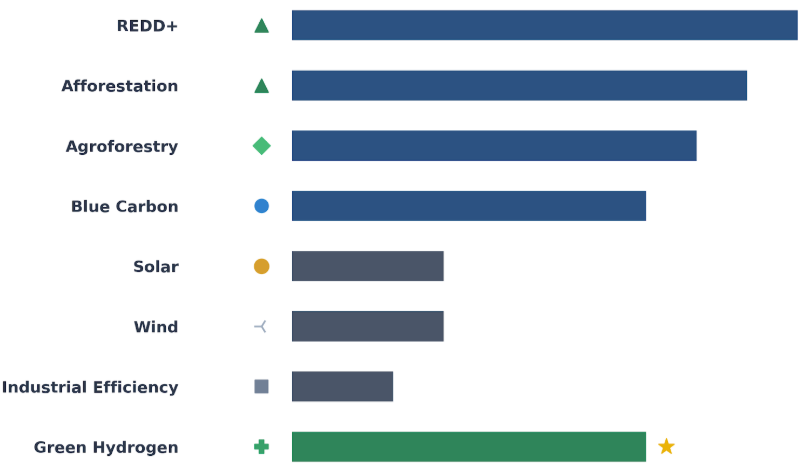
ITMO authorisation in India is not automatic for any project type, including those with existing Verra VCS or Gold Standard certification. Sovereign authorisation is a separate, parallel process controlled by India's National Designated Authority an institution that has not yet published final authorisation criteria but whose emerging framework reflects three filters.
First filter methodology: the project must use an Article 6.4 Supervisory Body-approved methodology or a methodology mutually recognised under a bilateral 6.2 agreement. Verra VCS and Gold Standard methodologies are not automatically equivalent. Some may be accepted under specific bilateral agreements; others will require separate methodology submission to the Supervisory Body. Second filter MRV quality: the project's monitoring data must meet sovereign-grade standards continuous, independently verifiable, uncertainty-quantified. Third filter sectoral reservation: certain sectors are retained by India for its own NDC accounting and are not available for ITMO export.
Why It Matters
- High-integrity REDD+ forest conservation (Odisha, Jharkhand, MP, Northeast India): Strong ITMO candidate priority sector with continuous satellite MRV
- Afforestation and reforestation on degraded land: ITMO-eligible with appropriate methodology; moderate authorisation probability
- Agroforestry and community forestry: ITMO-eligible with approved aggregation methodology and smallholder MRV infrastructure
- Mangrove and coastal blue carbon: Emerging ITMO candidate; pending Supervisory Body methodology approval
- Utility-scale solar and wind: Limited eligibility common practice concerns undermine additionality at scale in 2025–26 market conditions
- Industrial energy efficiency: Primarily channelled to domestic CCTS compliance; limited Article 6 export pathway expected
- Green hydrogen: High-priority bilateral 6.2 sector; likely authorized but requires complex MRV and Scope 3 emission accounting
The Price Premium for ITMO-Eligible Credits: Real Data from Post-Baku Markets
The most commercially significant consequence of the Baku agreement for Indian project developers is the price signal it generates. Before Baku, the ITMO premium was theoretical buyers signalled willingness to pay more for Article 6-authorised credits in principle, but the unsettled mechanics meant no price could be reliably discovered. Post-Baku, the premium is observable in actual broker transactions and bilateral agreement term sheets.
Market data from 2025 shows high-integrity NbS credits with ITMO authorisation in confirmed or advanced bilateral agreements trading at $18–35 per tonne. This range varies by buyer country, project type, vintage year, and the depth of authorisation documentation. High-forest, low-deforestation projects in Northeast India with continuous satellite MRV and multi-year verification records are at the upper end of this range. Projects in early authorisation stages without full MRV documentation are at the lower end.
Equivalent NbS credits on the voluntary market without ITMO designation same project type, same geography, same vintage are trading at $6–12 per tonne. The gap, $12–23 per tonne, is the corresponding adjustment premium. It is real, observable, and growing as ITMO supply remains constrained relative to institutional buyer demand from NDC-compliance-driven purchasers in Japan, South Korea, and Singapore.
For an Indian forest project generating 500,000 tCO₂e annually, the financial arithmetic of ITMO authorisation is significant. Selling all credits at $8 average VCM price generates $4,000,000 per year. Selling 200,000 as ITMOs at $25 and the remaining 300,000 at $8 generates $5,000,000 + $2,400,000 = $7,400,000. The ITMO premium adds $3.4 million in annual revenue from the same physical area of forest, without any change to the project's environmental activities. That differential is the financial case for pursuing Article 6 authorisation.
The dMRV requirement is non-negotiable
India's NDA will only authorise ITMO transfers backed by MRV data unambiguous at sovereign level. Continuous satellite monitoring, uncertainty quantification, and a tamper-proof digital audit trail are required not periodic field audits every five years. Projects monitored by Sylithe's dMRV pipeline have the continuous, independently verifiable evidence chain that authorisation applications require.
How Sylithe Positions Projects for Article 6 Authorisation
The core requirement for Article 6 authorisation independent, continuous, tamper-proof verification at sovereign-grade data standards is the precise problem Sylithe's dMRV platform is built to solve. Our pipeline combines Sentinel-1 SAR and Sentinel-2 optical satellite data, spaceborne LiDAR for biomass verification, AI-driven change detection within days alert capability, and pixel-level uncertainty quantification that meets the confidence interval requirements of institutional-grade reporting.
For project developers preparing for ITMO authorisation, Sylithe provides three specific capabilities. First, the continuous monitoring record that demonstrates no gap in verification coverage the kind of unbroken orbital evidence trail that government regulators can independently audit. Second, the uncertainty quantification documentation that meets Article 6.4 Supervisory Body reporting requirements. Third, the structured audit outputs emission reduction estimates with confidence ranges, methodology compliance records, and data provenance documentation formatted for both domestic BEE registry requirements and international Article 6 reporting standards.
What Developers Must Do Before the First ITMO Authorisation Window
India's NDA is expected to publish formal ITMO authorisation criteria and open application processes in 2026. The developers who benefit from the first authorisation window will be those who began preparation in 2025, not those waiting for criteria publication before assessing their projects. The lead time for upgrading MRV systems, submitting methodology equivalence requests, and building the NDA engagement relationship is measured in years, not months.
Why It Matters
- Audit existing MRV documentation against Article 6.4 Supervisory Body methodology requirements identify gaps before authorisation applications open
- Upgrade monitoring infrastructure to continuous satellite-based systems periodic field audits will not meet sovereign evidence standards
- Engage India's NDA proactively with project data and verification records, before formal authorisation processes are open
- Structure offtake agreements with ITMO contingency pricing clauses specifying price uplift mechanism if authorisation is obtained
- Model the OMGE levy (2%) and Adaptation Fund share (5%) into Article 6.4 credit volume projections
- Determine which bilateral 6.2 agreement pathway aligns with your project type and the geography of your likely buyer
- Assess whether your existing Verra or Gold Standard methodology is eligible for recognition under a relevant bilateral agreement or requires separate Supervisory Body submission
Baku settled the rules. The corresponding adjustment premium is observable in actual transactions. The authorisation queue will fill fast and the projects at the front will have been preparing for two years.
Article 6 readiness assessment
Sylithe helps Indian NbS project developers assess ITMO eligibility, upgrade monitoring systems to sovereign-grade data standards, and build the authorisation documentation that India's NDA will require. If your project has voluntary market credits and you want to understand the pathway to the Article 6 price premium, we should talk.