 New
Most greenbelt carbon numbers in India are estimated from how many saplings were planted. The right answer comes from measuring the trees that are actually standing.
To calculate the carbon stored by a tree, measure its trunk diameter, height and wood density, and use an allometric equation to estimate its above-ground dry biomass. Add the roots using a root-to-shoot ratio from the IPCC tables. Multiply the total dry biomass by 0.47 (the IPCC default carbon fraction) to get carbon, then by 44/12 to convert it into CO2. That gives the tree's carbon stock. Sequestration is the change in that stock over time, so measure again a year later and take the difference. For a greenbelt, do this on sample plots and scale it up to the whole area, using only trees that are alive.
1. What Does Carbon Sequestration of Trees Mean?
Trees take carbon dioxide (CO2) from the air during photosynthesis. They keep the carbon and use it to build their trunks, branches, leaves and roots, and release the oxygen. Roughly half of a tree's dry weight is carbon.
Carbon sequestration simply means this process of taking carbon out of the air and storing it. The bigger a tree grows, the more carbon it holds.
This matters for companies in India for several reasons. Many environmental clearances ask companies to report the carbon taken up by their greenbelt. Listed companies disclose environmental data in their BRSR. CSR teams want to show the climate benefit of their plantations. And at the national level, India has committed to creating an additional carbon sink of 2.5 to 3 billion tonnes of CO2 equivalent through more forest and tree cover by 2030. The Forest Survey of India's India State of Forest Report 2023 estimated that 2.29 billion tonnes of this had been achieved compared with 2005.
2. Carbon Stock vs Carbon Sequestration: What Is the Difference?
These two terms are often used as if they mean the same thing. They do not.
- Carbon stock is the total amount of carbon held in your trees (and soil) at one point in time. Think of it as a bank balance.
- Carbon sequestration is how much that stock increases over a period, usually one year. Think of it as the interest earned that year.
A greenbelt planted 20 years ago may have a large carbon stock but be sequestering very little each year if the trees have stopped growing, or if some are dying. A young plantation may have a small stock but be adding to it quickly.
When a report asks for "carbon sequestration per year", it is asking for the change, not the total. Mixing the two is one of the most common mistakes in corporate reports.
3. Why One Fixed Number Per Tree Does Not Work
Search online for "how much CO2 does a tree absorb" and you will find a single figure per tree, per year. Many companies take that figure, multiply it by the number of saplings they planted, and report the result.
The problem is that trees are not all the same:
- Size matters most. Biomass grows much faster than diameter. A tree with twice the trunk diameter can hold several times more carbon.
- Species matters. Some trees have dense, heavy wood; others have light wood. Two trees of the same size can store very different amounts.
- Age and growth stage matter. Young trees store little. Trees in their fast-growing years add the most each year. Old trees hold a lot but may add less.
- Site matters. Soil, rainfall and care all affect how fast a tree grows.
- Survival matters. A sapling that died in its first summer stores nothing, but it is still counted if you multiply by the number planted.
A fixed number per tree can be wrong in either direction, and an auditor has no way to check it. The better approach is to measure.
4. The Carbon Sequestration Formula, Step by Step
The standard method follows the 2006 IPCC Guidelines for National Greenhouse Gas Inventories (Volume 4, Chapter 4: Forest Land), which countries use to report forest carbon to the UN. It has five steps.
Step 1: Measure the tree
Three things are needed for each tree:
- Diameter (D) of the trunk in centimetres, measured at breast height, which is 1.3 metres above the ground. This is called DBH.
- Height (H) of the tree in metres.
- Wood density (ρ) in grams per cubic centimetre. This depends on the species and is taken from published wood density databases.
Step 2: Estimate above-ground biomass
Cutting down and weighing trees is not practical, so scientists use allometric equations: formulas built from thousands of trees that were measured and then weighed. The most widely used one for tropical trees is from Chave and colleagues, published in Global Change Biology in 2014, based on over 4,000 harvested trees at 58 sites:
Above-Ground Biomass (Chave et al., 2014)
AGB (kg) = 0.0673 × (ρ × D² × H) ^ 0.976, where ρ is wood density in g/cm³, D is diameter in cm, and H is height in m.
Where a local equation exists for a specific species or region in India, it can be more accurate and should be used instead. The authors themselves recommend local diameter-height relationships wherever possible.
Step 3: Add the roots
Roots also store carbon but cannot be measured without digging. The IPCC gives root-to-shoot ratios (R) in Table 4.4 of the Forest Land chapter. Below-ground biomass is the above-ground biomass multiplied by R. Some examples for tropical forests:
IPCC Root-to-Shoot Ratios (Selected, Tropical)
| Forest type | Above-ground biomass | Ratio (R) |
|---|---|---|
| Tropical dry forest | Less than 20 t/ha | 0.56 |
| Tropical dry forest | More than 20 t/ha | 0.28 |
| Tropical moist deciduous forest | Less than 125 t/ha | 0.20 |
| Tropical moist deciduous forest | More than 125 t/ha | 0.24 |
| Tropical rainforest | Any | 0.37 |
| Tropical shrubland | Any | 0.40 |
Total biomass = above-ground biomass × (1 + R).
Step 4: Convert biomass to carbon
Not all of the dry biomass is carbon. The IPCC default carbon fraction is 0.47 tonnes of carbon per tonne of dry biomass (Table 4.3). For tropical and subtropical forests, the range given is 0.44 to 0.49.
Carbon = total biomass × 0.47.
Step 5: Convert carbon to CO2
Reports usually state results in tonnes of CO2, not carbon. A carbon atom weighs 12, and a CO2 molecule weighs 44 (one carbon plus two oxygen atoms). So:
CO2 = carbon × 44/12, which is about 3.67.
5. A Worked Example: How Much Carbon Does One Tree Store?
Take one greenbelt tree with these measurements. We assume a tropical dry forest setting, which is common for industrial sites in much of India.
- Diameter at breast height (D): 30 cm
- Height (H): 12 m
- Wood density (ρ): 0.6 g/cm³, typical for a medium hardwood
Worked Example: Carbon Stock of One Tree
| Step | Calculation | Result |
|---|---|---|
| 1. ρ × D² × H | 0.6 × 30² × 12 | 6,480 |
| 2. Above-ground biomass | 0.0673 × 6,480 ^ 0.976 | 353 kg |
| 3. Add roots (R = 0.28) | 353 × 1.28 | 452 kg |
| 4. Carbon (CF = 0.47) | 452 × 0.47 | 213 kg of carbon |
| 5. CO2 (× 44/12) | 213 × 3.67 | 779 kg of CO2 |
So this one tree holds about 0.78 tonnes of CO2 in total. That is its carbon stock, built up over its whole life so far.
Now say the same tree is measured again a year later. It has grown to 31 cm in diameter and 12.5 m in height. Running the same five steps gives about 865 kg of CO2. The difference, about 85 kg of CO2, is what this tree sequestered in that one year.
This shows why measuring matters. A small change in diameter and height makes a real difference to the result, and a fixed number per tree would miss it completely.
6. From One Tree to a Whole Greenbelt
Measuring every tree on a large site by hand is slow and costly. In practice, the calculation is scaled up in one of two ways.
Sample plots
A field team lays out sample plots across the greenbelt, for example 20 m × 20 m squares spread over the different zones. Every tree inside each plot is measured and its carbon worked out. The average carbon per hectare from the plots is then multiplied by the total greenbelt area.
This works well if the plots represent the whole site. If the plots are placed only in the healthiest patches, the result will be too high.
Satellite and drone, calibrated with plots
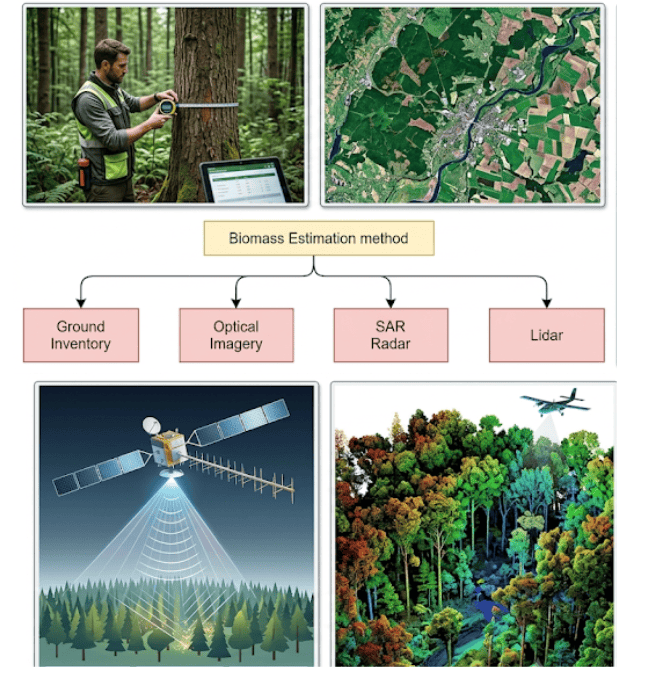
Drones and high-resolution satellite images can count trees and measure their crowns and heights across the whole site. LiDAR adds precise tree heights. The field plots are then used to calibrate these remote measurements, so every tree on the site gets an estimate, not just the ones in the plots. You can read more about this in our guides on biomass estimation methods and canopy height and LiDAR.
This is the approach Sylithe uses for corporate greenbelts and plantations: tree count and height from drone and satellite imagery, calibrated with field sample plots, converted to biomass and carbon with IPCC methods, and reported with uncertainty and the change since the baseline. See how Sylithe monitors corporate greenbelts for the full picture.
7. Do Not Forget the Soil
Trees are not the only place carbon is stored. The IPCC counts five carbon pools on forest land: above-ground biomass, below-ground biomass, dead wood, litter (fallen leaves and twigs), and soil organic matter.
For most greenbelts, trees and roots make up the main part of the change. But soil carbon can also build up under a well-kept greenbelt over time. It is measured by taking soil samples at set depths and testing them in a laboratory. If you include soil carbon, measure it at the start and again later, so you report the change, not just a one-off number. Our guide on soil carbon measurement explains this in more detail.
8. How Accurate Is a Carbon Sequestration Estimate?
Every step in the calculation has some uncertainty. The equation is an average of many trees. Wood density varies within a species. The root-to-shoot ratio is a default. The IPCC itself gives ranges, not single values, for the carbon fraction and root ratios.
This does not make the result useless. It means a good report gives the estimate together with its margin of error, for example "1,240 tonnes of CO2, plus or minus 12%". A number with an honest range is far more credible to an auditor than a precise-looking number with no explanation behind it.
The main ways to reduce uncertainty are to measure more trees, use local or species-specific equations where they exist, and calibrate remote data with good field plots.
9. How to Report Greenbelt Carbon in BRSR and Other Reports
Once you have a number, report it carefully:
- Report it as a removal. Greenbelt carbon should be shown separately from your Scope 1 and Scope 2 emissions. Do not subtract it from them to show lower net emissions.
- Say whether it is stock or yearly sequestration. Be clear which number you are giving, and for which period.
- Explain the method. Name the equation, the IPCC default values used, how many trees or plots were measured, and the date of measurement.
- Give the uncertainty. Include the margin of error, not just the central estimate.
- Keep the evidence. Store the field data, images and calculations so an assurance provider can check them.
If your company is working toward a net-zero target, our guide on how corporate net-zero claims get verified explains why keeping removals separate matters.
10. Common Mistakes in Corporate Tree Carbon Reports
- 1.Counting saplings planted instead of trees aliveOnly measured, surviving trees should be counted.
- 2.Using one fixed number per treeTrees differ hugely in size and species. Measure them.
- 3.Mixing up stock and yearly sequestrationSay clearly which one you are reporting.
- 4.Forgetting to convert carbon into CO2Or converting twice. Carbon × 44/12 = CO2, once.
- 5.Netting removals against emissionsReport greenbelt carbon separately from Scope 1 and 2.
- 6.Putting sample plots only in the best areasPlots must represent the whole site, including weak zones.
- 7.Giving no method or uncertaintyWithout these, the number cannot be checked or trusted.
Tree carbon is not a guess. It is a measurement: diameter, height, wood density, then four simple conversions. The companies that measure will have numbers that hold up.
Measure Your Greenbelt Carbon with Sylithe
Sylithe measures the trees on your greenbelt and plantations with drone, satellite and field data, and reports carbon stock and yearly removals with uncertainty, using IPCC methods. Visit sylithe.com/corporates or write to info@sylithe.com.
Sources: IPCC, 2006 IPCC Guidelines for National Greenhouse Gas Inventories, Volume 4, Chapter 4: Forest Land (Table 4.3, carbon fraction; Table 4.4, root-to-shoot ratios). Chave, J. et al. (2014), "Improved allometric models to estimate the aboveground biomass of tropical trees", Global Change Biology 20(10): 3177-3190. Forest Survey of India, India State of Forest Report 2023. India's Nationally Determined Contribution under the Paris Agreement. The worked example is illustrative and uses assumed measurements.