 New
New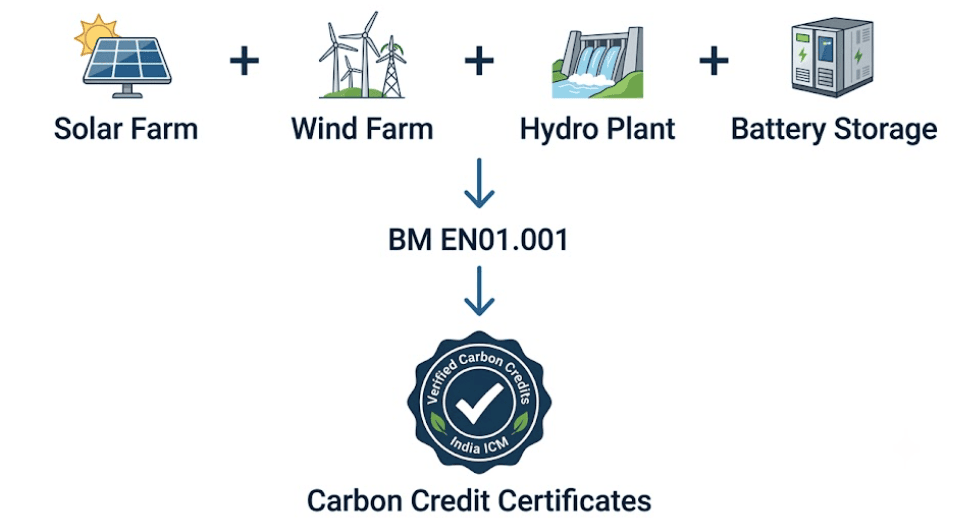
Every megawatt-hour of renewable electricity generated under BM EN01.001 has the potential to displace fossil-fuel-based power and create measurable carbon value. But eligibility, additionality and monitoring quality determine whether that value is realized as verified carbon credits.
Renewable energy is expected to become one of the largest credit-generating sectors within the Indian Carbon Market. BM EN01.001 establishes the rules that determine how renewable projects generate Carbon Credit Certificates under the Offset Mechanism. Understanding this methodology in depth is essential for project developers, investors, carbon advisors and compliance entities seeking to participate in India's growing carbon finance ecosystem.
What Is BM EN01.001?
BM EN01.001 is India's approved methodology for renewable energy projects under the Carbon Credit Trading Scheme (CCTS) Offset Mechanism. It provides the procedural and computational framework through which grid-connected renewable energy generation projects can quantify, verify and issue Carbon Credit Certificates. The methodology is adopted from and refers to the UNFCCC Clean Development Mechanism Methodology ACM0002, as valid from 31 May 2024, and was formally adopted under the Indian Carbon Market on 27 March 2025.
The fundamental climate logic of BM EN01.001 is displacement. When a renewable energy plant feeds electricity into the grid, it displaces electricity that would otherwise have been generated by existing, more carbon-intensive power plants. This avoided emission constitutes the climate benefit that the methodology quantifies and translates into Carbon Credit Certificates.
Why Renewable Energy Matters In India's Carbon Market
India is experiencing one of the most significant electricity demand expansions in the world. A rapidly growing economy, expanding industrial base, rising urbanization and increasing household electrification are driving electricity demand upward at rates that require massive additions to generation capacity. Estimates suggest India's electricity demand could triple or more by 2050 as the economy scales and energy access deepens.
Historically, this demand has been met primarily through coal. India has one of the largest coal-based power generation fleets in the world. Coal accounts for approximately 70% of India's electricity generation, making the power sector the country's single largest source of greenhouse gas emissions. The carbon intensity of India's grid, measured in tonnes of CO₂ per megawatt-hour, remains among the highest of any major economy.
Decarbonizing the power sector is therefore central to any credible Indian climate strategy. Recognizing this, India has set among the world's most ambitious renewable energy deployment targets. The Panchamrit targets announced at COP26 include reaching 500 gigawatts of non-fossil electricity capacity by 2030, with approximately 450 GW expected to come from solar and wind. Achieving this target requires adding renewable capacity at a pace with no historical precedent in Indian energy infrastructure.
India's long-term Net Zero 2070 commitment requires the power sector to complete a near-total transition away from unabated coal generation over the coming decades. While the transition timeline is longer than that of many developed economies, reflecting India's development context, the scale of investment required is enormous. Estimates suggest several trillion dollars of clean energy investment will be needed between now and 2070.
Carbon finance plays a specific and important role in this investment landscape. For many renewable energy projects, the core economics are already improving rapidly as technology costs fall. But not all projects in all locations are straightforwardly commercially viable. Projects facing higher development costs, more challenging grid connection requirements, less favorable resource conditions or higher financing costs may require additional revenue streams to become investable. Carbon credit revenue from BM EN01.001 can provide exactly this additional economic signal, improving project returns and unlocking investment in marginal projects that would not otherwise proceed.
Beyond individual project economics, BM EN01.001 connects the renewable energy sector to the growing pool of ESG-mandated institutional capital. As more investors adopt net zero commitments and require portfolio alignment with climate goals, assets with verified carbon credentials become more attractive. A renewable energy project generating Carbon Credit Certificates is not simply a power asset. It is a climate asset, with access to a broader financing universe and potentially more favorable risk-adjusted returns.
The renewable energy methodology is therefore a bridge between India's power sector transformation and its sustainable finance ambitions. It creates the financial infrastructure that allows climate outcomes from grid decarbonization to be quantified, verified and monetized in ways that attract private capital at scale.
Eligible Project Types
Why It Matters
- Greenfield renewable power plants
- Hydroelectric projects
- Geothermal power plants
- Offshore wind projects
- Wave energy projects
- Tidal energy projects
- Capacity additions to existing plants
- Retrofit projects
- Rehabilitation projects
- Replacement projects
- Hybrid renewable systems
- Renewable plants integrated with BESS
- Greenfield renewable plants connected with PSP
Greenfield Projects
A Greenfield project under BM EN01.001 is defined as a new renewable energy power plant constructed and operated at a site where no renewable energy power plant previously existed. Greenfield projects represent the most straightforward project type from a methodology perspective because there is no existing generation infrastructure against which to calculate baseline adjustments. The entire electricity output supplied to the grid is treated as project generation that displaces grid-average emissions.
For Greenfield projects, the baseline scenario is electricity that would have been generated by the existing mix of grid-connected power plants and any new capacity that would have been added in the absence of the project. Baseline emissions are calculated by multiplying total net electricity supplied to the grid by the Grid Emission Factor published annually by the Central Electricity Authority of India. The calculation is conceptually straightforward, though the accurate measurement of generation volumes and the selection of the correct emission factor require careful monitoring and documentation.
Standalone Greenfield solar and wind projects face an important eligibility constraint under BM EN01.001. Due to the rapid cost reduction of these technologies and their growing commercial viability, standalone grid-connected solar and wind are excluded from certain project configurations and must integrate BESS or qualify as part of a hybrid system to access the methodology. This design reflects additionality concerns: as solar and wind become economically self-sustaining, demonstrating that carbon finance is necessary for their implementation becomes increasingly difficult.
Capacity Expansion Projects
Key Takeaway
Capacity addition projects involve investment to increase the installed generation capacity of an existing renewable energy power plant. This can occur through installation of new generation units alongside existing ones, installation of additional units at the same site, or construction of a new reservoir combined with additional generation units in integrated hydropower configurations. Crucially, the existing generation units continue to operate after the capacity addition is implemented.
Capacity additions are treated differently from Greenfield projects in the baseline calculation because the existing facility was already generating electricity before the project. The methodology requires careful separation of generation from the added capacity and generation from the pre-existing facility. For most technology types other than offshore wind, wave and tidal, the methodology uses a historical reference period approach to characterize baseline generation from the existing facility, with the additional generation from new capacity measured separately.
For capacity addition projects, the existing plant must have commenced commercial operation before the start of a minimum five-year historical reference period. No capacity expansion, retrofit or rehabilitation may have occurred during this reference period before the project activity. This requirement ensures that the historical generation data used to characterize the baseline is representative of actual pre-project conditions rather than being distorted by recent changes to the facility.
Retrofit Projects
A retrofit is an investment to repair or modify an existing operating power plant with the purpose of increasing its efficiency, performance or generation capacity, without adding new generation units to the plant. A defining characteristic of retrofits under the methodology is that they must restore installed generation capacity to or above its original nameplate level. Retrofits involve only capital investments and must be distinguished from regular maintenance or housekeeping measures, which do not qualify.
Retrofit projects are particularly relevant for India's hydropower sector, where many aging generation units have experienced capacity degradation over time and could benefit from technology upgrades. A turbine replacement that restores a unit from 80% to 100% of original nameplate capacity while improving hydraulic efficiency represents a classic retrofit scenario. The emission reduction credit arises from the increase in clean electricity generation compared to the degraded baseline performance.
For retrofit projects, the baseline scenario under BM EN01.001 must be identified through the full BM-T-001 procedure, with the most plausible baseline being the continuation of the current situation using existing equipment with business-as-usual maintenance. This requirement ensures that projects claiming credit for retrofit improvements must demonstrate that the improvement would not have happened without carbon finance.
Rehabilitation Projects
Rehabilitation is defined as investment to restore an existing power plant that has been severely damaged or destroyed due to exceptional events including foundation failure, excessive seepage, earthquake, liquefaction or flood. The primary objective of rehabilitation is to restore the performance of facilities that have been rendered non-functional or severely impaired by such events. Rehabilitation projects may also lead to increases in efficiency or generation capacity as part of the restoration process.
The distinction between rehabilitation and routine repair is important. Rehabilitation under BM EN01.001 is triggered by major structural or mechanical failures caused by exceptional events, not by normal aging or wear. Rehabilitation projects generate carbon credit potential from the restoration of clean electricity generation capacity that would otherwise remain impaired or destroyed, displacing generation that would have been provided by the grid in the absence of the restoration.
Like retrofits, rehabilitation projects must satisfy the five-year historical reference period requirement and demonstrate through BM-T-001 that rehabilitation would not have proceeded without carbon finance. Given the exceptional circumstances that trigger rehabilitation, barrier analysis may be particularly relevant in demonstrating financial or regulatory obstacles to restoration.
Replacement Projects
Replacement involves investment in new power plants or units that replace one or several existing units at an existing facility. The new units have the same or higher generation capacity than the units being replaced. Unlike retrofits, which modify existing units without adding new ones, replacements involve installing entirely new generation equipment at an existing site where old equipment is decommissioned.
Replacement projects are particularly relevant for aging renewable energy infrastructure such as older wind turbines or hydropower equipment approaching end of life. By replacing old units with modern, more efficient technology, replacement projects can increase both generation volume and capacity factors, producing more clean electricity from the same site and displacing more grid-average emissions per unit of installed capacity.
The carbon credit potential of replacement projects lies in the generation increase attributable to the new equipment relative to continued operation of the old equipment under the baseline. This requires careful historical characterization of what the old equipment would have produced had it continued operating, combined with accurate measurement of actual generation by the new replacement units.
Battery Energy Storage Systems (BESS)
One of the most strategically important features of BM EN01.001 is the explicit inclusion of Battery Energy Storage Systems. This reflects the growing recognition that storage is not a peripheral add-on to renewable energy infrastructure but a fundamental component of a reliable, high-penetration renewable energy system.
BESS Eligibility Combinations
| Project Type | BESS Integration | Eligibility |
|---|---|---|
| Greenfield Renewable Plant | With BESS | Eligible |
| Solar PV | With BESS (Greenfield or Capacity Addition) | Eligible |
| Wind | With BESS (Greenfield or Capacity Addition) | Eligible |
| Solar PV | BESS only (no other changes) | Eligible |
| Wind | BESS only (no other changes) | Eligible |
| Solar PV / Wind | Retrofit with BESS | Eligible |
| Greenfield with PSP | With BESS at renewable plant site | Eligible |
| Other RE technologies | Without BESS | Eligible |
Why Storage Has Become Critical
Solar photovoltaic generation is inherently intermittent. Generation occurs only when sunlight is available, peaking around midday and falling to zero during evening, overnight and cloudy periods. This temporal mismatch between peak solar generation and peak electricity demand creates a fundamental challenge for grid operators. As solar penetration increases, midday electricity supply can substantially exceed demand, while evening and overnight periods experience significant supply shortfalls that must be met from other sources.
This phenomenon, known in energy systems analysis as the duck curve because of the characteristic shape of the net load curve in high-solar grids, becomes progressively more acute as solar penetration rises. In the duck curve scenario, very high midday solar generation combined with low midday demand creates a deep trough in the net load (total demand minus solar generation) curve. As the sun sets, demand rises rapidly while solar generation collapses, creating a steep evening ramp that must be met by dispatchable generation that can respond quickly.
Wind generation faces analogous but temporally different intermittency challenges. Wind speed varies on hourly, daily and seasonal timescales in ways that are partially predictable but never perfectly controllable. The combination of solar and wind variability in a grid with high penetration of both technologies creates complex supply patterns that require substantial grid balancing capability.
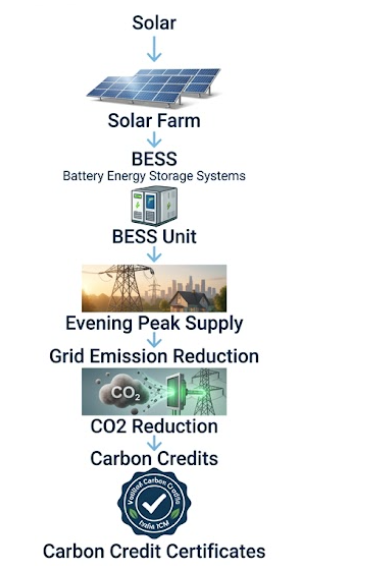
Battery Energy Storage Systems address intermittency by decoupling the timing of renewable generation from the timing of electricity delivery to the grid. A BESS integrated with a solar project can absorb midday excess generation, storing it for release during the evening demand peak. This temporal shifting converts a fundamentally variable supply asset into a more controllable and dispatchable one, improving grid stability and enabling higher renewable penetration without equivalent increases in fossil fuel backup capacity.
From a carbon accounting perspective, BESS integration creates additional climate value beyond simple generation displacement. By enabling renewable electricity to displace fossil fuel generation during periods of high demand and high grid carbon intensity, storage systems can increase the emission reduction per unit of renewable generation. Evening peak demand in most Indian grids is met partly by higher-carbon-intensity peaking plants. A solar-plus-storage project that delivers electricity during these periods displaces more carbon-intensive generation than a solar-only project that delivers primarily during midday.
The CCTS's decision to include BESS within BM EN01.001 reflects a forward-looking recognition that the energy transition requires both generation and storage infrastructure. By making storage-integrated projects eligible for carbon credits, the methodology creates additional financial incentives for the storage deployment that India's grid will require as renewable penetration increases.
Carbon accounting for BESS introduces specific technical challenges that the methodology addresses through defined rules. The primary challenge is that BESS round-trip efficiency is less than 100%: more electricity enters the battery than is subsequently released. This efficiency loss means that charging from renewable generation and discharging to the grid involves some energy loss. The methodology accounts for this through careful metering of both charging and discharging volumes.
Key Takeaway
A second challenge is the treatment of grid charging events. Under normal conditions, BESS must be charged exclusively from the associated renewable plant. However, in exceptional circumstances such as deep battery discharge, the BESS may need to charge from the grid. Any grid charging introduces emissions that must be accounted for as project emissions and reduces net climate benefit. The methodology imposes a strict 2% limit: grid electricity charging must not exceed 2% of total project renewable generation during any monitoring period. Projects that exceed this threshold for any monitoring period forfeit their right to issue credits for that period.
Monitoring requirements for BESS are correspondingly comprehensive. Projects must record generation at the renewable plant, BESS charge and discharge volumes, electricity supplied to the grid from the BESS, any grid electricity consumed for BESS charging, and all relevant meter calibration records. This monitoring architecture must be capable of clearly distinguishing between electricity flows in each direction and attributing emissions accurately to each source.
Pumped Storage Projects (PSP)
The methodology also includes Greenfield Pumped Storage Projects operating alongside renewable generation facilities, recognizing PSP as a critical long-duration storage technology for India's energy transition.
What Is Pumped Storage and How Does It Work?
Pumped Storage Projects are a form of hydroelectric energy storage that uses two water reservoirs at different elevations. During periods when renewable electricity generation exceeds grid demand, the system uses surplus electricity to pump water from the lower reservoir to the upper reservoir. When electricity demand exceeds supply, water is released from the upper reservoir downward through turbines, generating electricity and delivering it to the grid.
PSP is the most mature and widely deployed form of large-scale energy storage globally, accounting for over 90% of installed utility-scale storage capacity worldwide. Unlike batteries, which degrade with cycling and face chemical and thermal management challenges, pumped storage systems can operate for decades with minimal degradation and can be scaled to very large capacities. PSP is particularly suited to long-duration storage applications where batteries face economic and technical limitations.
For India, PSP is strategically significant because the country has substantial topographic potential for pumped storage development, particularly in mountainous and hilly regions. India has set ambitious targets for PSP development as part of its grid flexibility strategy, recognizing that achieving 500 GW of renewable capacity requires large-scale, long-duration storage to manage variability and maintain grid stability.
Why PSP Is Critical For India's Energy Transition
As India's renewable energy penetration rises toward 50% and beyond, the grid will face increasingly severe flexibility challenges. Solar generation is concentrated in midday hours. Wind generation has seasonal and regional patterns. The combination creates periods of simultaneous excess and deficit that require either curtailment of renewable generation (wasting clean energy), rapid deployment of fossil fuel peakers (increasing emissions), or storage that can absorb surplus and release it when needed.
Batteries are excellent for four to eight hour storage durations matching the solar generation window and evening peak demand period. But for longer-duration storage across multiple days or weeks of low renewable generation, batteries face limitations. Pumped storage can provide storage durations that battery systems cannot economically match at scale, making it complementary to rather than competitive with battery storage in a high-renewable grid.
PSP vs Battery Storage: Key Differences
PSP vs BESS Comparison
| Feature | BESS | Pumped Storage (PSP) |
|---|---|---|
| Technology maturity | Rapidly maturing | Highly mature (decades old) |
| Typical duration | 2–8 hours | 8–24+ hours |
| Capacity scalability | Modular | Very large scale |
| Degradation | Battery degradation with cycling | Minimal over project life |
| Environmental footprint | Mining for battery materials | Land and water impacts |
| Round-trip efficiency | 85–95% | 70–85% |
| Siting requirements | Flexible, modular | Requires elevation differential |
| Carbon accounting under BM EN01.001 | Grid charging tracked (2% limit) | Grid pumping tracked (2% limit) |
| Reservoir CH4 emissions | Not applicable | Must be accounted for |
Under BM EN01.001, PSP projects face analogous but distinct accounting requirements compared to BESS. During pumping operations, the PSP consumes electricity. Under normal conditions, this electricity must come exclusively from the associated renewable plant. When the PSP must consume grid electricity in excess of renewable plant output, this constitutes a project emission that must be quantified and deducted from the credit calculation. The same 2% threshold applies: grid electricity consumption must not exceed 2% of project renewable generation during any monitoring period.
PSP projects that create new water reservoirs or expand existing ones face the additional requirement to account for methane and CO₂ emissions from the reservoirs. Freshwater reservoirs can emit greenhouse gases from the decomposition of organic material submerged during reservoir filling. The power density of the project, calculated as the installed capacity divided by the reservoir surface area in watts per square metre, determines whether reservoir emissions must be quantified and whether specific emission factors apply.
Hydropower Requirements
Hydropower projects face additional requirements within BM EN01.001 regarding reservoir power density, water balance analysis and environmental conditions. These requirements reflect the more complex environmental profile of hydropower relative to solar, wind and other renewable technologies.
Why Hydro Requires Additional Safeguards
Unlike solar panels or wind turbines, large hydropower projects interact directly with freshwater ecosystems, river hydrology and surrounding landscapes in ways that can have significant environmental consequences. Dam construction and reservoir creation alter river flow regimes, affect sediment transport, inundate terrestrial habitats, and can displace communities. Large reservoirs in tropical and subtropical regions can emit substantial quantities of greenhouse gases from the decomposition of submerged vegetation and organic sediments.
These environmental considerations mean that not all hydropower projects are automatically beneficial from a full lifecycle climate perspective. A large dam creating a shallow, tropical reservoir over a wide area of organic-rich land could potentially emit more greenhouse gases through reservoir decomposition than the clean electricity it generates displaces. BM EN01.001 addresses this through the power density criterion.
The Power Density Requirement
Power density is a key eligibility parameter for hydropower projects under BM EN01.001. It is calculated as the installed generation capacity of the project in watts divided by the surface area of the reservoir or reservoirs in square metres. The result is expressed in watts per square metre (W/m²).
Projects with power density above 10 W/m² are assumed to have negligible reservoir emissions and no reservoir emission accounting is required. Projects with power density between 4 and 10 W/m² must apply a default reservoir emission factor to estimate and deduct reservoir emissions from the credit calculation. Projects with power density at or below 4 W/m² are generally ineligible unless they satisfy specific integrated project conditions that allow the project-level power density calculated across all reservoirs to exceed the threshold.
The power density criterion elegantly handles the environmental tradeoff in hydropower development. High power density projects generate substantial electricity relative to the reservoir area they create, suggesting that the carbon displacement benefit significantly outweighs any reservoir emission penalty. Low power density projects create large reservoirs relative to their generation capacity, raising concerns that reservoir emissions may offset a significant portion of the clean electricity benefit.
Water Balance Assessment
For integrated hydropower projects involving multiple reservoirs, BM EN01.001 requires a water balance analysis covering a minimum of five years of historical data prior to project implementation. The water balance must account for seasonal river flows, tributary contributions, rainfall patterns and the water management requirements of all reservoirs in the integrated system.
The purpose of the water balance is to demonstrate that the specific combination of reservoirs constructed under the project is necessary for optimizing power output, and that water flows between upstream and downstream elements of the integrated project system are properly characterized. This requirement prevents projects from claiming credit for hydropower generation that is dependent on upstream water inputs that have not been properly accounted for in the project boundary and monitoring plan.
For PSP projects specifically, the project participant must demonstrate in the Project Design Document that the project is not using water that would have been used to generate electricity in the baseline scenario. This requirement prevents double counting of generation from water resources that would have been utilized for hydropower generation regardless of the project activity.
Project Boundary
The project boundary includes the renewable energy facility and all grid-connected electricity generation sources that may be displaced by project generation.
Understanding Project Boundaries
The project boundary is the spatial and systemic definition of what the methodology monitors and accounts for. Getting the project boundary right is essential for both accurate credit calculation and defensible verification. A boundary that is too narrow may miss important emission sources. A boundary that is too broad may include sources that are difficult to monitor or that are not meaningfully affected by the project activity.
At the core of the project boundary is the renewable energy plant itself. This includes all generation units, associated electrical equipment, metering infrastructure and any on-site auxiliary systems. The plant boundary also encompasses any BESS installed at the site, with its charging and discharging measurement points clearly defined.
The grid connection point is a critical boundary element. The methodology requires measurement of net electricity actually supplied to the grid, after accounting for any on-site auxiliary consumption, BESS charging losses and transmission losses within the project boundary. This net generation figure is the basis for the baseline emission calculation. Metering at the grid connection point must be performed by calibrated instruments that meet the accuracy requirements specified in BM-T-003.
For BESS-integrated projects, the project boundary must clearly define the flows of electricity between the renewable plant, the battery system and the grid. Three distinct electricity flow categories require separate metering: generation from the renewable plant, charging of the BESS, and discharge from the BESS to the grid. The monitoring plan must specify how each of these flows is measured and how the net generation supplied to the grid is calculated from the combination of direct renewable plant output and BESS discharge.
For geothermal projects, the project boundary must include the emission sources associated with non-condensable gases and working fluids that the methodology requires to be monitored and quantified. The spatial boundary extends to all components of the geothermal system including production wells, heat exchangers, turbines and any re-injection infrastructure, since gas and fluid leakage from any of these components constitutes a project emission.
For hydropower and PSP projects, the project boundary encompasses all reservoirs and their surfaces, since reservoir methane and CO₂ emissions are potential project emission sources. The boundary also includes all generating units, penstocks, tailrace structures and any auxiliary fossil fuel systems used for backup or supplementary generation.
Baseline Scenario
The baseline represents electricity that would otherwise have been generated using more carbon-intensive technologies connected to the grid. Understanding baseline calculation in depth is essential for accurately projecting credit generation and for preparing documentation that will withstand verification scrutiny.
What Is a Baseline and Why Does It Matter?
A baseline is the estimated quantity of greenhouse gas emissions that would have occurred in the absence of the project activity. In the context of BM EN01.001, the baseline is the volume of CO₂ emissions that would have been generated to produce the same quantity of electricity that the project supplies to the grid, using the existing grid generation mix. The difference between baseline emissions and actual project emissions represents the emission reduction that earns Carbon Credit Certificates.
The baseline is not an observation of something that actually happened. It is a constructed counterfactual: a model of a world in which the project did not exist. The quality of this counterfactual directly determines the environmental integrity of the credits issued. A systematically overestimated baseline inflates credit generation and represents a form of over-crediting. A systematically underestimated baseline reduces credit generation and understates project climate benefit.
Business-As-Usual Electricity Generation
For Greenfield projects, the baseline scenario is defined as electricity delivered to the grid by the project activity that would otherwise have been generated by the operation of existing grid-connected power plants and by the addition of new generation sources. In other words, the baseline is the electricity that the grid would have produced to meet the same demand served by the project, if the project had not been built.
For retrofit, rehabilitation and replacement projects, the business-as-usual scenario is more specific: it is the continuation of operation of the existing generation equipment with normal maintenance. This means the baseline generation is characterized by the historical electricity output of the existing facility during a defined reference period, extrapolated forward as the counterfactual generation that would have occurred without the project improvement.
Grid Emission Factors and the Combined Margin Concept
The Grid Emission Factor is the average CO₂ intensity of the electricity mix in the relevant grid system, expressed in tonnes of CO₂ per megawatt-hour. Under BM EN01.001, the Grid Emission Factor used is the Combined Margin value published annually by the Central Electricity Authority of India. The CEA publishes separate emission factors for different regional electricity grids, and projects must apply the factor appropriate to the grid they are connected to.
The Combined Margin concept reflects that renewable electricity displaces a combination of existing operating plants and new capacity additions. The Operating Margin represents the emission factor of the existing plants most likely to be displaced by the project on an operational basis: typically the marginal plants that adjust output in response to changes in grid supply. The Build Margin represents the emission factor of the new capacity that would have been added to the grid in the absence of the project.
The Combined Margin is a weighted average of the Operating Margin and the Build Margin, typically weighted 50/50, though specific weighting conventions are defined by the CEA guidelines. Using a Combined Margin rather than an Operating Margin alone reflects the reality that renewable energy projects displace not only immediate operational generation but also the need for future capacity additions, reducing the long-term carbon intensity of the grid mix.
Additionality Requirements
Projects must demonstrate additionality through BM-T-001. This is not a formality. It is the core environmental integrity test that determines whether carbon credits represent real climate benefit beyond what would have occurred without carbon finance.
Step 1: Alternative Scenario Analysis
The first step requires identification of all realistic and credible alternative scenarios for power generation at the project site. Under BM EN01.001, three primary alternatives must be considered. The first is the project activity implemented without carbon credit revenue, representing the situation where the project proceeds based on its standalone financial merit without any carbon finance. The second is the continuation of the current situation, meaning continued operation of existing generation equipment at historical levels with business-as-usual maintenance. The third category encompasses all other plausible and credible alternatives technically feasible for the project participants, including different configurations of retrofit, retrofit level, technology selection or generation capacity.
The alternative scenario analysis must be grounded in evidence. Project developers cannot simply assert that alternatives are implausible. They must demonstrate through documented analysis why specific alternatives are not viable for the particular project, at the particular site, given the specific technical, economic and regulatory conditions applicable to the project participants. The analysis should draw on feasibility studies, engineering assessments, market data and regulatory information contemporaneous with the project decision point.
For Greenfield renewable projects in the current Indian market context, alternative scenario analysis increasingly must grapple with the question of whether standalone solar and wind projects would have been built without carbon finance. As the economics of these technologies have improved dramatically, demonstrating that a specific project would not have proceeded without carbon revenue requires careful, project-specific analysis rather than generic market claims.
Step 2: Barrier Analysis
Barrier analysis identifies specific obstacles that would prevent implementation of the project activity without carbon finance. Under BM-T-001, barriers may be financial, technological, operational, regulatory or institutional in nature. The objective is to demonstrate that at least one significant barrier exists that would make the project unlikely to proceed without the additional revenue or market signal provided by carbon credit income.
Financial barriers are among the most commonly cited for renewable energy projects. These may include insufficient returns relative to the risk profile of the investment in the project's specific context, limited access to debt financing at acceptable rates, foreign exchange risk for imported technology components, or unfavorable power purchase agreement terms that make standalone project economics marginal. Carbon credit revenue that improves project IRR to above the required threshold constitutes evidence of a financial barrier.
Technology barriers may be relevant for novel configurations including BESS-integrated projects, hybrid renewable systems or less commercially mature technologies such as offshore wind, wave and tidal in the Indian context. Barriers arising from limited local expertise, supply chain constraints, technology risk premiums or the absence of established operations and maintenance ecosystems for specific technologies can all constitute technology barriers.
Institutional barriers include delays in permits and regulatory approvals, challenges in securing grid connection agreements, land acquisition difficulties, and community engagement requirements that increase project timelines and costs. In the Indian context, grid connection delays, state-level policy inconsistency and land assembly challenges are frequently documented barriers that affect project development timelines and economics. Documentation of these barriers must be specific and contemporaneous rather than generic assertions.
A critical requirement of barrier analysis is that the barriers identified must be specific to the project activity itself, not merely to the sector in general. A claim that all renewable energy projects face financial barriers does not satisfy the additionality requirement. The analysis must demonstrate that the specific project, at its specific scale, location and configuration, faces barriers that make it unlikely to proceed without carbon finance.
Step 3: Investment Analysis
Investment analysis provides quantitative financial evidence of additionality by demonstrating that the project would not be financially attractive without carbon credit revenue. Under BM-T-001, investment analysis can take the form of an investment comparison analysis or a benchmark analysis.
An investment comparison analysis calculates the financial return of the project activity with and without carbon credit revenue. If the project without carbon revenue fails to achieve the minimum financial return required by the project participants, as evidenced by a return on equity or internal rate of return below a documented benchmark, then carbon credit revenue is demonstrated to be financially necessary for the project's implementation. The financial model must reflect actual project conditions including capital costs, operating costs, electricity revenue under the applicable power purchase agreement or merchant market conditions, financing costs and the applicable tax environment.
A benchmark analysis compares a financial parameter of the project, typically the internal rate of return, to a sector-specific benchmark return that represents the minimum acceptable return for investors in the relevant technology and market context. If the project's pre-carbon IRR falls below the benchmark, financial additionality is demonstrated. The benchmark must be credibly derived from the investment environment applicable to the project, not adopted from unrelated markets or technologies.
Under BM EN01.001, hydropower and pumped storage projects are treated as automatically additional with respect to investment analysis, meaning they are deemed to pass the investment analysis step without separate quantitative financial analysis. This provision reflects the recognition that hydropower and PSP projects consistently face capital costs and development risks that make them difficult to finance without the additional revenue streams that climate finance mechanisms provide.
Step 4: Common Practice Analysis
Common practice analysis assesses whether the project activity is already widespread practice in the relevant region and sector. The premise is that activities which are already common in the relevant context are unlikely to require the additional financial incentive of carbon credits to be implemented. If the project activity is already standard practice among comparable entities in the same geographic and market context, additionality becomes very difficult to demonstrate even if individual financial barriers exist.
For renewable energy in India, common practice analysis has become increasingly complex as the sector has grown rapidly. Grid-connected solar and wind projects have proliferated across the country, making it more difficult to argue that a new solar or wind project in a well-developed renewable energy market is not common practice. This is a primary reason why standalone grid-connected solar and wind are excluded from certain BM EN01.001 project configurations: the common practice concern is addressed at the methodology design level rather than being left entirely to project-level analysis.
Common practice analysis requires examining the actual market penetration of the specific project type in the relevant region, not the national average. A technology may be common practice in one state but not another. A project configuration may be standard in one market segment but novel in another. Evidence for common practice analysis should include market statistics, regulatory reports and industry data contemporaneous with the project decision point.
Why Additionality Protects Market Integrity
Additionality is the cornerstone of carbon market environmental integrity. Without genuine additionality, carbon credits do not represent real climate benefit. They represent a financial transfer for activities that would have happened anyway, generating paper credits that give buyers the impression of compensating for emissions without any actual atmospheric benefit.
The integrity risk is particularly acute for renewable energy given the rapid cost reduction of solar and wind technologies. As these technologies approach and exceed grid parity, the number of projects for which carbon finance is genuinely additional decreases. Maintaining rigorous additionality standards ensures that credits issued under BM EN01.001 represent genuine incremental climate benefit beyond the baseline trajectory of renewable energy deployment that market forces alone would have produced.
ACVAs scrutinize additionality documentation carefully during the validation process because it is the foundational integrity question for the entire project. A project that is approved with weak additionality documentation is at risk of having its validation questioned by subsequent reviewers or by market participants who examine underlying project documentation. Building a rigorous, evidence-based additionality case from the outset is therefore both an environmental obligation and a commercial risk management measure for project developers.
Calculating Emission Reductions Under BM EN01.001
Key Takeaway
The fundamental equation for emission reductions under BM EN01.001 is straightforward in concept: Emission Reductions equal Baseline Emissions minus Project Emissions minus Leakage. However, each component of this equation requires careful calculation and documentation to produce a defensible credit quantity.
Baseline emissions are calculated as the product of net electricity generation supplied to the grid by the project activity and the Grid Emission Factor (Combined Margin) published by the CEA for the applicable grid region. This calculation reflects the CO₂ that would have been emitted to generate the same quantity of electricity using the existing carbon-intensive grid mix. Baseline emissions are the largest component of the emission reduction calculation for most renewable energy projects and the primary driver of credit generation volume.
Project emissions are non-zero for several project types. Geothermal projects must account for CO₂ and CH4 emissions from non-condensable gases in produced steam, and for fugitive emissions from working fluids in binary geothermal configurations. Hydropower projects with new or expanded reservoirs in the power density range between 4 and 10 W/m² must apply default reservoir emission factors to estimate CH4 and CO₂ emissions from decomposing organic material. BESS-integrated projects must account for emissions from any grid electricity consumed for battery charging beyond the renewable plant output. PSP projects must account for emissions from grid electricity used during pumping operations.
Leakage is defined as greenhouse gas emissions occurring outside the project boundary that are caused by the project activity. For renewable energy projects, leakage is generally negligible or zero. Unlike forestry projects where project activities may displace deforestation pressure to unprotected areas, renewable energy projects typically do not create significant off-site emission effects. The methodology does not require a leakage deduction for most renewable energy configurations, simplifying the emission reduction calculation compared to land-use sector methodologies.
The net emission reduction for each monitoring period is the key output of the calculation. This quantity, expressed in tonnes of CO₂ equivalent, determines the number of Carbon Credit Certificates that can be issued following verification. Projects that achieve better-than-expected grid emission factor conditions, lower project emissions or higher generation volumes than projected will generate more credits than originally estimated. Projects that experience generation shortfalls, monitoring gaps or higher-than-expected project emissions will generate fewer credits.
Monitoring Requirements
Electricity Generation Monitoring
The foundation of BM EN01.001 monitoring is accurate measurement of electricity generated by the renewable energy plant and supplied to the grid. Generation must be measured using calibrated revenue-grade electricity meters that meet defined accuracy standards. The methodology references BM-T-003 for detailed specifications regarding meter accuracy class, calibration frequency and data recording requirements.
Generation data must be recorded at intervals sufficient to capture daily and seasonal variability accurately. Most monitoring systems capture generation in fifteen-minute or hourly intervals, producing continuous time-series data that supports calculation of total generation over each monitoring period. Data logging systems must be tamper-evident and must produce records that can be independently audited by ACVAs during verification.
For capacity addition projects, separate metering of generation from added capacity and from pre-existing capacity may be required depending on the technology type. The monitoring plan must specify whether combined metering at the grid connection point or separate metering at each generation unit is used, and must demonstrate how the net generation attributable to the project activity is calculated from available metering configurations.
Generation monitoring data forms the primary input to the baseline emission calculation and must be maintained in complete, auditable form for the duration of the crediting period and for a specified period thereafter. Gaps in generation data create verification problems, as ACVAs cannot verify credit calculations for periods during which monitoring data is missing or incomplete.
Grid Export Monitoring
Net electricity exported to the grid is the specific parameter used in baseline emission calculations, distinguishing between total generation and generation consumed for on-site auxiliary uses. Grid export is measured at the interconnection metering point where the project connects to the distribution or transmission network. The interconnection meter must be calibrated and maintained to the accuracy standard required by the applicable utility and by BM-T-003.
For BESS-integrated projects, grid export monitoring must capture the combined effect of direct renewable plant generation and BESS discharge. Some electricity generated by the renewable plant flows directly to the grid, while some charges the BESS for later discharge. Grid export meters capture the aggregate of these flows, but the monitoring plan must also record BESS charging and discharging separately to enable calculation of net renewable generation, BESS efficiency losses and grid charging events.
Projects that experience periods of zero grid export, such as during curtailment events when grid operators reduce renewable injection, must document these periods accurately. Curtailment records affect the generation quantity used in credit calculations and must be distinguishable in monitoring records from generation shortfalls attributable to resource conditions.
Storage Monitoring (BESS and PSP)
For BESS-integrated projects, the monitoring system must separately record electricity charged into the BESS from the renewable plant, electricity discharged from the BESS to the grid, and any electricity charged from the grid during exceptional circumstances. This three-way measurement enables calculation of BESS round-trip efficiency, verification that grid charging has not exceeded the 2% threshold, and accurate attribution of generation to renewable versus grid sources.
For PSP-integrated projects, the monitoring system must record electricity consumed during pumping operations and electricity generated during discharge. The monitoring plan must clearly distinguish between electricity drawn from the associated renewable plant during pumping and any supplementary grid electricity consumed. Records must support calculation of the PSP round-trip efficiency and demonstration that grid electricity consumption has not exceeded permitted limits.
Meter Calibration
All electricity meters used in BM EN01.001 monitoring must be calibrated at intervals defined in the monitoring plan. Calibration intervals for revenue-grade meters are typically one to three years depending on meter type and accuracy class. Calibration must be performed by accredited testing laboratories, and calibration certificates must be maintained as part of the project monitoring record.
Failure to maintain meter calibration records is one of the most common reasons for verification findings requiring correction before credit issuance. ACVAs routinely check calibration certificates as part of the verification process. Missing, expired or improperly conducted calibration represents a material monitoring deficiency that can affect the credibility of generation data for the entire period since the last valid calibration.
Data Archiving
Monitoring data must be archived in a secure, accessible format for the duration of the crediting period and typically for several years after crediting period completion, as required by the CCTS registry and BEE. Digital data archiving systems must include backup procedures, access controls and data integrity verification to ensure that archived records remain complete and unmodified.
Data archiving requirements extend beyond raw metering data to include calibration certificates, maintenance records, operational logs, grid emission factor references, emission factor calculation worksheets and all other documentation supporting the credit calculation. A well-organized project documentation system significantly reduces the burden of verification preparation and improves verification efficiency.
Verification Evidence
Each monitoring period culminates in the preparation of a Monitoring Report that presents all monitored parameters, emission reduction calculations and supporting documentation in the format required by the applicable CCTS monitoring plan template. The Monitoring Report is submitted to an ACVA for verification, which involves detailed review of all monitoring records, recalculation of emission reductions from primary data sources, and site visits to inspect monitoring equipment and records.
Verification evidence should be organized to enable efficient review, with clear references between each calculation component in the Monitoring Report and the underlying data sources that support it. ACVAs typically issue queries or corrective action requests for any element of the monitoring record that cannot be clearly traced to verifiable primary data. Addressing these queries efficiently requires well-organized, comprehensive documentation from the outset of project monitoring.
Common Reasons Renewable Projects Fail Verification
Verification is the final gate before Carbon Credit Certificates are issued. Projects that arrive at verification with incomplete documentation, weak monitoring records or incorrect calculations face delays, deductions or in some cases loss of credits for entire monitoring periods. Understanding the most common verification failure modes allows project developers to prevent them proactively.
Missing or uncalibrated metering records are the single most common cause of verification findings. Revenue-grade electricity meters are generally reliable, but calibration records are frequently not maintained with the same diligence as the generation data itself. An ACVA that cannot confirm that a meter was calibrated during the monitoring period cannot accept the generation data from that meter as fully verified. Projects should implement calendar-based calibration management systems that generate automated reminders before calibration deadlines.
Incorrect baseline assumptions produce systematic errors in credit calculations that may only become apparent during verification. The most common baseline errors include applying the wrong grid emission factor for the project's regional grid, using outdated emission factors from previous years rather than the current year values published by CEA, and incorrectly calculating the historical generation baseline for retrofit or rehabilitation projects based on a reference period that does not meet methodology requirements.
Additionality weaknesses discovered during validation can prevent project registration entirely. Projects that proceed to registration with optimistic additionality assessments that do not accurately reflect actual project economics or barrier conditions may face challenges during validation. The investment analysis must reflect actual project financials, not idealized scenarios. Common practice assessments must be based on verified market data, not estimates. ACVAs are experienced at identifying financial models that have been constructed to support additionality conclusions rather than to accurately reflect project realities.
BESS accounting errors arise from the complexity of measuring multiple electricity flow directions. A common error is failing to record grid charging events, either because the monitoring plan did not include dedicated grid charging meters or because events were not logged during monitoring. This creates discrepancies between the total generation balance and recorded BESS flow volumes that ACVAs will identify during verification. Projects with BESS must ensure their monitoring architecture can capture all electricity flow categories from the start of operations.
Incomplete documentation packages create verification delays even when underlying monitoring data is accurate. ACVAs must review a comprehensive set of documents including the validated Project Design Document, monitoring plan, calibration certificates, operational records, maintenance logs, grid emission factor references and all supporting calculations. Missing elements require the project developer to locate or reconstruct documentation under time pressure, often leading to verification delays that defer credit issuance.
Storage accounting errors occur most commonly in the treatment of round-trip efficiency losses and in the attribution of discharge generation to the correct source. Projects must clearly track the ratio of grid electricity consumed for charging versus renewable electricity consumed for charging to ensure that the 2% grid charging threshold is demonstrably satisfied. Projects that cannot demonstrate compliance with this threshold for specific periods must forfeit credit issuance for those periods.
Renewable Energy Carbon Markets Around The World
BM EN01.001 does not emerge from a vacuum. India's renewable energy methodology draws directly on decades of experience in international carbon market frameworks. Understanding this global context helps project developers and investors appreciate both the maturity of the underlying methodology design and the positioning of the Indian Carbon Market within global carbon finance.
The Clean Development Mechanism was the first large-scale international framework for crediting renewable energy projects. Between its establishment under the Kyoto Protocol in 2001 and its effective decline following the collapse of European carbon prices in the mid-2010s, the CDM registered thousands of renewable energy projects globally. India was among the largest CDM host nations, with renewable energy including wind, small hydro and biomass projects generating substantial CER volumes. The CDM methodology ACM0002, which forms the direct basis for BM EN01.001, was developed through this era and refined through multiple revisions based on implementation experience.
The Verified Carbon Standard, operated by Verra, became the dominant voluntary carbon market standard following the decline of CDM. VCS includes renewable energy methodologies including VM0038 and ACM0002 adoption that allow renewable projects outside mandatory compliance markets to generate Verified Carbon Units. VCS renewable energy credits trade globally and are purchased by companies seeking voluntary emission compensations, creating a template for the commercial infrastructure that India's domestic market is now building.
The Gold Standard, developed by WWF and other NGOs, applies particularly stringent environmental and social co-benefit requirements to renewable energy and other carbon project types. Gold Standard certified projects command premium pricing in voluntary markets because of the additional quality assurance their certification provides. The emphasis on co-benefits including community development, air quality improvement and biodiversity protection in Gold Standard has influenced the broader evolution of carbon market integrity standards.
Article 6 of the Paris Agreement creates the framework for the next generation of international carbon markets. Under Article 6.4, a new international crediting mechanism overseen by the UNFCCC will issue credits from projects meeting internationally agreed standards. Renewable energy is expected to be a major project category under Article 6.4. India's development of a credible domestic methodology framework through BM EN01.001 positions Indian renewable energy projects as potential suppliers to both domestic and international carbon markets as Article 6 mechanisms mature.
India's CCTS represents the most significant development in domestic carbon market infrastructure in the Asia-Pacific region outside China's national ETS. By adopting ACM0002 as the basis for BM EN01.001, India has chosen a methodology with a well-established international track record, reducing the risk of methodological disputes during project validation and verification. At the same time, the CCTS adaptation reflects India-specific considerations including the CEA grid emission factor system, BESS and PSP integration rules calibrated to India's energy transition needs, and additionality assessment procedures aligned with the Indian renewable energy market context.
The Future Of Renewable Energy Carbon Credits In India
India's renewable energy carbon credit landscape is poised for significant evolution over the coming decade, driven by rapidly changing technology economics, expanding methodology coverage, growing institutional investor interest and the eventual development of Article 6 linkages.
Solar energy will remain central to the Indian renewable energy story and to BM EN01.001 credit generation. India currently has over 80 GW of installed solar capacity, a figure that is expected to grow to several hundred gigawatts by 2030. While standalone solar projects face additionality challenges as the technology matures, solar-plus-storage configurations are growing rapidly and provide a more defensible additionality pathway. As grid integration challenges intensify with rising solar penetration, the value of storage-integrated solar projects, both in power market terms and in carbon credit terms, is likely to increase.
Wind energy, both onshore and offshore, presents significant credit generation opportunities. India has over 45 GW of onshore wind capacity and is beginning development of offshore wind, initially targeting 30 GW of offshore capacity by 2030. Offshore wind projects are explicitly eligible under BM EN01.001 without storage integration requirements, reflecting their higher development costs and stronger additionality credentials. As India's offshore wind sector develops, methodology experience in complex offshore monitoring and verification will become increasingly important.
Energy storage, including both BESS and pumped storage, will become increasingly important as renewable penetration rises and the grid flexibility premium grows. BM EN01.001's inclusion of BESS and PSP positions the methodology to capture carbon value from storage alongside generation, creating more comprehensive carbon accounting for the integrated renewable-plus-storage assets that will increasingly define India's electricity system.
Green hydrogen represents one of the most promising frontier opportunities for renewable energy carbon credits in India. BM EN01.002 specifically addresses green hydrogen production from renewable electricity, creating a complementary methodology to BM EN01.001 for projects that consume renewable electricity to produce hydrogen rather than injecting it into the grid. As India's green hydrogen sector develops, projects combining renewable generation with electrolyzer operations may seek credit generation under multiple methodologies for different components of their climate impact.
Hybrid renewable energy projects combining multiple generation technologies with storage systems are increasingly becoming the preferred configuration for new utility-scale energy development. A hybrid project combining solar, wind and battery storage at a single site can smooth generation profiles, improve capacity factors and provide more consistent grid services than any single technology alone. BM EN01.001 explicitly includes hybrid systems as eligible project types, positioning the methodology to remain relevant as project configurations evolve toward greater technological integration.
The long-term trajectory of renewable energy carbon credits in India will be shaped by the interaction between additionality standards and technology economics. As more renewable technologies cross the threshold of commercial viability without carbon finance, methodology design will need to evolve to identify and credit those project types and configurations where carbon finance continues to provide genuine additionality. The parallel development of Article 6 mechanisms may create additional demand for high-quality Indian renewable credits in international markets, providing a revenue uplift that preserves additionality credentials even as domestic project economics improve.
How Sylithe Supports Renewable Carbon Projects
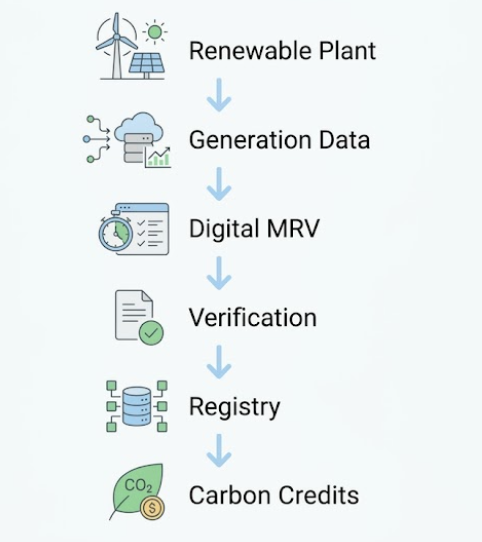
Sylithe enables continuous monitoring and verification of renewable energy projects through digital MRV infrastructure, automated reporting systems and registry-ready datasets. The platform integrates with generation monitoring systems, BESS management systems and grid data interfaces to produce structured, auditable monitoring records that meet CCTS documentation requirements and support efficient verification by ACVAs.
Digital MRV for Renewable Energy
As India's carbon market scales, automated monitoring and verification systems will become critical for renewable energy project developers seeking cost-effective credit issuance. Sylithe's platform supports BM EN01.001 monitoring requirements from generation recording through verification evidence preparation, reducing the operational burden of compliance and improving data quality across the monitoring period.
“BM EN01.001 transforms renewable energy generation from a power asset into a climate asset. The methodology's depth and rigor reflect a market that is building for permanence, not convenience.”