 New
New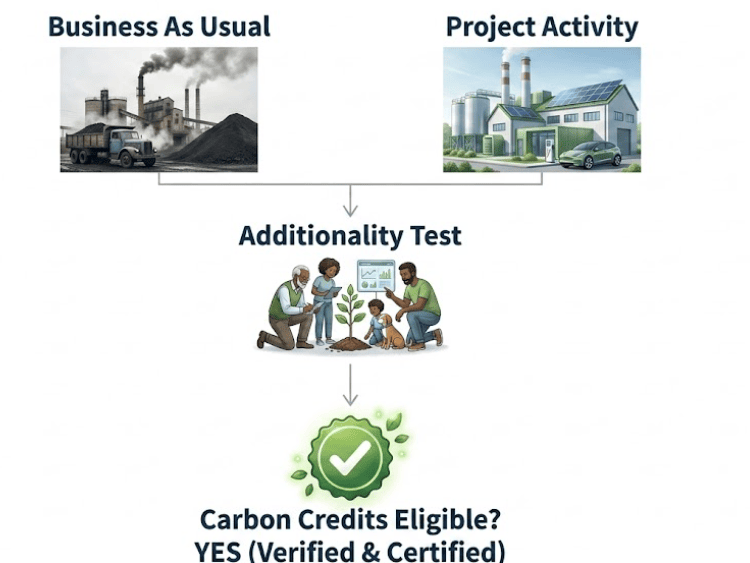
Every carbon credit issued under the Indian Carbon Market begins with one critical question: Would this project have happened anyway? BM-T-001 exists to answer that question with evidence, not assertions.
BM-T-001 is the Combined Tool to Identify the Baseline Scenario and Demonstrate Additionality under India's Carbon Credit Trading Scheme. It provides the methodological foundation upon which every offset project in the Indian Carbon Market must be built. Without a satisfactory BM-T-001 analysis, no project can be registered, no credits can be issued, and no environmental claim can be made.
Most explanations of BM-T-001 focus on the four analytical steps: Alternative Scenarios, Barrier Analysis, Investment Analysis and Common Practice. What they consistently miss are the two mandatory screening stages that precede these steps: Regulatory Analysis and Lock-In Risk Analysis. The methodology is explicit that these are not optional. Every Project Design Document must address them before the four-step sequence can begin.
Why Additionality Exists In Carbon Markets
Additionality is not a bureaucratic invention. It is the response to a fundamental problem that emerged the moment people began designing market mechanisms for emissions reduction: how do you ensure that the credits being sold represent real, measurable, atmospheric benefit and not simply the monetization of activities that would have happened anyway?
Non-additional credits are a form of fraud against the climate. When a company buys a carbon credit believing it compensates for one tonne of CO₂ emissions, and that credit was issued for a project that would have proceeded without any carbon finance, no real atmospheric benefit has been delivered. The company's emissions have not been offset. They have simply been reclassified on paper. In aggregate, widespread issuance of non-additional credits allows total global emissions to continue rising while the market provides the false reassurance that they are being addressed.
Carbon markets need additionality to maintain environmental integrity. Without it, the financial flows from carbon credit transactions do not drive real change in the physical economy. They recirculate money between sellers of business-as-usual activities and buyers seeking affordable compliance, while the atmosphere bears the cost of the fiction.
Key Takeaway
The Kyoto Protocol's Clean Development Mechanism was the first large-scale international test of additionality in practice. The CDM created the concept of the additionality test and encoded it into project registration requirements through its regulatory framework. However, the CDM also demonstrated the difficulties of operationalizing additionality at scale. Academic reviews of the CDM found that a significant proportion of registered projects, particularly in China and India, were of questionable additionality: they were commercially viable without carbon finance, would have proceeded regardless, and generated CERs that gave their buyers no real atmospheric offset.
The voluntary carbon market through Verra, Gold Standard and other standards developed more rigorous additionality frameworks in response to CDM's weaknesses. Verra's Verified Carbon Standard requires explicit demonstration of financial, regulatory and technological additionality. Gold Standard applies additional filters related to sustainable development co-benefits and community engagement. These frameworks improved market integrity but also revealed that additionality assessment is inherently judgment-dependent: different assessors examining the same project can reach different conclusions depending on how they interpret barrier significance, financial benchmarks and common practice evidence.
India created BM-T-001 to establish a standardized, nationally applicable additionality framework that draws on international experience while adapting to the Indian regulatory and market context. By grounding additionality assessment in a common tool referenced by all approved methodologies, the CCTS creates consistency across project types and reduces the variability in additionality conclusions that plagued earlier market frameworks.
For buyers, additionality confidence translates directly into purchase confidence. An institutional buyer seeking to make a climate claim based on purchased credits needs assurance that those credits represent genuine emission reductions. Credits issued under a rigorous, consistently applied additionality framework provide that assurance in a way that credits from frameworks with weak additionality standards cannot.
For project developers, a clear and transparent additionality framework reduces uncertainty about what evidence is required and what standards must be met. A well-designed additionality tool is not an obstacle to credit generation. It is the quality signal that makes generated credits credible and therefore valuable in the market.
The Complete BM-T-001 Framework: More Than Four Steps
Key Takeaway
BM-T-001 is formally structured around four mandatory steps: Alternative Scenario Analysis, Barrier Analysis, Investment Analysis and Common Practice Analysis. However, the methodology specifies two additional mandatory requirements that must be addressed in every Project Design Document before these four steps can begin: Regulatory Analysis and Analysis of Lock-In Risk.
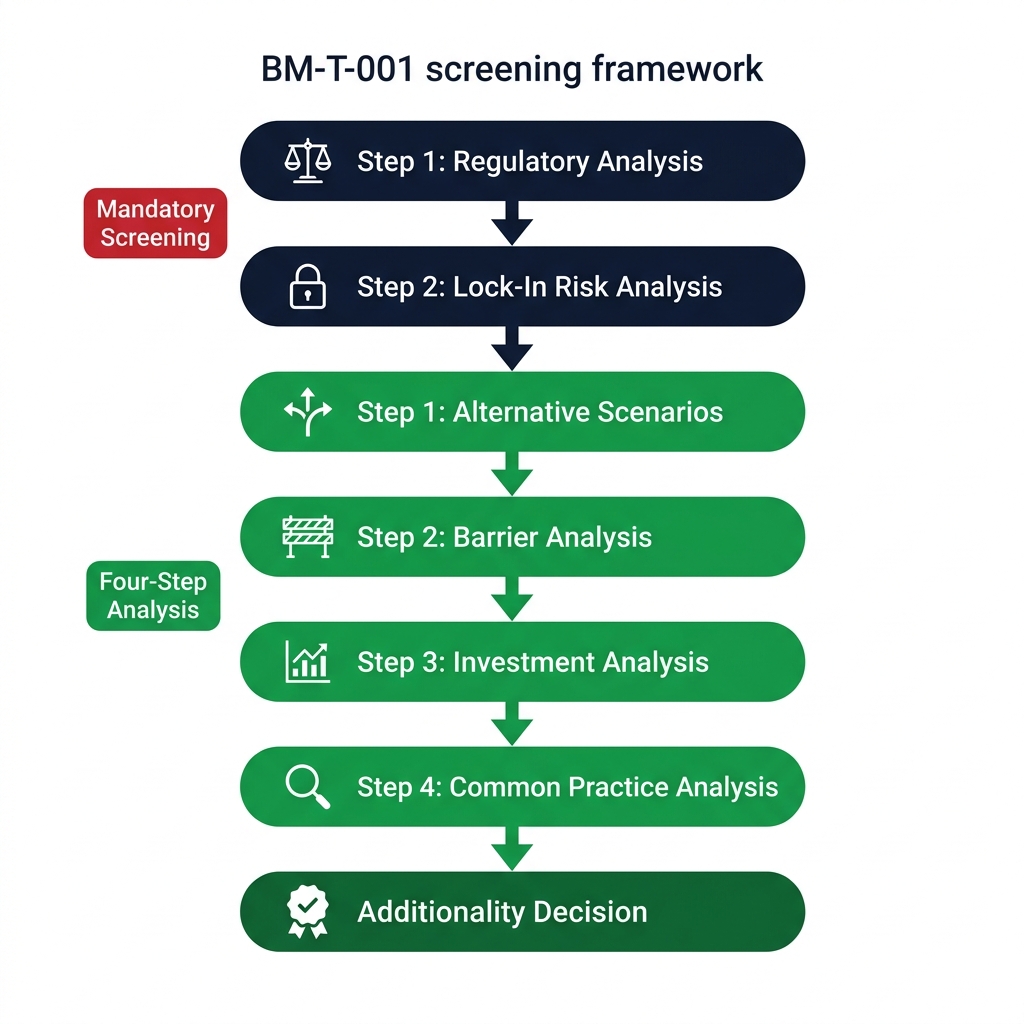
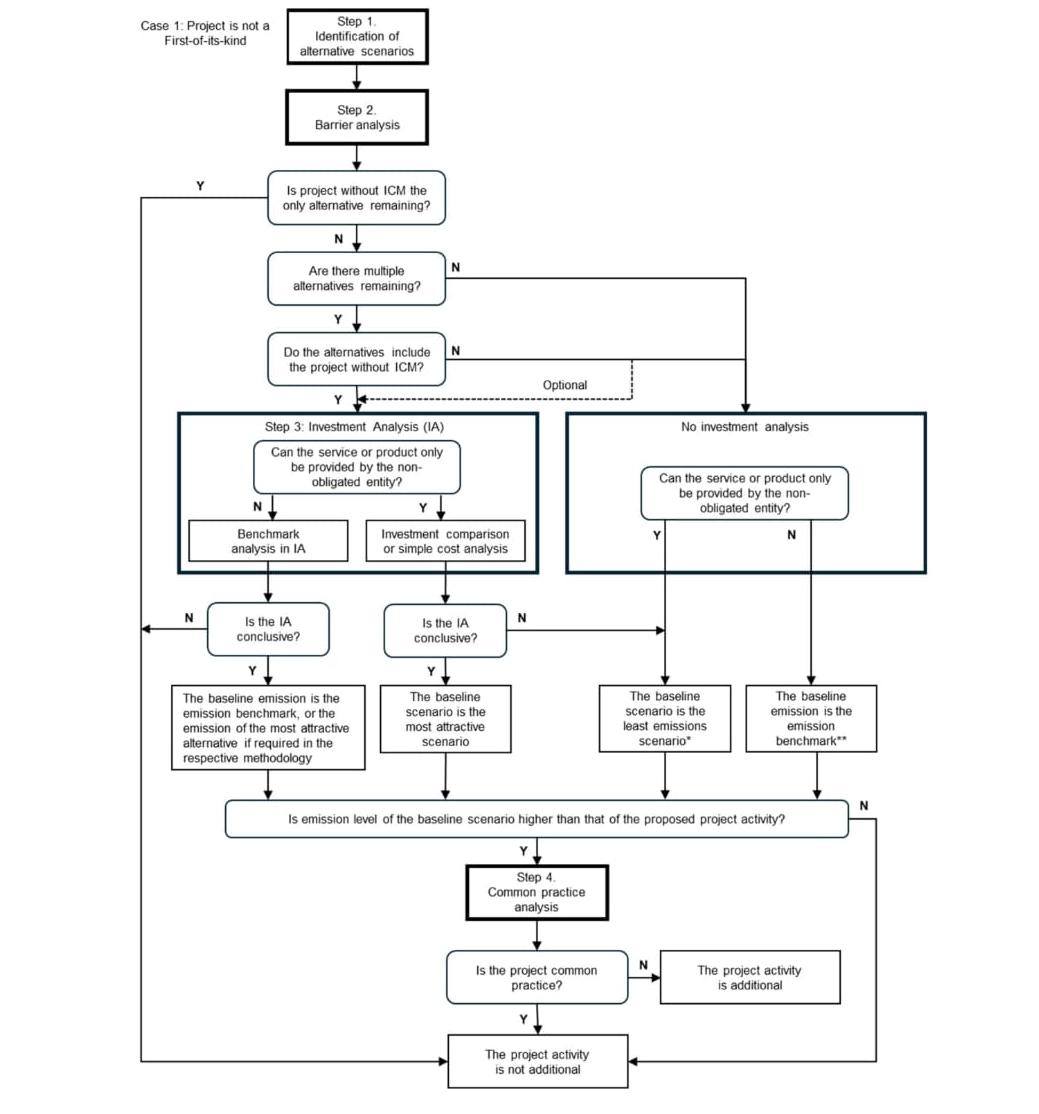
BM-T-001 Complete Framework
| Stage | Name | Status | Purpose |
|---|---|---|---|
| Pre-Step A | Regulatory Analysis | MANDATORY | Screen for legally required activities |
| Pre-Step B | Lock-In Risk Analysis | MANDATORY | Screen for Paris Agreement incompatibility |
| Step 1 | Alternative Scenario Identification | MANDATORY | Identify all plausible counterfactuals |
| Step 2 | Barrier Analysis | MANDATORY | Eliminate scenarios blocked by barriers |
| Step 3 | Investment Analysis | CONDITIONAL | Compare financial attractiveness |
| Step 4 | Common Practice Analysis | MANDATORY | Test for market diffusion |
Regulatory Analysis: The First Gate Before Additionality
Why Regulatory Analysis Matters
The fundamental principle behind regulatory analysis is simple but profound: if a law or regulation already requires a project activity to happen, then that activity cannot generate carbon credits. The logic is that if the activity would occur anyway due to legal obligation, it is by definition not additional to a regulatory baseline. Carbon credits issued for legally mandatory activities would represent a windfall to regulated entities rather than an incentive for beyond-compliance climate action.
Regulatory analysis requires project developers to examine all applicable laws, regulations and support schemes and determine whether any of them would mandate, incentivize or practically compel the implementation of the project activity. This is not a simple checklist exercise. Regulatory environments are complex, enforcement varies across jurisdictions and the relationship between a regulation and a specific project activity is not always direct.
Direct Regulatory Requirements
A direct regulatory requirement is the most straightforward case: a regulation explicitly mandates the specific project activity. The canonical example is landfill gas capture. If a regulation requires all landfills above a certain size to capture methane emissions, then a landfill gas capture project at such a facility is implementing a legally required activity. No additional incentive is needed, no barrier exists, and the activity would happen regardless of carbon finance. Under BM-T-001, such a project fails regulatory analysis and cannot proceed to the four-step additionality test.
The regulatory analysis must examine enforcement as well as legal text. A regulation exists in a different context depending on whether it is systematically enforced. BM-T-001 acknowledges that in jurisdictions where mandatory legal requirements are systematically not enforced and non-compliance is widespread, an alternative scenario that technically violates the regulation may remain a plausible counterfactual. Project developers must therefore assess both the content of applicable regulations and the actual enforcement environment in the project's specific geographic context.
Indirect Regulatory Requirements
Indirect regulatory requirements are more complex and require more careful analysis. An indirect requirement occurs when a regulation establishes performance standards that effectively require the project activity even though it does not mention the activity explicitly. The example in BM-T-001 is illuminating: an air pollution regulation for landfill sites may not explicitly require methane capture, but if meeting the air quality standard is practically impossible without capturing the methane, then the regulation indirectly requires the project activity. Credits from that activity would not be additional to the regulatory requirement.
Indirect requirements are particularly relevant in sectors where environmental, health and safety regulations intersect with greenhouse gas reduction activities. Industrial energy efficiency projects, fugitive emission reduction projects and waste management projects all operate in regulatory contexts where the intersection between non-climate environmental regulations and greenhouse gas outcomes requires careful analysis.
Support Schemes and Subsidies
Support schemes present a particularly nuanced regulatory analysis challenge. A government subsidy or financial support scheme does not always disqualify a project from additionality, but a support scheme that meets three specific conditions does: the scheme must be designed to achieve a quantitative target or outcome for the relevant technologies, it must be applicable to the project activity, and it must be likely to result in the same amount of emission reductions even if the specific project were not implemented.
The critical test is not whether a subsidy exists but whether the subsidy would cause the same emission reductions to occur without the specific project. A production-linked incentive scheme for renewable energy that applies to all qualifying projects in a sector might meet these three conditions if it is designed to achieve a specific renewable deployment target and if the market would reach that target regardless of whether this particular project participates. A project-specific grant that would not affect market-wide outcomes generally does not meet the three conditions.
Renewal Requirements and Crediting Period Updates
Regulatory environments change over time. A project that was not subject to a direct regulatory requirement at the time of registration may find that new regulations have been introduced during its crediting period. BM-T-001 requires that regulatory analysis be updated at each renewal of the crediting period. This ensures that projects do not continue generating credits for activities that have become legally mandatory due to regulatory evolution since initial registration.
For project developers, this renewal requirement emphasizes the importance of maintaining ongoing regulatory monitoring throughout the crediting period. Regulatory changes in the relevant sector must be tracked, and their implications for the project's additionality status must be assessed at each crediting period renewal.
Understanding Lock-In Risk
What Is Carbon Lock-In?
Carbon lock-in refers to the risk that investment in a technology or infrastructure today will constrain future decarbonization by making fossil fuel or high-emission systems economically rational to continue operating long after a net-zero transition would require their closure. A coal power plant built today with a 40-year operational lifetime represents a lock-in risk: even if the plant reduces emissions relative to the baseline, it locks in continued fossil fuel infrastructure in a world that needs to be net-zero by 2070.
The Paris Agreement's long-term goal of limiting warming to 1.5°C requires a near-complete transformation of energy systems within the coming decades. Infrastructure investments made today that are incompatible with this transformation pathway create path dependencies that become increasingly expensive to exit over time. Carbon markets should not subsidize the adoption or prolongation of such incompatible technologies, even if those technologies reduce emissions relative to a higher-emission baseline.
Why the Paris Agreement Alignment Test Exists
Lock-in risk analysis was introduced into the BM-T-001 framework to ensure that India's domestic carbon market does not inadvertently finance infrastructure that will need to be prematurely retired or expensively retrofitted as climate ambition increases. A carbon market that issues credits for projects incompatible with long-term decarbonization goals is not merely failing to solve the climate problem. It is financing its continuation.
The methodology requires that project activities not lead to the adoption or prolongation of the lifetime of technologies or practices that are incompatible with the long-term goals of the Paris Agreement, taking into account India's specific national circumstances, development pathways and transition constraints.
Long-Life Infrastructure and the 10-Year Lifetime Rule
The lock-in risk concern is proportional to the operational lifetime of the technology being installed. A technology with a three-year operational lifetime creates minimal lock-in risk even if it is slightly carbon-intensive, because it will be retired and replaced within a short window during which decarbonization pathways can adjust. A technology with a thirty-year operational lifetime in a capital-intensive sector creates significant lock-in because the financial investment must be recovered over decades, creating economic pressure to continue operating the asset regardless of evolving climate standards.
BM-T-001 provides a specific simplification for short-lived technologies: where a technology or practice has a technical or operational lifetime of no more than 10 years, the methodology may assume that no lock-in risk exists, provided that appropriate evidence and justification are provided for the lifetime estimation. This 10-year rule reduces the analytical burden for projects involving rapidly cycling technologies while maintaining the lock-in screening requirement for long-life infrastructure.
High Emission Technologies and Carbon Market Eligibility
Certain technology categories raise immediate lock-in concerns that require careful justification. Coal plant retrofits that reduce emissions relative to the baseline but extend the operational life of coal infrastructure are the most obvious example. If a coal plant would have been retired without the carbon project, and the project's intervention causes it to continue operating for 15 additional years, the net climate impact may be negative even if the project generates credits for the efficiency improvement achieved during the retrofit period.
Natural gas infrastructure represents a more nuanced case. Gas generation has significantly lower emissions than coal but is incompatible with a net-zero electricity system. Projects that transition from coal to gas may be Paris-aligned in the near term while creating medium-term lock-in. The methodology requires analysis to consider the scale of the project, the emissions intensity of the technology relative to alternatives in the relevant region, and the availability and feasibility of zero-emission alternatives given Indian national circumstances.
Renewable energy and green hydrogen projects generally pass lock-in analysis readily because these technologies are inherently compatible with net-zero pathways. Electrolyzers, solar panels, wind turbines and battery systems are the infrastructure of a decarbonized economy rather than an obstacle to it. Nature-based solutions including forestry, mangroves and regenerative agriculture are similarly compatible with long-term climate goals, assuming that associated carbon removals are permanent and that biodiversity considerations are addressed.
Technology-Neutral Assessment
The lock-in analysis must follow a neutral approach with respect to technology and emissions source. The methodology does not prohibit specific technologies from participating in the carbon market. It requires that the lock-in analysis be conducted rigorously and honestly for any technology, considering the specific national circumstances, existing infrastructure and path dependencies relevant to India.
India's development context is explicitly recognized. The analysis shall consider the availability and feasibility of alternative options given national circumstances. A technology that would represent lock-in risk in a highly developed economy with abundant clean alternatives may be a legitimate transitional investment in a development context where the alternative is a more carbon-intensive option due to infrastructure and capital constraints.
Step 1: Identification of Alternative Scenarios
What Is a Baseline Scenario?
A baseline scenario is the most plausible description of the situation that would have prevailed in the absence of the proposed project activity. It is not merely a theoretical construct. It must represent a realistic, plausible and economically defensible account of what would actually have happened had the project not been implemented. The baseline scenario determines the emission level against which the project's reductions are measured, and therefore directly determines the volume of credits the project can generate.
Baseline scenarios are selected from among the alternative scenarios identified in Step 1. The selection process works by elimination: alternatives that are inconsistent with mandatory regulations are eliminated first, then alternatives that are blocked by significant barriers. The remaining alternatives are compared through investment analysis when multiple plausible options remain, and the baseline scenario is the alternative that would most plausibly have been adopted without the project activity.
The quality of baseline identification has profound financial implications. An overestimated baseline that represents a more carbon-intensive counterfactual than would realistically have occurred inflates credit generation, over-credits the project, and ultimately reduces market integrity. An underestimated baseline produces fewer credits than the project's genuine climate contribution warrants, disadvantaging the project developer. Getting the baseline right is both an integrity obligation and a financial imperative.
For projects delivering a service or product that could only be provided by the project developer, the baseline is the most financially attractive alternative remaining after barrier elimination. For projects delivering commodities that could be provided by the market (such as electricity), an emission benchmark approach is typically required, where the baseline corresponds to the market average emission intensity (such as the grid emission factor) rather than a specific identified alternative.
The Six Alternative Scenario Categories
BM-T-001 requires identification of all alternative scenarios providing the same output as the proposed project. The methodology specifies six categories that must be considered. Understanding each category in detail is essential for complete and defensible Step 1 analysis.
S1: The Project Without ICM Registration
S1 represents the proposed project activity implemented without registration as an ICM carbon credit project. This is the most fundamental alternative scenario: the project is built and operated exactly as planned, but without seeking or receiving carbon credit revenue. If S1 is commercially viable without carbon finance, the project would likely proceed regardless, and the carbon credits it generates would not represent additional climate benefit. S1 must always be considered and explicitly evaluated in the alternative scenario analysis.
S1 is the scenario that investment analysis is primarily designed to eliminate. If investment analysis demonstrates that S1 is not financially attractive without carbon revenue, that is the core quantitative evidence of additionality. Conversely, if investment analysis shows that S1 achieves an adequate return without carbon finance, the project is not additional and cannot proceed to Step 4.
S2: No Investment by the Developer (Third-Party Provision)
S2 covers the scenario in which the project developer does not invest at all, but the same output is provided by other market participants. This is particularly relevant for commodity-producing projects. In the case of a greenfield power project, S2 represents the scenario where the developer does not build the plant but power continues to be available from existing grid generators and new capacity added by others. In the case of a transport project, S2 might represent the scenario where the developer does not invest in rail infrastructure, but a third party implements the alternative transport mode.
S2 recognizes that carbon markets operate within economies where markets provide services through multiple competing actors. The question is not only whether the specific developer would proceed but whether the same output would be available from other sources regardless. For grid-connected electricity projects, S2 is almost always a relevant scenario because the electricity grid will continue to operate and provide power regardless of any individual project's decision to participate.
S3: Continuation of Current Situation at No Cost
S3 represents scenarios where the current situation continues without requiring any investment or significant expense. The paradigmatic examples are continued methane venting from a landfill or continued release of N₂O from industrial processes. In S3, the existing situation persists because doing nothing costs nothing beyond routine operations. This scenario is particularly relevant for projects that address passive emission sources: emissions that occur without any specific action by the entity and would continue indefinitely unless actively addressed.
S3 scenarios have a significant implication for baseline emission intensity: they often represent a higher-emission baseline than S4, S5 or the project itself. If S3 is the most plausible counterfactual (i.e., the entity would simply continue venting methane), the baseline emissions are higher, the emission reduction credit volume is larger, and the financial case for the project with carbon revenue is stronger. This creates an incentive for project developers to characterize S3 as the baseline wherever defensible.
S4: Continuation of Current Situation With Investment or Maintenance Costs
S4 covers situations where the current situation continues but requires ongoing investment or maintenance expenses. Examples include continued use of an existing boiler requiring maintenance expenditure, continued operation of an existing power plant with ongoing capital maintenance, or continued use of existing transportation infrastructure requiring investment to remain serviceable. Unlike S3, S4 involves ongoing costs for the status quo, which affects the investment analysis comparison between the current situation and the project alternative.
Key Takeaway
The distinction between S3 and S4 matters for investment analysis. In S3, the financial indicator for the do-nothing scenario is typically assumed to be zero (no cost, no revenue). In S4, the ongoing costs of maintaining the current situation must be accounted for, potentially making the current situation financially less attractive than it appears at first and strengthening the relative financial case for the project alternative. However, if the current situation is genuinely less attractive than the project even without carbon revenue, investment analysis cannot establish additionality for S1.
S5: Other Plausible and Credible Alternatives
S5 is the catch-all category covering any other plausible and credible alternative scenario not captured by S1 through S4. This includes different technologies delivering the same service, different project configurations, common practice approaches used by others in the sector, and any other realistic options available to the project developer or available in the market. S5 requires active investigation: project developers must identify what comparable entities in comparable situations are actually doing and include those approaches as potential alternative scenarios.
The methodology specifies that S5 should include technologies or practices identified in an analysis of at least ten facilities providing the same output in the applicable geographic area. This market survey requirement creates a documentation obligation: project developers must conduct a systematic review of how the sector is operating and present this analysis as evidence supporting the identification of S5 scenarios.
S6: Delayed Implementation
S6 represents the scenario where the project activity would be implemented at a later point in time without carbon market participation. This captures situations where the project would eventually occur due to regulatory trajectory, equipment lifecycle, or economic evolution, but would not have been implemented as early as the project developer plans without the additional incentive of carbon revenue. S6 is particularly relevant for projects involving end-of-life equipment replacement or for activities in sectors where regulatory requirements are evolving but have not yet been enacted.
Key Takeaway
S6 introduces a temporal dimension to additionality analysis. Even if a project will eventually happen, bringing it forward in time through carbon finance generates genuine additional climate benefit by achieving emissions reductions years or decades earlier than they would otherwise occur. However, demonstrating that the delay would genuinely have occurred requires credible evidence that implementation without carbon finance would be postponed, rather than simply asserting that it could have been delayed.
How Alternative Scenarios Are Eliminated: Legal Compliance Screening
Step 1b of the alternative scenario analysis requires elimination of any alternative scenario that does not comply with mandatory applicable legal and regulatory requirements. This screening step ensures that the baseline scenario reflects a legally plausible counterfactual rather than an illegal one.
The principle is straightforward: if a potential alternative scenario would require the project developer to violate mandatory laws or regulations, that scenario cannot be considered a realistic counterfactual in the jurisdiction where compliance with those laws is generally enforced. An alternative that requires illegal disposal of waste, illegal emissions levels or non-compliance with safety regulations cannot serve as the baseline if the project developer would face legal consequences for adopting it.
Key Takeaway
However, BM-T-001 recognizes that legal requirements are not uniformly enforced across all jurisdictions and contexts. The methodology allows an alternative scenario that technically violates a mandatory requirement to remain in consideration if it can be demonstrated that the relevant law or regulation is systematically not enforced and that non-compliance is widespread in the country or region. This provision reflects the real-world complexity of regulatory environments in developing economies where enforcement capacity varies significantly across sectors and geographic areas.
The assessment of regulatory enforcement requires evidence. Project developers cannot simply assert that regulations are not enforced. They must provide documented evidence of enforcement patterns, regulatory agency capacity and actual compliance rates in the relevant sector and region. This evidence must be credible, current and specific to the applicable geographic area.
Regional enforcement differences are particularly important in the Indian context, where regulatory enforcement capacity and practice can vary significantly between states, between urban and rural areas, and between large and small enterprises. A regulation that is strictly enforced for major industrial facilities in metropolitan areas may have much lower enforcement rates for small and medium enterprises in rural districts. BM-T-001's enforcement assessment requirement means that legal compliance screening cannot be done with generic national-level data alone.
The outcome of Step 1b is a refined list of alternative scenarios that are both plausible in technical terms and compliant with the legal environment that would actually apply to the project developer. If this list contains only S1 (the project without ICM registration), the project is not additional and cannot proceed further. If the list contains other alternatives alongside S1, barrier analysis proceeds.
Step 2: Barrier Analysis
Barrier analysis is designed to eliminate alternative scenarios that are theoretically possible but are prevented from occurring in practice by real-world obstacles. Not all technically and legally plausible alternatives are equally implementable. A barrier analysis identifies specific, documented impediments that would prevent particular alternative scenarios from being chosen by the project developer in the absence of carbon finance.
Investment Barriers
Investment barriers are obstacles to capital mobilization that are distinct from the simple financial attractiveness comparison conducted in Step 3. BM-T-001 identifies two primary categories of investment barriers that are relevant beyond insufficient financial returns.
The first category is the requirement for grants or non-commercial financing. If similar activities in the applicable geographic area have only been implemented with access to grants, concessional loans, government co-financing or other non-commercial financial terms, this demonstrates that the activity cannot be financed through conventional commercial channels. The barrier is not simply that the return is insufficient but that access to appropriate financing is structurally constrained for this type of project.
The second category is country or political risk. If capital from domestic or international markets is unavailable or prohibitively expensive due to real or perceived risks associated with investing in India or in the specific sector, project region or enterprise type, this creates a genuine financing barrier. Evidence for this barrier includes credit ratings, country risk reports from reputable international institutions, and documented experiences of comparable project developers seeking financing for similar activities.
For nature-based solutions projects in India, investment barriers are frequently documented. Forest carbon projects in remote areas may be unable to access commercial financing because lenders are unfamiliar with the asset class, lack collateral structures for forest carbon receivables, or perceive regulatory and permanence risks as unacceptably high without the additional security that carbon credit revenue provides. Documenting these specific financing constraints with evidence from actual financing attempts or from market data on comparable projects is essential for a credible barrier analysis.
Technological Barriers
Technological barriers prevent alternative scenarios from being implemented due to limitations in the availability, knowledge, infrastructure or risk profile of the relevant technology in the applicable geographic area. Four specific categories of technological barrier are recognized in BM-T-001.
Skilled labor unavailability addresses situations where the technical expertise required to operate and maintain a technology safely and effectively does not exist in the applicable geographic area, creating an unacceptably high risk of equipment malfunction, underperformance or failure. For advanced renewable energy configurations including floating solar, offshore wind and green hydrogen electrolysis, skilled operations and maintenance labor may be a genuine technological barrier in certain Indian states and regions.
Infrastructure gaps cover situations where the physical or logistical infrastructure required to support the technology is absent. The example in BM-T-001 is the absence of a gas transmission and distribution network preventing natural gas use. In the Indian context, analogous infrastructure barriers exist for certain green hydrogen applications where pipeline infrastructure, refueling networks or industrial feedstock delivery systems are not yet developed.
Technological failure risk addresses situations where the specific technology has a significantly higher failure rate in local conditions than comparable alternatives. This barrier requires documentation from scientific literature or technology manufacturer specifications demonstrating that local operating conditions (climate, grid characteristics, water quality, etc.) create failure risks not present in the technology's typical deployment contexts.
Technology unavailability addresses the straightforward situation where the specific technology required by the alternative scenario is simply not available in the applicable geographic area. This barrier must be documented with evidence that the technology is not locally available and cannot be reasonably imported or transferred from other markets at costs comparable to those assumed in the alternative scenario analysis.
Operational, Market and Institutional Barriers
Beyond investment and technological barriers, BM-T-001 recognizes that other categories of barrier may be relevant depending on project type and methodology context. Operational barriers include challenges related to supply chain reliability, vendor ecosystem availability, spare parts access and operational risk management that make certain alternative scenarios impractical in specific contexts. Market barriers address situations where the output of an alternative scenario cannot be sold at the prices assumed in the analysis, or where offtake agreements or power purchase contracts are unavailable on the terms required for project viability. Institutional barriers include permitting delays, regulatory complexity, inter-agency coordination challenges and governance constraints that increase the cost and risk of implementing specific alternatives.
Evidence Requirements for Barrier Analysis
BM-T-001 places strong emphasis on the quality and credibility of evidence supporting barrier claims. Assertions without documentation do not satisfy the barrier analysis requirement. The methodology requires at least one of the following evidence categories for each significant barrier identified.
Relevant legislation, regulatory information or industry norms provide the most authoritative evidence for barriers created by the legal and regulatory environment. Sectoral studies or surveys from universities, research institutions, industry associations, companies or multilateral institutions provide external validation of barrier conditions. National or international statistics can quantify the prevalence of conditions giving rise to barriers. Market data documentation includes price data, tariff schedules, market reports and transaction records.
Key Takeaway
Company-internal documentation is also accepted, including board minutes, correspondence, feasibility studies and financial information. This category of evidence reflects the legitimate role of internal decision-making processes in establishing that barriers affected actual project development decisions. However, internal documents are most credible when they are contemporaneous with the project decision point, not retrospectively prepared for the additionality analysis, and are supported by at least one external evidence source.
Step 3: Investment Analysis
Why Financial Attractiveness Matters to Additionality
The investment analysis step provides the quantitative financial evidence for additionality that barrier analysis provides qualitatively. Even where barriers are credibly documented, the definitive test of whether carbon finance is necessary for a project is whether the project generates an adequate financial return without that revenue. A project that clears all barriers and achieves a strong financial return without carbon revenue does not need carbon finance and is therefore not additional.
Investment analysis is conditional in BM-T-001: it is required only when multiple alternative scenarios remain after Step 2, specifically when those alternatives include S1 (the project without ICM registration). If the only remaining alternative after Step 2 is not S1, the project developer may choose either to conduct investment analysis or to use an alternative route that determines the baseline based on whether the service can only be provided by the developer.
Financial Indicators: IRR, NPV and Beyond
BM-T-001 requires selection of the financial indicator most appropriate to the project type and decision-making context. For most carbon projects, the Internal Rate of Return is the preferred indicator because it enables direct comparison with sector-specific benchmark returns that represent the minimum acceptable return for investments in the relevant technology and market. IRR is expressed as a percentage annual return and can be compared intuitively against cost of capital benchmarks.
Net Present Value discounts all future cash flows to a present value using a specified discount rate representing the project developer's required return. A negative NPV indicates that the project does not generate sufficient returns to cover its capital and operating costs at the required return threshold, establishing that the project would not proceed without additional revenue. For S2 and S3 scenarios representing business-as-usual situations where no investment is required, BM-T-001 specifies that the NPV should be assumed to be zero for comparison purposes.
Cost-benefit ratios and unit costs of service such as levelized cost of electricity production are also accepted financial indicators where they better reflect the decision-making framework relevant to the specific project type. Levelized cost analysis is particularly relevant for comparing competing electricity generation technologies where the decision criterion is cost of electricity delivered rather than investor return on equity.
Benchmark Analysis
Benchmark analysis is the approach used when the project delivers a commodity that can be provided by the market (such as electricity) or when the project is part of a portfolio of technologies delivering electricity to the power grid. In benchmark analysis, the baseline scenario corresponds to the market-average emission intensity (such as the grid emission factor) rather than a specific identified alternative technology.
The financial benchmark in a benchmark analysis is the sector-specific minimum acceptable return for the relevant technology and market context. If the project's IRR without carbon revenue falls below this benchmark, additionality is demonstrated on financial grounds. The benchmark must be credibly derived from the investment environment applicable to the project, not adopted from unrelated sectors or geographies.
For renewable energy projects in India, the financial benchmark is typically derived from the weighted average cost of capital applicable to the relevant project type, reflecting the risk profile of the technology, the regulatory environment, the power purchase agreement structure and the availability of debt financing at competitive rates in the Indian market. Benchmark analysis is mandatory for renewable energy projects that form part of a portfolio of technologies or where the project developer is the sole power supplier in the applicable area.
Investment Comparison Analysis and Simple Cost Analysis
Investment comparison analysis directly compares the financial returns of all remaining alternative scenarios, including S1, and determines which is the most financially attractive. The alternative with the highest IRR or lowest unit cost is identified as the baseline scenario. If that most-attractive alternative is S1 (the project without ICM registration), the project is not additional. If S1 is less financially attractive than another alternative, the project may be additional.
A simple cost analysis is appropriate where financial returns are not the relevant decision criterion, such as for public investments evaluated on a cost-effectiveness basis. Unit cost comparisons in terms such as cost per tonne of CO₂ reduced or cost per unit of energy delivered can be appropriate for projects where the decision-maker is a public institution using standard public investment evaluation methods.
Revenue Assumptions, Subsidies and Incentives
The investment analysis must include all relevant revenues and costs, including applicable subsidies and fiscal incentives. In India's renewable energy sector, project revenues may include electricity sales under power purchase agreements, renewable energy certificates, production-linked incentives, viability gap funding and other government support schemes. These revenues must all be included in the pre-carbon financial model.
The inclusion of subsidies in revenue assumptions is one of the more contested aspects of renewable energy additionality analysis. A project that achieves adequate returns when all subsidies are included may not be additional even if it appears unprofitable without subsidies. The methodology notes that subsidies and incentives may be excluded from consideration in certain cases, but the default position is that available support mechanisms should be included in the financial model to ensure that the analysis reflects the actual investment decision context.
Sensitivity Analysis: Testing the Robustness of Conclusions
BM-T-001 requires a sensitivity analysis to assess whether investment analysis conclusions are robust to reasonable variations in critical assumptions. Financial models for long-lived infrastructure projects involve projections of capital costs, operating expenses, electricity prices, fuel costs, exchange rates and financing terms over multi-decade periods. No single set of assumptions can predict these variables with certainty. The sensitivity analysis tests whether the additionality conclusion holds across a realistic range of scenarios.
Critical assumptions for sensitivity analysis in renewable energy contexts typically include capital cost variations of plus or minus 10-15%, electricity price variations reflecting power purchase agreement renegotiation scenarios, financing cost variations reflecting interest rate uncertainty, and capacity factor variations reflecting resource variability. If the investment analysis conclusion (that S1 is not financially attractive without carbon revenue) holds across all sensitivity scenarios, the analysis is considered conclusive and additionality is established on financial grounds.
If sensitivity analysis is inconclusive, meaning that the conclusion changes depending on which assumptions are used, BM-T-001 requires adoption of a conservative approach. Specifically, when investment comparison analysis is inconclusive, the alternative scenario with the lowest emissions among the remaining alternatives is designated as the baseline. This conservative default ensures that additionality cannot be established through a financial model that is sensitive to assumption choices.
Step 4: Common Practice Analysis
What Is Common Practice?
Common practice analysis is the final check in BM-T-001 and functions as a credibility test that complements the quantitative analyses of Steps 2 and 3. The premise is that if a project type is already widely adopted in the relevant sector and geographic area, this broad adoption suggests that the technology or practice is commercially viable and does not require the additional incentive of carbon finance to be implemented. Widespread adoption is taken as evidence that barriers are not preventing similar activities, undermining the barrier analysis conclusions.
Common practice analysis is applied across the applicable geographical area, which BM-T-001 defines as India by default, though project developers may limit it to a specific state, district or other defined area provided they justify why the narrower geography constitutes an essential distinction from the rest of India. The size of the geographic unit matters because a technology may be common practice in one region while remaining uncommon in others.
Similar Activities and Essential Distinctions
The common practice assessment requires identification of similar activities to the proposed project. Similar activities are defined as those relying on broadly similar technology or practices, of similar scale, taking place in a comparable regulatory and market environment, and located in the applicable geographic area. Other registered ICM project activities are explicitly excluded from the count used to assess common practice prevalence.
If similar activities are identified, the project developer must assess whether essential distinctions exist between the proposed project and those similar activities. Essential distinctions are fundamental, verifiable differences in circumstances that explain why similar activities proceeded without carbon finance while the proposed project would not. These may include the end of promotional subsidies that enabled earlier similar activities, new barriers that have arisen since earlier activities were implemented, or changed market conditions that make the current investment environment materially different from the context in which similar activities were built.
The threshold for what constitutes a "fundamental and verifiable" change is high. Gradual market evolution, minor regulatory adjustments or incremental cost changes do not typically constitute essential distinctions. The distinction must represent a qualitative shift in the investment environment sufficient to explain why a project that would have been viable under earlier conditions cannot proceed under current conditions without carbon finance.
When Common Practice Does Not Apply: Promotional Policies and New Technologies
BM-T-001 includes provisions that prevent the common practice test from being applied mechanically in ways that would penalize projects in sectors undergoing government-supported transition. If a technology has been adopted widely because of promotional policies (subsidies, mandates, preferential tariffs), the common practice test may not apply in the same way as it would to commercial adoption driven by market economics alone.
The rationale is that if similar activities were only implemented because of exceptional support that the proposed project cannot access, the market penetration of those similar activities does not demonstrate that the proposed project is also commercially viable without support. If renewable energy projects were deployed widely under a feed-in tariff scheme that has since been discontinued, new renewable projects facing market-rate electricity prices operate in a fundamentally different economic context than those that benefited from the preferential scheme.
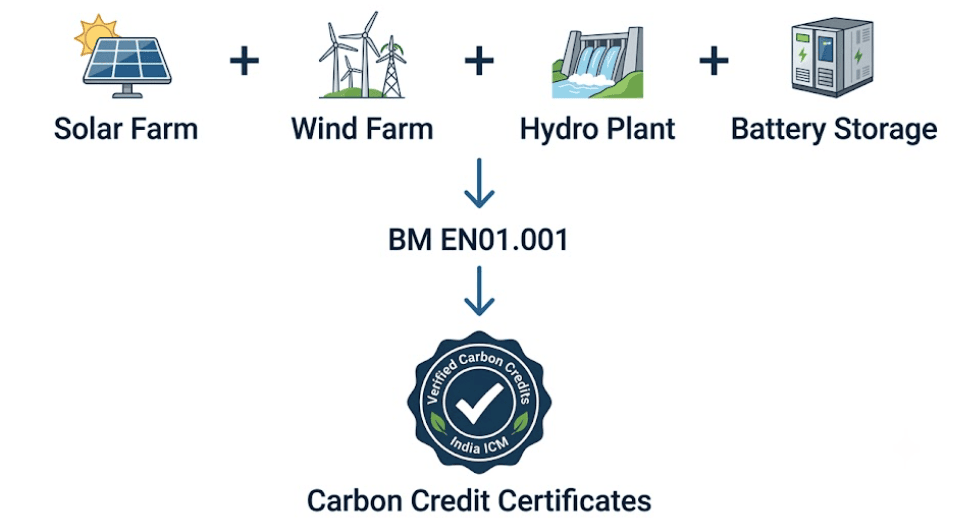
For genuinely new or emerging technologies where market penetration is still very low, the common practice test should reflect the actual market development stage rather than extrapolating from a few pioneer projects. Green hydrogen production, offshore wind in India, floating solar, and BESS-integrated renewable projects were all at early market development stages at the time of BM EN01.001's adoption. For such technologies, demonstrating that similar activities are not common practice is relatively straightforward because the market data supports the assessment.
The BM-T-001 Decision Tree Explained
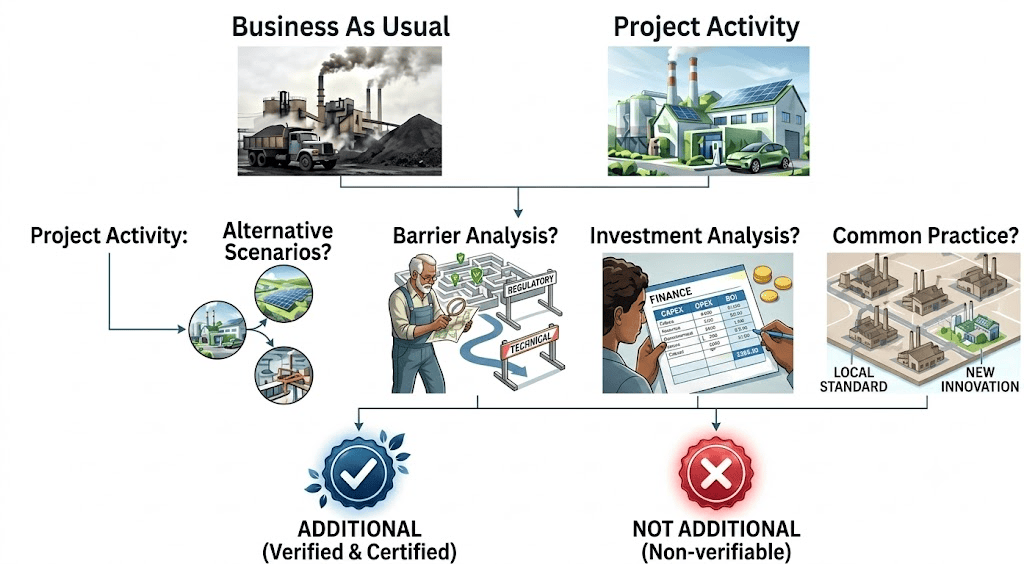
The BM-T-001 decision tree is the operational summary of the entire methodology. Understanding every branch is essential for using the tool correctly and for anticipating how ACVA validators will assess a project's additionality documentation.
After barrier analysis eliminates scenarios blocked by identified barriers, the decision tree diverges based on how many alternative scenarios remain. If only one alternative remains and it is not S1 (the project without ICM registration), the project is identified as the baseline scenario directly, subject to whether the output can only be provided by the developer or also by others. If the output can be provided by others, an emission benchmark approach is required.
If multiple alternatives remain after Step 2, the decision tree asks whether those alternatives include S1. If yes, investment analysis is mandatory. If no, the developer may choose between investment analysis and a direct baseline identification based on lowest-emission alternative. When investment analysis is conducted and is conclusive, the most financially attractive alternative becomes the baseline. If S1 is the most financially attractive, the project is not additional. If investment analysis is inconclusive, the lowest-emission alternative becomes the baseline as a conservative default.
After the baseline is identified through Steps 2 and 3, Step 4 common practice analysis applies regardless of how the baseline was determined. If common practice analysis reveals that the proposed project type is already widespread and no essential distinctions can be identified, the project is not additional even if barrier analysis and investment analysis supported additionality.
Common Reasons Projects Fail BM-T-001
Understanding the most common additionality failure modes helps project developers avoid the mistakes that lead to rejection during ACVA validation.
The most significant failure mode is a project that is directly required by law. If regulatory analysis reveals that the project activity is mandated by a regulation with which there is general compliance in the applicable area, the project fails before any additionality analysis can begin. Projects in waste management, industrial emissions control and certain energy efficiency categories must conduct thorough regulatory screening because these sectors frequently have overlapping regulatory requirements that may directly compel the proposed activity.
Common practice failures are increasingly frequent as renewable energy markets mature. A solar project in a state with a thriving solar industry and no specific barriers to solar development may fail common practice analysis even if barrier analysis identified some financial constraints. The combination of a commercially dynamic sector, available financing channels, strong project pipelines and demonstrated by comparable projects that have proceeded without carbon finance creates a common practice determination that carbon credits cannot overcome.
Weak barrier evidence is one of the most frequently cited deficiencies in ACVA validation reports. General assertions that financing is challenging, that regulatory processes are complex or that technology is difficult do not satisfy BM-T-001's evidence requirements. Each barrier must be demonstrated with specific, documented evidence tied to the particular project, technology and geographic context. Generic market commentary is insufficient.
Poor financial analysis can undermine an otherwise strong additionality case. Financial models that use unrealistically high capital cost assumptions, fail to include applicable subsidies, apply incorrect discount rates, or present sensitivity analyses that are not genuinely independent tests of the core conclusion will be queried by ACVAs. The model must be transparent, reproducible and consistently applied across all alternative scenarios.
Incorrect baseline selection errors arise from failing to complete the full S1-S6 alternative scenario identification and elimination process. Selecting a high-emission baseline without rigorously eliminating all lower-emission alternatives inflates credit generation and creates a material integrity risk. ACVAs specifically check whether the baseline scenario has been selected from among all plausible alternatives or has been chosen selectively to maximize credit generation.
Unsupported assumptions in any component of the BM-T-001 analysis create grounds for validation failure. Assumptions about future electricity prices, capital cost trajectories, regulatory evolution, technology availability and market conditions must be grounded in documented evidence rather than in optimistic projections that cannot be independently verified.
How BM-T-001 Supports Environmental Integrity
Additionality is the foundation of environmental integrity in carbon markets, and BM-T-001 is the operational instrument through which additionality is established in India's Carbon Credit Trading Scheme. The tool's six-category alternative scenario framework, mandatory regulatory and lock-in screening, evidence-based barrier analysis, quantitative investment analysis with sensitivity testing, and common practice credibility check together create a multi-layer quality assurance system that dramatically raises the standard of evidence required before any project can generate credits.
Credibility flows from structure. The sequential, documented nature of BM-T-001 means that every stage of additionality analysis is transparent, auditable and reproducible. An ACVA reviewing a project can trace each conclusion to the specific evidence and reasoning that supports it. This transparency is the foundation of the trust that investors, buyers and regulators place in credits issued under the CCTS framework.
Avoiding greenwashing is a direct consequence of rigorous additionality. When a company buys Carbon Credit Certificates issued under BM-T-001, it has the assurance that those credits were subjected to a comprehensive additionality test before issuance, validated by an accredited independent agency, and registered in a national registry where the evidence base is accessible. This quality assurance pathway distinguishes CCTS credits from credits issued under frameworks with weaker additionality standards.
Buyer confidence depends on the integrity of the additionality framework. Institutional buyers managing net-zero commitments, ESG mandates and regulatory sustainability obligations increasingly scrutinize the quality of additionality evidence behind the credits they purchase. A credit with a strong, documented BM-T-001 analysis is substantially more defensible in a corporate sustainability disclosure than one supported by a generic narrative additionality claim.
Carbon market trust, at the systemic level, is built through consistent application of high standards across all participating projects. The CCTS framework's requirement that all offset projects use BM-T-001 creates a common baseline of additionality quality across the market. This consistency enables buyers, regulators and market participants to form expectations about credit quality that apply across the entire market rather than project by project.
How Sylithe Supports Baseline Development and Additionality
Additionality assessments are ultimately evidence arguments. They are only as strong as the data and documentation that supports each analytical step. For nature-based solutions projects, forestry carbon projects and land-use sector activities, assembling credible, comprehensive and auditable evidence for each stage of BM-T-001 represents one of the most challenging and costly aspects of project development. Digital MRV infrastructure transforms this challenge.
Historical land use reconstruction is one of the most powerful contributions that satellite intelligence makes to baseline development. A forest protection project's alternative scenario analysis depends on credibly characterizing what would have happened to the forest without the project. Demonstrating a plausible deforestation baseline requires historical evidence of land use change patterns, deforestation drivers, agricultural frontier dynamics and infrastructure development trajectories in the applicable geographic area. Satellite archives extending back decades provide objective, spatially explicit records of historical land cover change that cannot be disputed on the basis of selective sampling or observation bias.
Remote sensing evidence generation produces the spatial data products required for common practice analysis and baseline quantification. Land cover classification maps, deforestation rate calculations, forest degradation assessments and ecosystem condition indices can all be derived from multispectral satellite imagery and SAR data, providing the documented evidence base that BM-T-001's evidence requirements demand.
Dynamic baseline modeling enables baseline scenarios to be updated as conditions change, ensuring that the counterfactual against which project emissions are measured reflects current conditions rather than assumptions made at project registration. As deforestation rates, grid emission factors, agricultural commodity prices and land tenure conditions evolve over multi-year crediting periods, dynamic baselines that incorporate new observational data produce more accurate and defensible credit calculations than static baselines frozen at registration.
Monitoring workflow automation reduces the manual burden of evidence collection and organization that consumes substantial project developer resources during monitoring periods and before ACVA verification. Structured data pipelines that automatically capture, timestamp, archive and organize monitoring parameters from sensors, meters and remote sensing sources produce the complete, tamper-evident monitoring records that verification requires. Automated workflows reduce human error, improve data completeness and enable efficient preparation of monitoring reports without expensive manual compilation.
Verification-ready reporting organizes all BM-T-001 evidence into structured packages aligned with the documentation requirements of the relevant methodology and ACVA verification protocols. Rather than assembling additionality evidence retroactively when validation is imminent, Sylithe's documentation systems maintain ongoing records of baseline evidence, barrier documentation and monitoring data in formats that can be efficiently reviewed by ACVAs. This preparation reduces validation timelines, minimizes corrective action requests and improves project registration success rates.
For the Indian Carbon Market's long-term development, the quality of additionality evidence infrastructure across participating projects will be one of the most important determinants of market credibility. Projects that invest in rigorous, digital-native evidence systems do not merely satisfy compliance requirements. They build the reputational foundation on which buyer confidence, international market linkage and long-term credit value depend.
Build Defensible Additionality From Day One
The strongest additionality cases are built from the beginning of project development, not assembled retroactively before validation. Sylithe helps project developers establish the evidence infrastructure for regulatory analysis, baseline identification, barrier documentation and investment analysis from project inception, producing a verification-ready documentation package that reduces ACVA review time and improves registration success rates.
“In the Indian Carbon Market, additionality is not a paperwork exercise. It is the foundation of environmental integrity and the most important quality signal in the carbon credit ecosystem.”